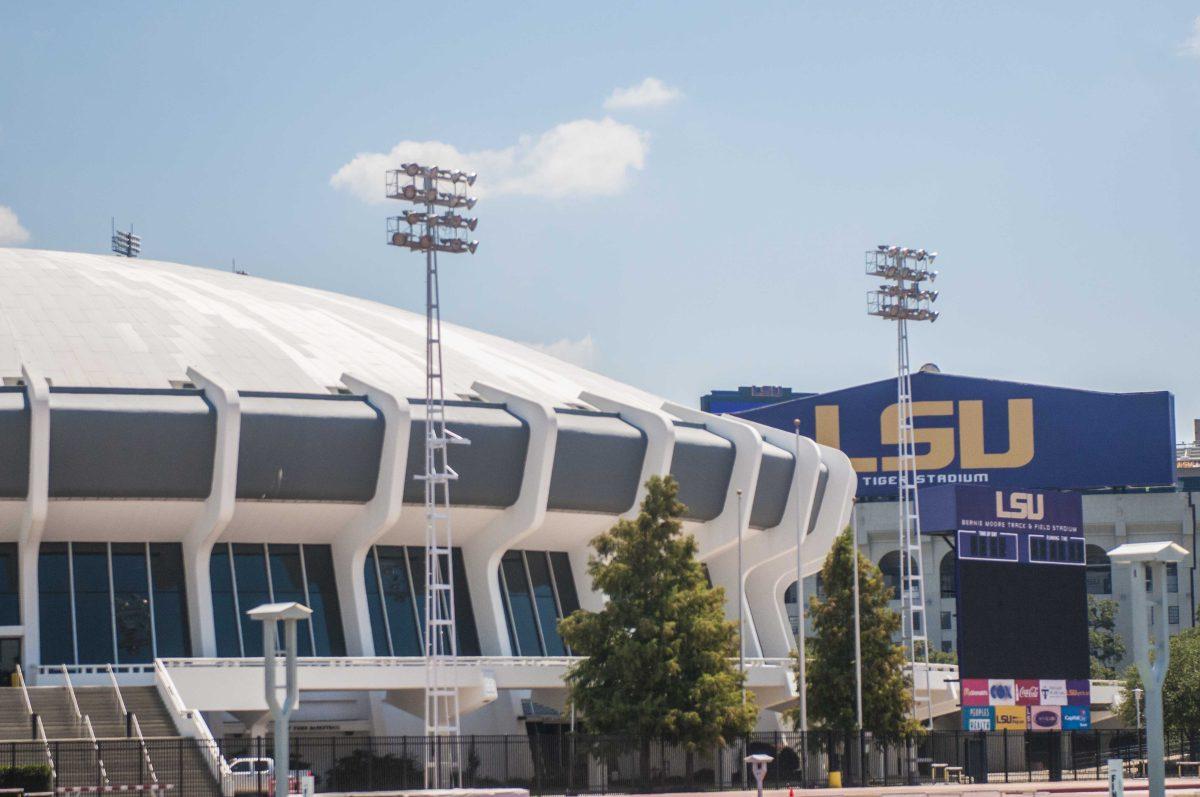
When Hurricane Katrina bore down on Louisiana in 2005, a traffic plan designed at LSU moved hundreds of thousands out of danger. The system, known as contraflow, reversed interstate lanes to double outbound traffic and was the product of research led by LSU civil and environmental engineering professor Brian Wolshon and his students.
The idea had taken root years earlier when Wolshon had just moved from Michigan to LSU in 1997. A traffic roadway safety expert, he was still new to Louisiana when Hurricane Georges forced an evacuation that fall. Watching it unfold on television, he saw gridlock stretching for miles.
“I just assumed that there was a big playbook that they would open up if there was a big storm, and they would know what to do,” Wolshon said. “As I was watching it on TV… it was not good. There were traffic jams all over the place.”
He quickly realized the problem wasn’t too many cars; it was poor coordination.
“The people who are the experts in traffic in the state of Louisiana, namely the Louisiana DOTD [Department of Transportation and Development], weren’t really involved in the process at all,” Wolshon said. “There was almost a disconnect between the emergency management people and the transportation people.”
Wolshon and three of his civil environmental engineering students began researching traffic-related evacuations.
“The more we would look, the less we would find,” Wolshon said. “It fell between the cracks. It wasn’t transportation enough to be a transportation problem, and it wasn’t an emergency problem enough to be an emergency management problem.”
They began collecting every evacuation plan and document they could find from hurricane-prone states.
“If we’re going to start this, we’ve got to figure out what everybody knows and what everybody’s doing,” Wolshon said.
Wolshon had students run traffic simulations to see how different scenarios might play out. The models compared evacuations with and without contraflow and revealed a dramatic difference in how quickly cars could move.
“I would have them run these simulations with and without contraflow, and it was obvious that contraflow would be a huge benefit,” Wolshon said.
Not long into his research, the U.S. Department of Transportation contacted Wolshon about the method. Officials had already spoken with 14 states, all of which recommended him as the expert on the subject. One of Wolshon’s students was asked to turn her thesis on contraflow into a 10-page report for federal officials.
“They said, ‘Can you send us 10,000 copies?’” Wolshon recalled.
The reports, stamped with LSU’s name, were shipped to Washington, D.C., and mailed out to police departments, transportation offices, the Federal Emergency Management Agency and emergency managers across the country.
When Hurricane Ivan hit in 2004, contraflow was used for the first time. The plan was run largely by the state police, with cones and crossovers and stops that created bottlenecks.
“Their contraflow plan didn’t really work very well, and a lot of the public was not happy,” Wolshon said. “So they put together this task force and said, ‘Let’s get this guy at LSU who studies this stuff, and then let’s get the police and the DOTD together and see what they can do.’”
For the first time, the LSU researchers were working alongside state agencies.
“To their credit, especially the state police, they listened,” Wolshon said. “If we said, ‘I think it’d be good if you did this,’ they’re like, ‘That’s a great idea. We never thought of that.’”
The plan they created was finished only two weeks before Katrina struck.
“I didn’t know how well it worked, or if it worked, but all you saw on the news was the flooding and the deaths,” Wolshon said. “But after things settled down, we started getting all the data, all the counts of how many cars went by these locations, and it was clear they had moved twice as much traffic as they did during Hurricane Ivan. They had effectively doubled the outbound rate of flow.”
The university’s role in contraflow brought international attention. Wolshon said he and his students began working with agencies in China, Australia, Europe and across the U.S.
“LSU is really looked at as probably the world leader and expert in this topic,” he said. “I’m so proud of all of our kids and the work we’ve done here.”
Looking back, Wolshon said the project didn’t begin with a clear problem to solve but with curiosity.
“We never knew that any of this would amount to anything. We just did it because we were interested in the topic. It wasn’t a solution to a problem. It was a solution in search of a problem.”
Two decades after Katrina, he continues to study evacuation planning as storms become harder to predict.
“We’ve seen numerous examples of rapid intensification,” Wolshon said. “So what I think is important is that we have plans. A failure to plan is planning for failure.”
Wolshon said the challenge now is ensuring those plans reach beyond highways. While contraflow remains central to Louisiana’s strategy, he noted that not everyone has the means to evacuate by car. Future preparedness, he argued, must include options for people with limited mobility and clear communication to the public.
“People will make rational, intelligent decisions if you give them good information,” he said. “The key is making sure they have that information before the storm arrives.”