



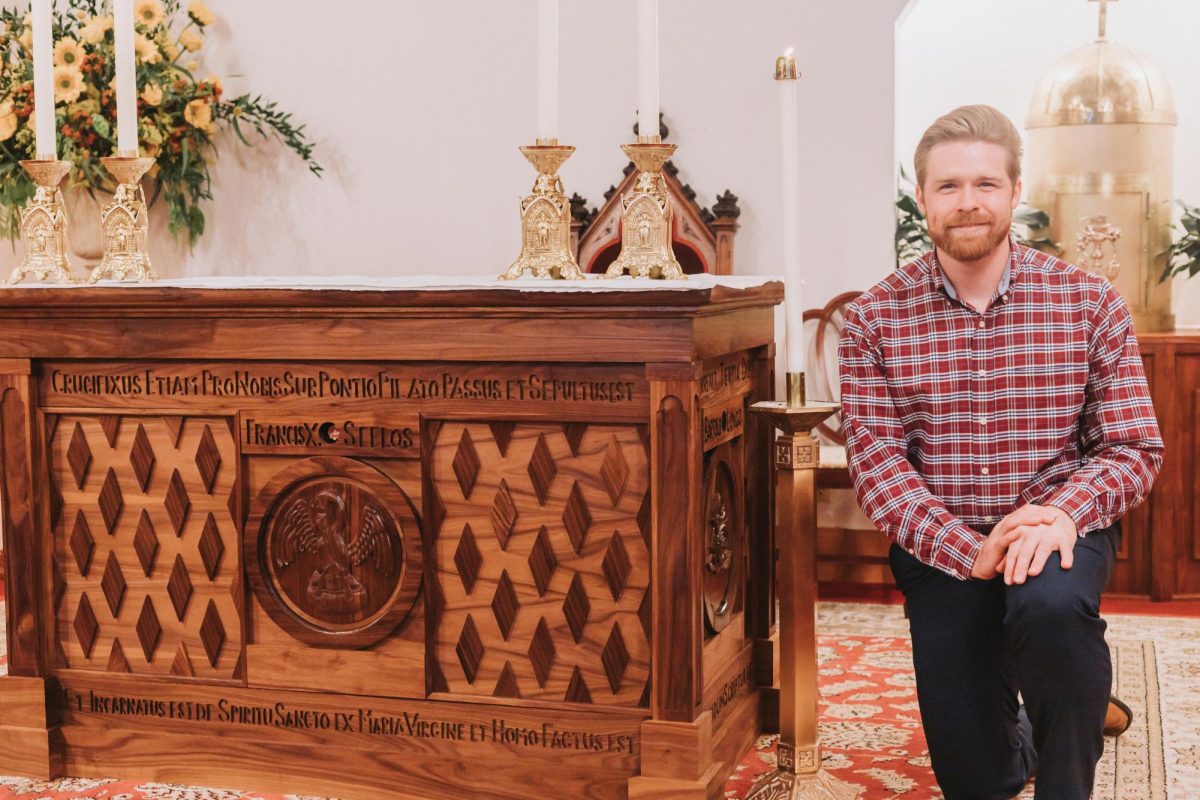
His studio space is small, just a shed in the back yard, but every corner is packed with tools and materials. One wall is lined with shelves of raw lumber, in the center of the room is a table saw and next to that is a planer used to level planks of wood. Everything is blanketed in a layer of saw dust.
But in the very back corner of the shed-turned-studio is a workbench, and mounted on the wall above it is a floating shelf holding about two dozen different hand chisels, used to carve fine details and intricate designs into the wood. It is through this hand-tool woodcarving that Andrew Coleman is keeping an ancient art alive.
Coleman, 32, is a carpenter and woodcarver who specializes in Catholic art. The Baton Rouge native picked up the hobby in his high school shop class, and later started his business, Coleman’s Handcrafted, in 2021, turning a passion into his full-time job. He now uses his art as a way to share his beliefs with others.
“Insofar as I can help bring people closer to God, that’s the goal,” Coleman said. “To edify and catechize.”
Starting out, Coleman knew he could not afford the expensive equipment he had access to in shop class, so he turned to hand tools. Rather than acting as a hindrance, the hand tools became a blessing in disguise, forcing Coleman to slow down and learn the intricacies of woodcarving. He realized that working by hand allowed him to create organic, detailed shapes that power tools are incapable of.
“It’s the difference between drawing a shape with a pencil free hand and using a ruler,” he said. “You’re very much stuck doing straight lines with power-tool woodworking, whereas with hand-tool woodworking, it can be a lot more organic.”
It is not a loss on the artist that many of the tools he uses are very close, if not the same, to the tools St. Joseph the Carpenter would have used over two millennia ago. Coleman said that the time-tested chisels and hand planes he uses are just another way his work brings him closer to God.
Coleman’s business is commission-based, and most of his clients are church parishes hoping to beautify their spaces, or everyday people looking to add a sacred piece to their homes. Some clients come in with a very clear vision of what they want, while others have only a vague idea, said Coleman. Regardless, the initial design phase is always a collaborative process between the two parties.
“There’s always a creative process, or almost every job is,” said Coleman. “It’s very rare that someone comes to me and says, ‘I want you to make this and exactly this.’”
First, he must determine the scope and scale of the work and how it will fit into its intended space. Finding a balance between function and aesthetics is key to incorporating the piece into a space seamlessly.
Next, Coleman begins the trial and error process of drawing up designs until he and his client are satisfied that the piece will encapsulate the original vision. Once a design is settled on, Coleman calls his local lumber supplier to purchase the necessary materials.
The wood he chooses is very intentional. Because he does not like to stain his finished pieces, Coleman picks woods that are naturally different colors to get the results he wants.
“If you want a red color, you can do domestic woods like cherry,” he said. “If you want a brown color, there’s walnuts, like a beautiful chocolate-brown wood. You want more pale colors, we have maple to choose from.”
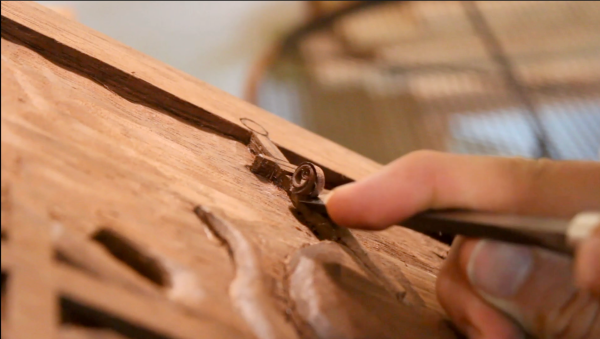
Once all of the preparation is complete, Coleman can finally move on to the actual carving phase. He makes the initial cuts with power tools, then uses his hand tools to add details and finishing touches to his designs. Altogether, this process can take anywhere from a couple of weeks to multiple months, depending on the scale of the project.
Coleman is usually working on one to two pieces at any given time, with three or four more in the design phase. Altars, tabernacles, church pews and monstrances are just some examples of the carpenter’s work.
His largest project ever was aiding in the construction of a new church in northern Alabama, for which Coleman built a 25-foot high altar, an altar railing, a baptismal font and a choir loft railing. The whole project took close to two years, but the work poured into it was worth it to see how touched the congregation was with the final product, he said.
“You stop. You look. For the first time in literally months, I’m like, ‘Oh, wait, it’s beautiful,’” Coleman said. “And then you see people praying in front of what you just made.”
Reintroducing classical beauty into Catholic art and architecture is one of Coleman’s biggest goals. So much of art history is steeped in Catholicism, he said, that it is impossible to separate the two concepts from one another, and there is a reason for this. Coleman believes that beauty is a way to touch people’s souls in a way that words cannot, so the loss of traditional beauty in Catholic spaces is a missed opportunity to bring people closer to God.
“What’s unique about the beauty is it’s a way to touch people where they’re at,” Coleman said. “They could be as anti-Christian and anti-Catholic as possible, but when they encounter the beauty, there’s something that can pierce through all those barriers to the heart. So I’m trying to do that well.”


