




“Unwinding the Universe” is a performance art piece written and performed by LSU professor Malcom McClay, combining video, audio and physical elements to portray his experience living with ADHD and bring awareness to the mental illness. But in a culture that has largely destigmatized ADHD, whether a performance like this will have much of an impact is up for debate.
“I take the metaphysical and I make it a physical, tangible experience,” McClay said. “I’m giving it to you not as a metaphor, but as an actual experience.”
“Unwinding the Universe” was performed Thursday, Nov. 13 and Sunday, Nov. 16 at the HopKins Black Box Theater in Coates Hall. I attended the 7:30 p.m. showing on Sunday. Doors did not open until a few minutes after 7:30 p.m., and while the rest of the audience and I were waiting in the hall, crew members passed around a QR code for a pre-show survey, which was meant to gauge the general understanding of ADHD.
This survey, along with a post-show survey, was part of the show’s secondary purpose to gather research about public perception of the mental illness. This production actually received a grant from the Provost’s Fund for Innovation in Research, which funds research in a myriad of disciplines.
The research coming out of the show was just as impressive as the research that went into it. Throughout the developmental phase, McClay and director Jeff Becker were in constant consultation with Dr. Elia Soto, an assistant professor in the Department of Psychology at LSU.
“She’ll advise us on how accurately we’re portraying these conditions,” said McClay. “And then we will amend the performance to get closer to her suggestions.”
The actual performance ran for just under an hour with no intermission and will say that I was engaged the entire time. The performance was already underway when the doors opened, with McClay standing in the center of a circular, gray-scale bookcase. Inside the ring, the professor was writing on a chalkboard that made up the back of the shelves. Audience members could go up to the circular library and peer in at McClay through engraved script on alternating shelves.
One of my favorite parts was a scene where McClay was reading. Though there was no spoken dialogue throughout the performance, this scene had vocal recordings of McClay reading from these books.
The audio, along with the rest of the performance’s score, was arranged by Dr. Stephen Beck, a professor in the School of Music. Beck layered four vocal recordings on top of one another, the words bleeding together and becoming nonsensical, reflecting McClay’s own experience when trying to read.
The rest of the audio was more musical, crescendoing and speeding up to match McClay’s hyperactivity on stage. It was important for Beck to consider how the music would impact the audience’s perception of the events on stage.
“One of the things that I was trying to do that we worked on was to use music to change the pace of perceived time,” Beck said. “So to try to slow down how you perceive what is going on, so that you could appreciate both the positive and the negative things that were happening.”
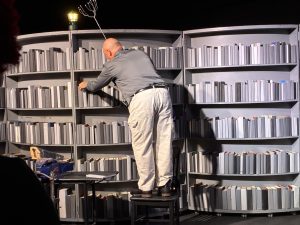
The performance was also visually compelling. The gray-scale bookshelf mimicked the character’s attempts at conformity, while the Tree of Harvested Ideas — a headpiece attached to a track on the ceiling that resembled a network of neurons growing out of McClay’s head — used strobing, colorful lights to represent the multitude of creative ideas that a person with ADHD can have.
Overall, the performance was engaging and, at times, emotionally evocative. However, my only question is whether this show was entirely necessary in today’s climate. During the post-show panel discussion, McClay reiterated his desire to spread awareness about the reality of having ADHD, citing a conversation with another professor who was unfamiliar with the mental illness at all.
To me, that story was a shock, not only because a learned professor should know this very common mental illness, but also because my generation is so open about it. I know many people with ADHD, and though I cannot speak for everyone’s experience, I have personally seen less and less taboo around talking about ADHD in school and on social media.
Perhaps this openness is exclusive to Gen Z, but I do believe that a piece like this just cannot be as groundbreaking as it would have been 10 or 20 years ago. Still, the show was well done, and the research it helped to facilitate was important.


