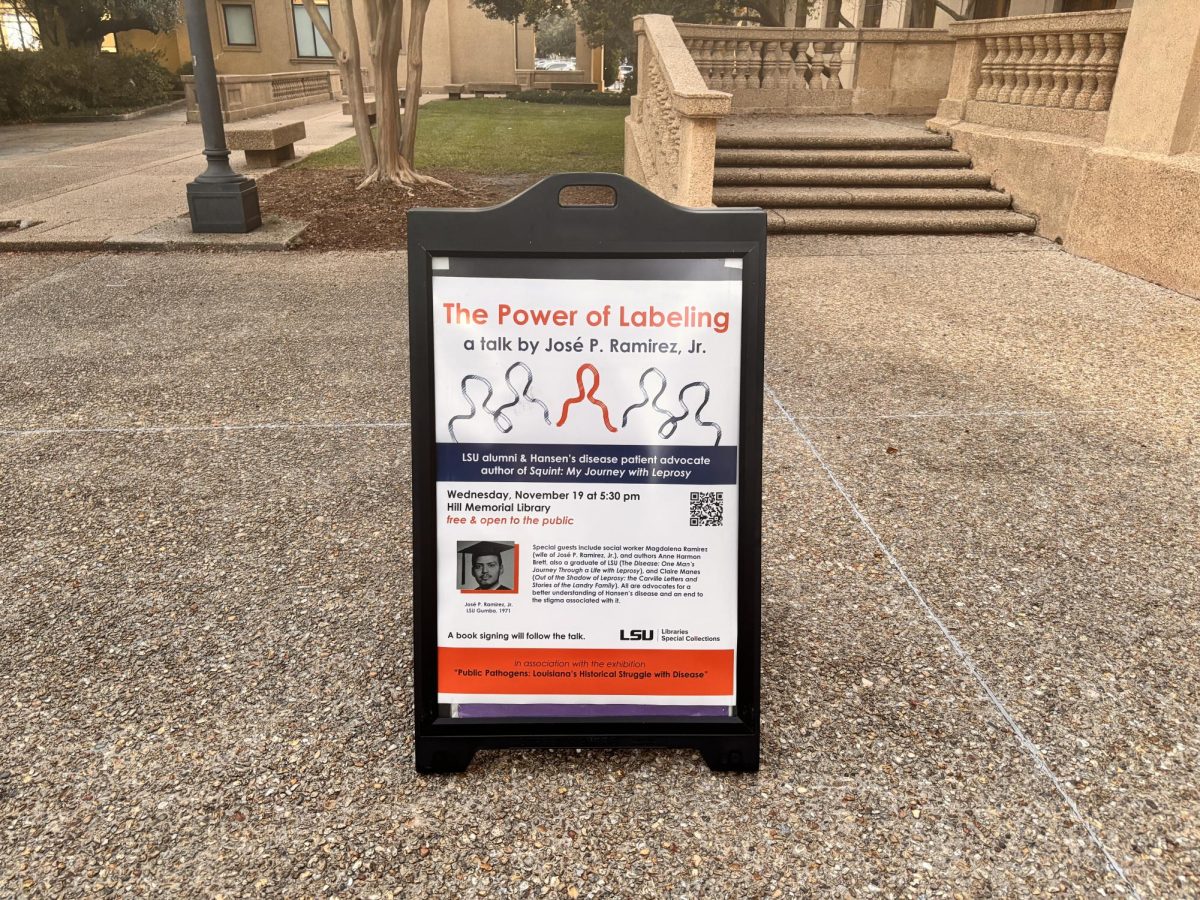
Hosted by LSU Libraries Special Collections in connection with their Public Pathogens: Louisiana’s Historical Struggle with Disease exhibit, José P. Ramirez, Jr. gave a talk in Hill Memorial Library about his struggle with Hansen’s disease, as well as his inspirational journey of advocacy for awareness about the sickness.
A clinical transplant social worker and author of the memoir “Squint: My Journey with Leprosy,” José P. Ramirez, Jr. was admitted to the then-called United States Public Health Service Hospital in Carville, Louisiana at just 20 years old in February of 1968. The institution was the first and only national leprosarium in the United States.
In his book, he recounts what happened before, during and after his seven years spent at the Carville home, as well as his time as an LSU student from 1969 to 1974.
Ramirez emphasized the difficulty in having to look back on his experience with the pain he dealt with before an official diagnosis, the reactions from his family and the support from his girlfriend.
“I went back to look at my medical records, reviewed all the 5,000 letters that I had received from my family and my girlfriend at the time,” said Ramirez. “And reflected back on my memories when I was diagnosed, admitted, the time at the hospital, how I ended up being a student at LSU and my experiences at LSU.”
He described his experience as painful, yet enriching. Despite the difficulty in existing as a person with both leprosy and a dark complexion during the ‘60s, he was able to grow as a man, form many relationships and become involved in school activities. He was even elected president of a sociology club at LSU.
However, his admittance to and attendance at LSU were not easy to accomplish. Ramirez faced inner turmoil with being involuntarily removed from his hometown of Laredo, Texas, and being of college age, he expressed interest in attending school to the facility’s social worker and medical director. The facility moved to advocate for Ramirez’s wishes and fought tooth and nail for his spot at LSU.
“They told me that LSU would not admit anyone there as a student with a disease or to work there with a disease, so they had to arrange a meeting with the President of LSU and reverse that policy,” said Ramirez. “I was admitted as a student with the help of the Texas Rehabilitation Commission because at the time with the disease, I was considered disabled. They funded my enrollment and paid for my schooling.”
Ramirez detailed that the most beneficial part about writing his memoir was how it provided healing. He refers to when he was diagnosed with the disease, his mother cried and begged for forgiveness because she thought God was punishing her for sins through her own son.
His mother’s sense of guilt stemmed from her Catholicism, drawing from biblical stories of the disease in the Book of Leviticus. Even how he was labeled as the L-word, which spelled backwards is repel, was dated back to Biblical times. It was seen as a curse inflicted by God.
Despite having to look back on his mother’s painful belief, it made him realize the powerful relationship he had with her, the rest of his family and his girlfriend, who today is his wife. When completing the memoir, he thought about how nothing about the disease could have prevented their relationship from growing as strong as it is today.
Special Collections Exhibitions manager Leah Wood Jewett invited Ramirez to the Hill Memorial Library to come and speak about his experience with Hansen’s disease, as well as others who were affected by the disease in some way. The other three guests were Ramirez’s wife, Magdalena Ramirez, author Anne Harmon Brett and author Claire Manes.
“The four individuals who are speaking tonight, specifically José Ramirez, all have either personal experience or their family members experienced Hansen’s disease and living in isolation at the hospital in Farmville,” said Jewett. “All of these individuals have stories that are inspirational. They’re heartbreaking, but they’re also about the resilience of the human spirit.”
Seeing the Public Pathogens exhibit’s portion on Carville and Hansen’s disease was emotional for Ramirez, as he knew many of the people who were in the displayed photographs. It also was emotional for him because he was the youngest person there to be admitted in the facility.
After his physical, spiritual and emotional journey with the disease, Ramirez continues to advocate for awareness about the disease to prevent people from still holding fear. He details how the stigma of Hansen’s disease fosters rejection by society as well as unsettling images that come to the mind when people have this unexplained fear.
Ramirez and his wife have traveled to places such as Japan, China and Brazil to provide education about the disease not just in the United States but also the world.
“Knowledge is power, but ignorance is more powerful,” said Ramirez. “When you don’t know a subject matter and all you do is go on hearsay in images that are incorrectly placed in your mind as a young child, then it causes a cycle of rejection.”