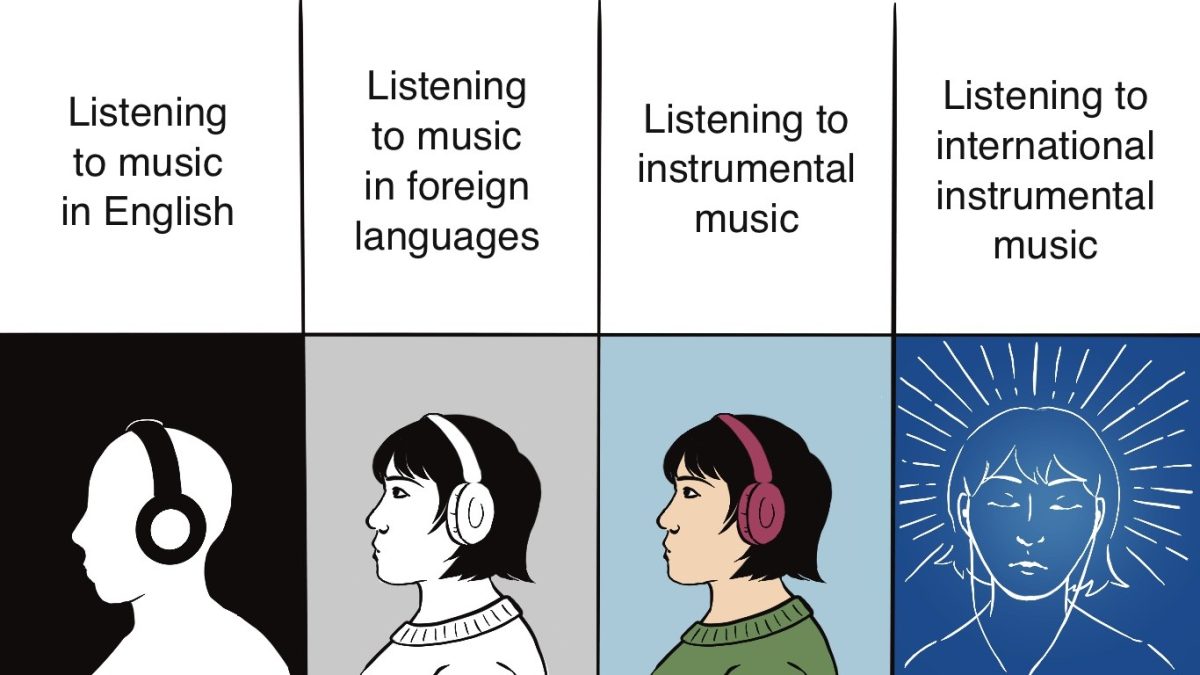
Not to date myself with this reference, but in “The Fault in Our Stars,” when our main characters, Hazel Grace Lancaster and Augustus Waters, meet their favorite estranged author, Peter van Houten, they find him listening to Swedish hip-hop.
Lancaster, now disappointed in meeting her hero, complains, “We don’t speak Swedish, sir,” whereas van Houten retorts, “Who the hell speaks Swedish? It’s not what nonsense the voices are saying, but what the voices are feeling.”
While not at all the highlight of John Green’s beloved 2012 novel, this interaction stuck with me, especially as I began to listen to music in languages I didn’t understand or, in some cases, music that abandoned words altogether.
I found that the lack of lyrical comprehension not only gave me more to think about but actually increased my enjoyment of music that much more — in the same kind of way that solving logic puzzles tickles the brain.
Speaking from experience, writing can be hard, so I can only imagine how hard writing lyrics to a song can be. Balancing reason, rhyme and rhythm can be tricky business, making a track unforgettable — good or bad.
However, when I can easily understand every word, it can sometimes seem like a singer is dictating to me what to feel and how to feel it. Much like van Houten’s refusal to write a definitive ending for his novel, “An Imperial Affliction,” I much prefer to solve the intentions of a composition myself.
I know very little Spanish, but I love the bold, story-driven ballads of Mexican corridos. I know only a handful of Arabic words, but can groove to the mellowed, otherworldly sounds of Arab synth-pop all day. I know only enough Russian phrases to get myself into trouble, but the emotive dark synths of Russian post-punk could easily make up most of the soundtrack to my life. Despite the obvious linguistic barriers, none of these genres feel particularly inaccessible to me.
If anything, the absence of lyrical comprehension makes a piece far more honest, exposing the elements hiding behind the surface of sound.
Without the focus on the meaning behind words, the character of the musical variables speak for themselves: the strained intonation of a singer’s voice can reveal the intense pain behind lyrics, a complex bassline can weave a lattice of attitude to keep a bluesy track ice cold or a subtle background guitar jangle can be the only thing keeping a chorus from sounding hollow.
Without lyrics providing emotional directions, you’re left to interpret feelings through textures, rhythms and vibes. This listening habit takes an awful lot more participation, but the payoff is far more rewarding than your average two-minute-and-53-second Top 100 track.
Art enjoyers of the cinephile category also deliver a similar thesis about watching their niche foreign films, especially without subtitles — once dialogue stops carrying, the other methods of visual storytelling like cinematography, physical and emotional acting and sound designs absolutely supplement a viewing experience. While usually missing the visual medium, music operates in exactly the same way. When words step back, everything else has room to speak.
These days, lots of items in pop culture are demanding your consumption with their mathematically successful advertising and their algorithmically digestible stories, attempting to make art nothing more than cheap novelties for you to get a quick dopamine hit, then move on to the next bauble. Listening to music through the language barrier not only adds a hint of hand-crafted spice to your life but also can serve as a radical liberation cry against consumerism.
So, you don’t need to know Japanese to feel the luxury of city pop, Brazilian to get hype on phonk or German to stomp down to industrial techno in an abandoned warehouse. You just need ears that hear and a mind that’s open. The voices don’t always need to make sense — they just need to feel.
Thomas Bergeron is a 25-year-old graduate student from Baton Rouge, La.