Since I was in the seventh grade, I’ve always dreamed of becoming an electrophysiologist, a cardiologist that specializes in care for the electrical system of the heart. To some, that may seem an absurd dream for a 13-year-old; for me, however, it is one that has always been close to my heart. Both my mom and my aunt are nurses, and my cousin is a doctor. My family also has a multitude of genetic heart issues. To seventh-grade me, such an aspiration was a no-brainer.
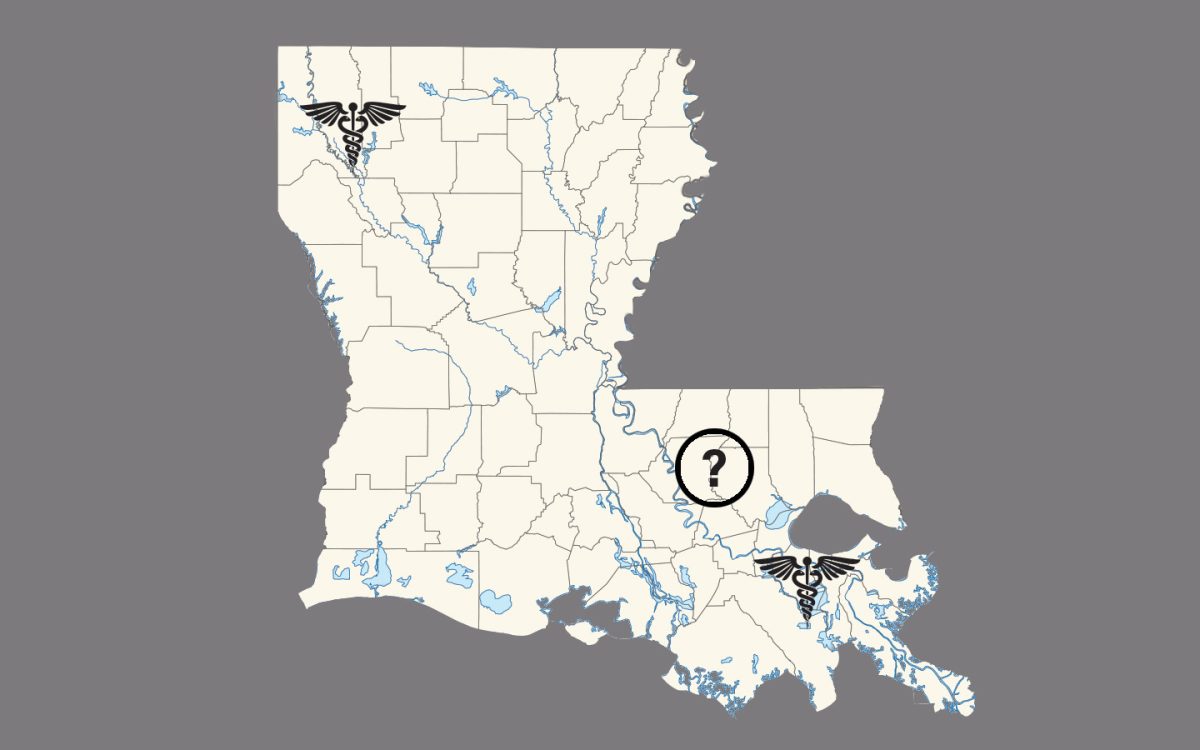
Now in college, I am actually beginning the journey to achieve this goal of mine. Out of the many issues I’ll have to overcome along the way, one seems to nag at me more than the others: LSU has no medical school in or around Baton Rouge.
The idea that LSU has no nearby medical program feels somewhat ridiculous to me. In the last few years, LSU has really hammered down on their campaign to appear as one of the most STEM-forward institutions in the South and in the nation at large.
In 2024, LSU broke ground on a 200,000 square-foot Interdisciplinary Science Building in partnership with Our Lady of the Lake. The university has added nearly $488 million in research activity over the last year and, as a result, contributed a massive $1 billion sum to the state’s economy.
Through the Gordon A. Cain Center for STEM Literacy, LSU also amped up its Pathways initiative, which provides curriculum, scholarship and research support to K-12 schools all throughout Louisiana, over the past year in an effort to increase interest in pre-engineering, pre-veterinary, pre-medical and other science-based study programs.
With these and many more landmark moves to further STEM education and advance professional STEM roles in Louisiana, it is laughable to me that LSU does not have its own medical school campus in or around Baton Rouge for a multitude of reasons.
Firstly, at least for myself and many of my pre-med friends, I am certain that the choice to apply to certain medical schools will be difficult because none of us want to attend LSU Health New Orleans or LSU Health Shreveport. It is not that these schools are not excellent; rather, they are poorly placed.
New Orleans is not exactly the safest city for young people, or any people for that matter. Shreveport is arguably an even worse option as it lacks not only the liveliness and eventfulness of a large city like New Orleans, but it also lacks proximity to the rest of the LSU education system and health system at large; additionally, it is far away from most major urban employment hubs in the rest of the state.
Secondly, while Louisiana is projected to face a physician shortage of nearly 5,000 by 2030, there is no shortage of pre-med students wishing to apply to medical school in the state. In the last academic year, there were 7,959 combined applicants to LSU Health New Orleans and LSU Health Shreveport, out of which only 345 were accepted — a mere 4.3% acceptance rate.
Moreover, when factoring in that Louisiana’s only other doctor of medicine program, Tulane University School of Medicine, only accepted 190 applicants out of 15,708 — a 1.21% acceptance rate, Louisiana medical schools overall only accept around 2.3% of applicants yearly.
To ignore such a serious demand for another medical school in Louisiana on both an interest-level and a level of necessity to the well-being of our state’s population is completely abhorrent.
Lastly, LSU has a large amount of classroom space to use. The new OLOL Interdisciplinary Science Building exists solely for the purpose of educating undergraduates in STEM programs here and is one more connection to the already strong relationship between LSU and the Our Lady of the Lake health network — why not utilize some of that new space for medical students?
Additionally, many programs of study do not have classes concentrated in singular buildings or areas. For example, many English classes are in Lockett Hall, but many are in Coates Hall and other buildings. So many classrooms sit empty for hours or even days on a weekly basis, and it makes no sense not to concentrate as many classes as possible in specific buildings by time scheduled. This large amount of free lecture space could be easily utilized by an LSU Health branch in Baton Rouge.
The idea that a medical school here would need to be centralized is a nonsensical one, especially as first- and second-year medical students are more involved in lecture material than active practice, whereas third- and fourth-year medical students do more hands-on work.
The former groups could be lectured in the Interdisciplinary Science Building, these empty halls and perhaps in a newly constructed building while the latter groups could be integrated into the OLOL hospital system right by LSU much like their New Orleans and Shreveport counterparts are at their respective locations.
LSU isn’t exactly wanting for funding at the present moment, and if the system at large can shell out a reported $91 million to new football head coach Lane Kiffin — a single individual, mind you — then perhaps it ought to put the same or more money toward the localized medical program that people so clearly want and need.
Riley Sanders is a 19-year-old biology major from Denham Springs, La.