Utilizing materials such as oil and acrylic paint, two LSU professors combined their extremely different art styles to present a collection of both of their works that convey how they meet in the middle. From opaque, distinct images to faint silhouettes, their paintings’ differences are a display of the strength in collaboration and creativity.
LSU School of Art and Design presents LSU faculty Bradley Kerl and Will Maxen’s exhibition, “The Middle.” The opening reception occurred on Saturday, Jan. 17 from 6 to 8 p.m. in the Glassell Gallery at 100 Lafayette St., Baton Rouge, Louisiana. The exhibition will be open for viewing to the public until Saturday, March 14, and admission is free.
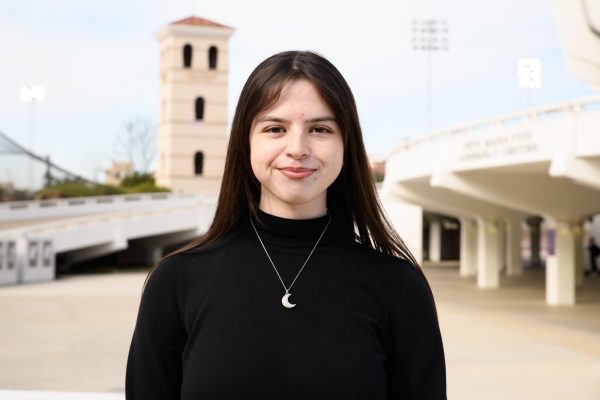
Bradley Kerl, a painter and assistant professor in the LSU School of Art, created half of the paintings for the exhibition, and his work features both medium-scale and large-scale paintings, as well as prints of etchings. Kerl joined the LSU faculty as a professor in the 2025 fall semester; he teaches courses starting from introductory drawing to advanced drawing.
“One of my goals for the show is to show, more or less, a survey of what I do generally,” Kerl said. “My work will always be that way, where I like working on really, really large paintings, and then all the way down to more intimately scaled drawing, watercolors, works on paper.”
He expressed that his and his gallery partner’s paintings oscillate between abstraction and representation. He described how there are moments of recognition when looking at the paintings, but then there is a subtle switch to specific instances of abstraction. The paintings’ observer loses context in specificity then.
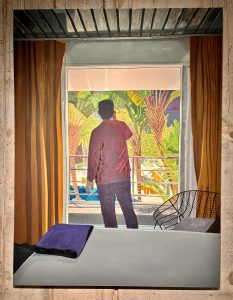
Kerl said his favorite from his works in the exhibition is the painting “Tenderloin (Self-Portrait at the Phoenix).” The painting depicts a solid figure from behind looking out into a window. The interior’s coloring is dark and murky, meanwhile the exterior is bright and colorful. He painted the self-portrait when the COVID-19 pandemic occurred in 2020.
He described the painting as significant to the time it was created because, despite having an original intention for the piece, the context shifts quickly with the present.
“Just the fact that we were shut inside gave that painting a whole different feeling and connotation. I like that it’s a little more charged now that we’ve all lived through that,” Kerl said. “It unintentionally has more depth and meaning behind it for me, and for people that will view it, it might make them think of that time.”
Kerl’s pieces often depict a window motif, where a figure is looking out or into the visible opening; sometimes, it can even be the observer looking into the painting’s window.
In tune with the exhibition’s name, the physical middle of the gallery takes a hard shift from Kerl’s pieces to Will Maxen’s work. Maxen is both a painter and an assistant professor of professional practice at LSU.
Maxen’s displayed work consists of mostly large-scale paintings with just a few smaller paintings. He joined the LSU faculty in the 2024 fall semester, and he teaches courses such as beginning painting, beginning drawing and advanced figure drawing.
“I always think that my work is in some ways surrealistic; thinking about this unconscious behavior, this dream-like state or this memory state of trying to recover something,” said Maxen. “I’m not really trying to make something super realistic.”
While the two artists both use acrylic and oil paints, Maxen explained how the frames of his smaller paintings are made from pieces of wood he found along the bank of the Mississippi River. He talked about always looking for things that interest him, such as physical objects that he finds on walks.
“It tells the environment of where you are, and also the history of displacement, both the structures and people,” said Maxen. “I’m always interested in material – the language of material – rather than just the language of subject matter or imagery.”
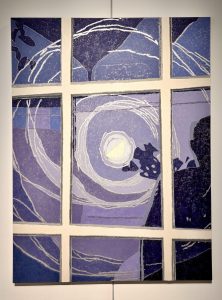
Maxen said his favorite from his own pieces is “In These Fields We Run.” He said it is his favorite because of how he was successfully able to create a predominantly blue painting. Maxen recounted how a professor told him he makes a lot of yellow and brown paintings, and blue is the hardest color to work with.
Once he finished the painting, he liked how it came about; he especially liked being able to tell the sufficient amount of definition and seeing the way the light hits it from the gallery window.
Kerl and Maxen conceptualized the exhibition’s title as a finding of a middle ground. They were interested in a more professional exhibition, and they put in effort to find similar threads in their work that would offer ideal similarities and contrasts.
“That process really can be difficult, but it’s also really fun. Most artists really enjoy that process of trying to fine-tune the relationship between the work,” said Kerl. “It goes back to the title, like finding a middle ground and finding the right way to introduce ourselves to the students through our work.”
Maxen explained how his solo galleries usually include more poetic titles, but for “The Middle,” he and Kerl were thinking about how they could make a show that works for both of them.
“I think we’re very similar in a lot of ways, but we were also very different in the way we paint, the style of painting,” said Maxen. “‘The Middle’ was where we found a mid-ground in our painting practices and what we believed about painting. That’s where we can meet in the middle.”
The exhibition’s message stands strong in the artistic medium as well as in the context of real life. There is a translation from along the walls of the Glassell Gallery to the streets of Baton Rouge; to the shared experiences across the country, and, in the grand scheme of things, the world.
“We all need the reminder of finding a middle ground and remembering why we’re here– what the purpose is and what we ultimately gain out of time here,” said Kerl. “I think we’re all humans here for a short period of time, and it’s better if we work together than against each other, right?”