Standing at the north end of the Quad, the LSU Library is impossible to miss. In fact, it was designed to be that way when built nearly 30 years after the completion of the original campus.
Now big changes are coming — changes that will lead to the demolition of the library building and restoration of the Quad to its original cruciform shape.
“The building that I’m sitting in right now, it cannot be preserved long term,” Stanley Wilder, dean of libraries, said, “because it’s crumbling in ways that can’t be fixed.”
In the book “Under Stately Oaks: A Pictorial History of LSU,” Thomas F. Ruffin wrote that the land where LSU’s Baton Rouge campus sits was bought in 1918 from the Gartness Plantation. The university couldn’t purchase the land on its own, so a group of Baton Rouge businessmen fronted the cost, Ruffin wrote.
The university originally contracted the Olmsted Brothers to draw up the plan for the campus. The group was known for designing Audubon Park in New Orleans and the campuses of Stanford and Cornell universities.
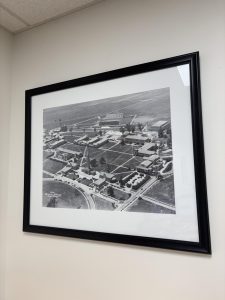
Rick Olmsted Jr. designed a plan modeled after the University of Virginia campus. It included two large quadrangles designed around the land’s natural features, John Michael Desmond wrote in “The Architecture of LSU.” Olmsted’s design never came to fruition, as officials decided to move on due to cost, Desmond wrote.
Theodore Link, known for designing Union Station in St. Louis, Missouri, and the Mississippi State Capitol, took over the project. He combined Olmsted’s original two separate quadrangles into an overlapping cruciform shape. One ran from the War Memorial Tower in the east to the Hill Memorial Library in the west, the other from Foster Hall in the north to Atkinson Hall in the south.
The Quad was completed in 1926 and served as the academic center of campus. Declining tax money led to a delay in construction of some buildings around the Quad, Ruffin wrote. Those buildings would later be added throughout the 1930s.
Link’s design lacked a plan for construction beyond the original Quad, which led to the haphazard growth of campus throughout the years. This included the construction of the LSU Library in the middle of the Quad in the late 1950s.
Hill Memorial Library served as the university’s original library. By the 1940s, the collection had outgrown the space, Wilder said. The LSU Library was conceived by then-President Troy H. Middleton, who wanted the new library to be central to campus.
“He wanted the library to be in a place where LSU students would have to trip over it,” Wilder said. “He wanted them to use the library, and he thought that by putting it in their laps was going to be the best way forward.”
Middleton’s vision is not shared by Wilder. The library’s placement at the intersection of the cruciform interrupted the flow of the original Quad, he said, and it also disregarded the architecture of the Quad buildings.
“It’s all about who you select as the architect and who is overseeing what they do,” University Architect Danny Mahaffey said. “And they just tried to go modern in the 1950s. They were ignoring the Italian Renaissance architecture.”
Construction began in 1956. After its completion in 1958, the LSU Library served as the academic center of campus. In addition to housing literary works, the building served as a study space for students during midterms and finals.
Nicole Bayard Cowart, a 1997 alumna, visited the library frequently. Many students at the time did not have personal computers, so the only place Cowart could go to check her email was the library.
“Email was only in the male dorms,” Cowart said, “which kind of ticked me off. So my last year I was at the library a lot, you know, waiting in line.”
The library building’s architecture was not the only thing that made it stand out. Since opening, the LSU Library faced constant flooding and a need for upgrades, Wilder said. When Wilder was hired in 2014, the university planned to completely gut the LSU Library building. However, it became clear that the cost to fix the infrastructure alone would be too expensive, Wilder said.
Mahaffey and other planning officials decided while drafting the university’s 2017 Master Plan that the time had come to move on from the LSU Library. Serving as a roadmap for future construction on campus, the plan made it official: LSU would build a new library south of the Quad and demolish the old library building and Lockett Hall. A timeline was not provided for the completion of these projects.
Construction began on the new library on South Quad Drive in January. The project is scheduled to be completed in time for a grand opening in the fall of 2029. However, the timing of the existing library’s demolition depends on receiving funding for the project, Mahaffey said.
The library construction and demolition are not the only impending projects on campus. The university has received funds to gut and renovate the historic Quad buildings, Director of Campus Planning Danielle Breaux said. This will require the temporary relocation of the classrooms and offices in those buildings for the duration of the renovations.
Other officials suggested using the empty library space as swing-space during the Quad reconstruction. Mahaffey said he opposes using the library for that purpose.
“The danger is if we start doing that, people say, ‘Well, let’s keep it as a swing space building,’” Mahaffey said, “and we don’t want that to happen. So, we’re working on options to be able to tear it down and have other options for swing space.”
Anderson Krupala, a Baton Rouge native and freshman, said he looks forward to the demolition of the LSU Library. During his time in the building, he said, he has faced challenges with the inconsistent Wi-Fi and lack of charging outlets.
“It’s supposed to be the sort of, like, center of knowledge in the campus,” Krupala said. “A place where people can go to focus on their studies. And I think that the current conditions that the library is in make it so that people tend to avoid it.”