


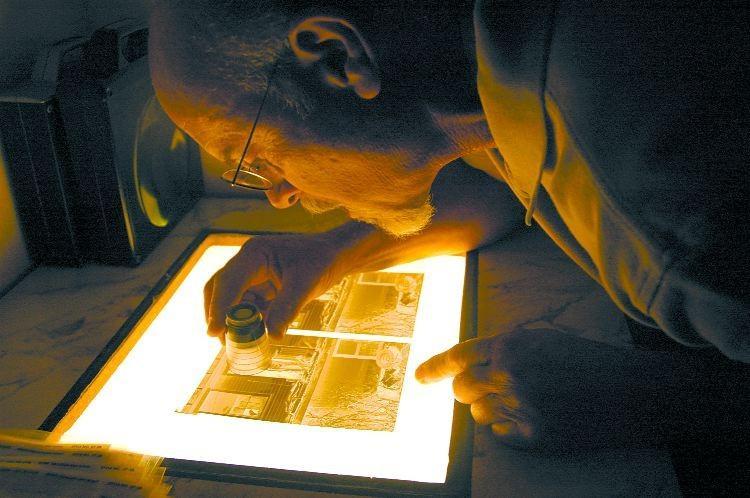
Thomas Neff is a colorful man. He has a vibrant yellow Volkswagen Karman-Ghia in his garage, accompanied by two flamboyantly painted motor scooters. But color does not define this man and his interests – black-and-white photo prints provide the window into his soul.
Neff, who has been a photography professor at the University for 24 years, had planned to take a sabbatical this semester to explore and photograph the American West – a project he hoped would be his career’s best.
But everything changed when Hurricane Katrina struck New Orleans.
Like thousands of others, Neff’s priorities changed overnight. He went into “crisis mode” – more specifically, telling the stories of this catastrophe through photographs.
“I felt conflicted that I would leave Louisiana while the state was in such turmoil,” he said.
Neff’s Katrina experience began when he volunteered less than a week after the storm hit. He worked with a police SWAT team and a synagogue to remove residents who had stayed in the city.
“I spent the day there and talked to a lot of people who had touching stories,” he said. “Of those that stayed through it all with no power and few provisions, they were a spirited body.”
Once his volunteer work was complete, Neff packed his camera equipment and supplies into his van and began making trips to the devastated city, offering his friendship and black-and-white photo prints to his subjects.
He has now spent 14 days shooting in New Orleans. He often sleeps in a van customized with a bed and storage compartments for his equipment on “media row,” on the neutral ground of Canal Street.
Some in New Orleans are eager to tell their story, to be captured on film for eternity. Some are just intrigued by his camera.
Neff’s camera is more than 80 years old. It is large, wooden and looks like something out of an antique shop. Unlike many cameras, Neff does not have to hide behind the lens while shooting. Instead, he stands to the side of the camera and takes the picture using a button attached to a wire.
When his subjects are photographed, they are not just seeing a camera, they are seeing the man as well.
“That way, you’re looking at us,” Neff said. “The personal connection, it just puts people at ease.”
To Neff, the purpose of his job is to make that personal connection. His pictures represent a story: sometimes of hardship, sometimes of hope.
“I found people of great affluence and great poverty,” he said. “Each time I talked to one, a whole new meaning came to me, and it’s about the spirit of the people.”
Shuffling through prints in the darkroom of his Kenilworth-neighborhood garage, Neff pulls out a photo of two people he met in New Orleans, Susie Chenevere and Joseph Bode. The picture looks ordinary enough, with two people advancing in age standing and a storefront as the backdrop.
But like most people Neff has photographed, they are far from ordinary.
These two, Neff eagerly describes, had been together in their youth but apart for decades. On Sept. 12, only days after the storm hit, they reunited and were married by a Salvation Army chaplain.
Another man, who Neff called “Joseph on Josephine Street,” was photographed looking disheveled and peering out over his balcony.
Again, the picture did not tell the whole story.
After the first floor of his complex flooded, Joseph was forced to move up to the second-floor balcony, where he took a running start and jumped over a swamped truck into the water, swimming and looking for people he could help.
“One thing this project has taught me,” Neff said, “is we make judgments about people based upon their appearance, and usually those judgments are totally wrong.”
Most people Neff has photographed just wanted to be captured as if nothing had happened: a man named “Ride” photographed with his motorcycle, another man named Clyde with his instruments – he was a one-man band.
Others just find solace in simple pleasures.
A man named Ronnie just wanted a hot sausage po-boy. When a market on Royal Street opened and began making the sandwiches, Neff delivered one to him.
“He could feel how warm it was and nearly started crying,” he said.
Recounting these experiences, Neff also struggles to hold back tears.
“I’ve never seen this kind of disaster in my life, and I’ve never seen people in such pain,” he said. “It changes you. It reminds me of how powerful of a tool [photography] is. Without it, I would have never met the people I have met and have shared emotions with.”
For now, Neff plans to continue his trips to New Orleans to take photographs and cultivate relationships.
“I believe that a good photographer gives, and a bad photographer takes,” he said.
His face reads of a man who has given much.
As for Neff, he plans to return to the University next semester after completing his sabbatical.
“I may still do part of that Western road trip,” he said. “I’ve yet to ask the University for formal permission to change my topic.”
Contact Mathew Sanders at [email protected]
Life behind the Lens
October 3, 2005
More to Discover


