History is written by the victors. Power shapes memory, and memory valorizes power.
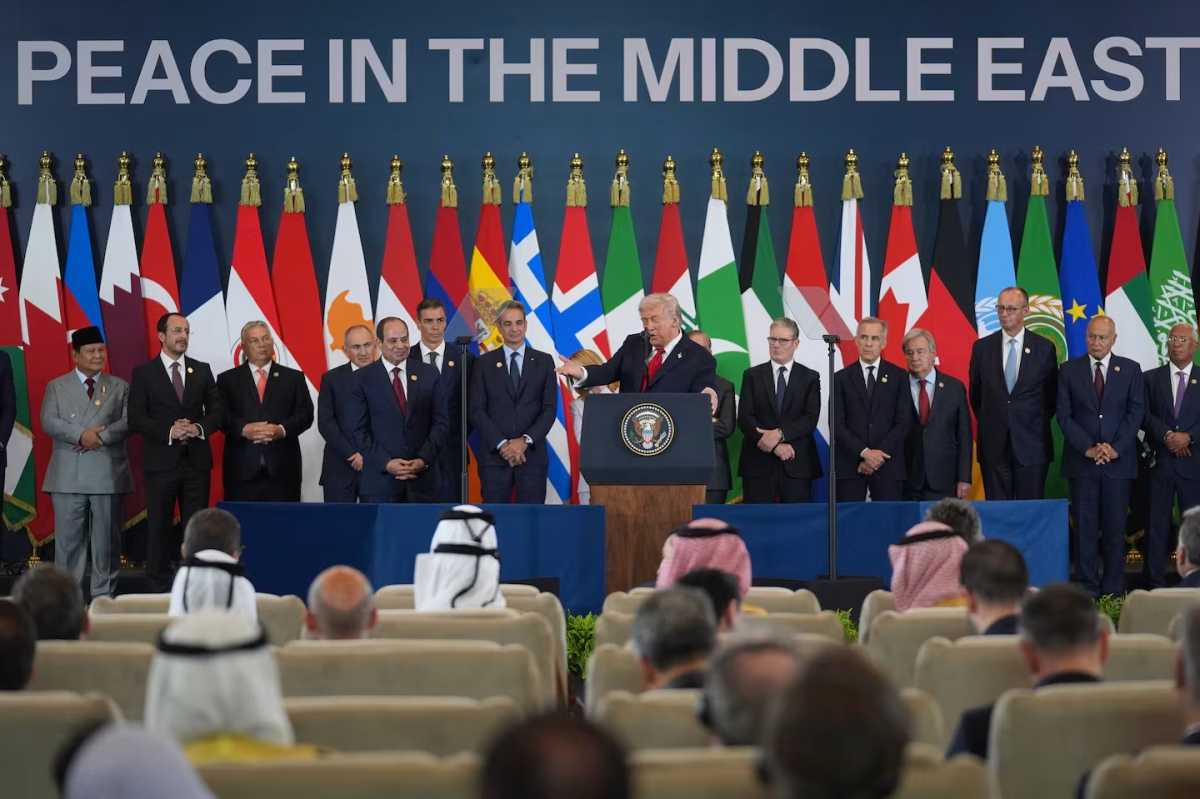
So on Oct. 10, when President Trump punctuated his long-awaited ceasefire agreement by praising Israeli Prime Minister Benjamin Netanyahu for having the “guts” to end his two-year military operation in Gaza, I couldn’t help but cringe.
The ceasefire is an undoubtedly positive development. Hamas has returned its 20 living Israeli hostages to their homes, and Gazans can begin rebuilding their lives without missiles lurking overhead. Trump has brokered peace — at least for now.
But as Israelis remember Oct. 7 and celebrate the return of their compatriots, let’s remember: for Netanyahu, this war was never about hostages.
To understand why, let’s wind back the clock to April 2024.
Only six months into his military incursion into Gaza, the Israeli military had slaughtered an estimated 34,488 Palestinian people, approximately 30 times the number of Israelis Hamas insurgents murdered on Oct. 7. Facing backlash from the international community and pressure from his constituents to facilitate the return of hostages, Netanyahu was ready to strike a deal.
After weeks of Egypt-mediated negotiations, Israeli and Hamas representatives had drafted a promising proposal: the deal would pause the Gaza war for six weeks and lay the groundwork for negotiations for a permanent truce. It would have released 30 hostages in a matter of weeks, and even more if the two parties agreed to extend the truce.
Not only would this deal have returned hostages to their families and averted famine in Gaza, it might have saved Israel’s international reputation: ending the war would have boosted Israel’s chance of brokering a peace deal with Saudi Arabia, improving its waning human rights credibility, and re-legitimizing its standing in the Abraham Accords.
All Netanyahu had to do was consult his cabinet — an already-fragile coalition of right-wing parties.
The problem? Many of the far-right lawmakers who comprised the coalition didn’t want peace in Gaza. Only four months into the war, coalition members had published maps imagining Jewish-majority towns dotting the Gaza Strip (you may recall President Trump posting an AI-generated video featuring he and Netanyahu sunbathing next to a glitzy “TRUMP GAZA” resort on the newly-cleared territory).
For Netanyahu’s political allies, Hamas could not choose between war and peace; they had to choose between destruction and displacement, oppression and occupation.
Were Netanyahu to reach a ceasefire too soon, he risked collapsing his coalition, triggering a snap election which polls showed he was likely to lose.
As he presented the peace deal to his Cabinet, his fears were quickly confirmed. “I want you to know that if a surrender agreement like this is brought forward, you no longer have a government,” said Bezalel Smotrich, Netanyahu’s finance minister.
And so the career politician faced a daunting choice: he could either approve the peace deal and sacrifice his office, or reject it and stay in power.
Where were Netanyahu’s guts then?
Of course, the Egypt-brokered deal was only one of many opportunities Netanyahu had to save Israeli hostages and stop his genocide in Gaza. This July, The New York Times published a groundbreaking special feature, revealing how the minister’s political calculations since Oct. 7 consistently prioritized power over peace — and even national security.
And of course, the obvious reality that Netanyahu was a bad actor didn’t stop the Trump and Biden administrations from continuing to send billions of dollars of military aid to our nuclear-armed ally, even as the IDF continued to bomb civilian hospitals and block humanitarian aid at Rafah.
Still today, Israel has yet to withdraw its military from a large portion of the Gaza Strip. It still continues to enforce an apartheid regime in the West Bank, and the ceasefire doesn’t change the fact that Israel has systematically murdered more than 67,000 Palestinians and displaced more than 2 million from their homes. It doesn’t guarantee Palestinian self-determination, and it’s certainly not a “two-state solution.”
So by all means, celebrate the ceasefire.
But don’t expect Gazans to smile as they march back to their destroyed homes and search for loved ones buried beneath rubble. And more importantly, stop pretending like Netanyahu and Trump are peacemakers. Genocidaires don’t deserve your admiration.
Cade Savoy is a political science and philosophy major from Breaux Bridge, La.