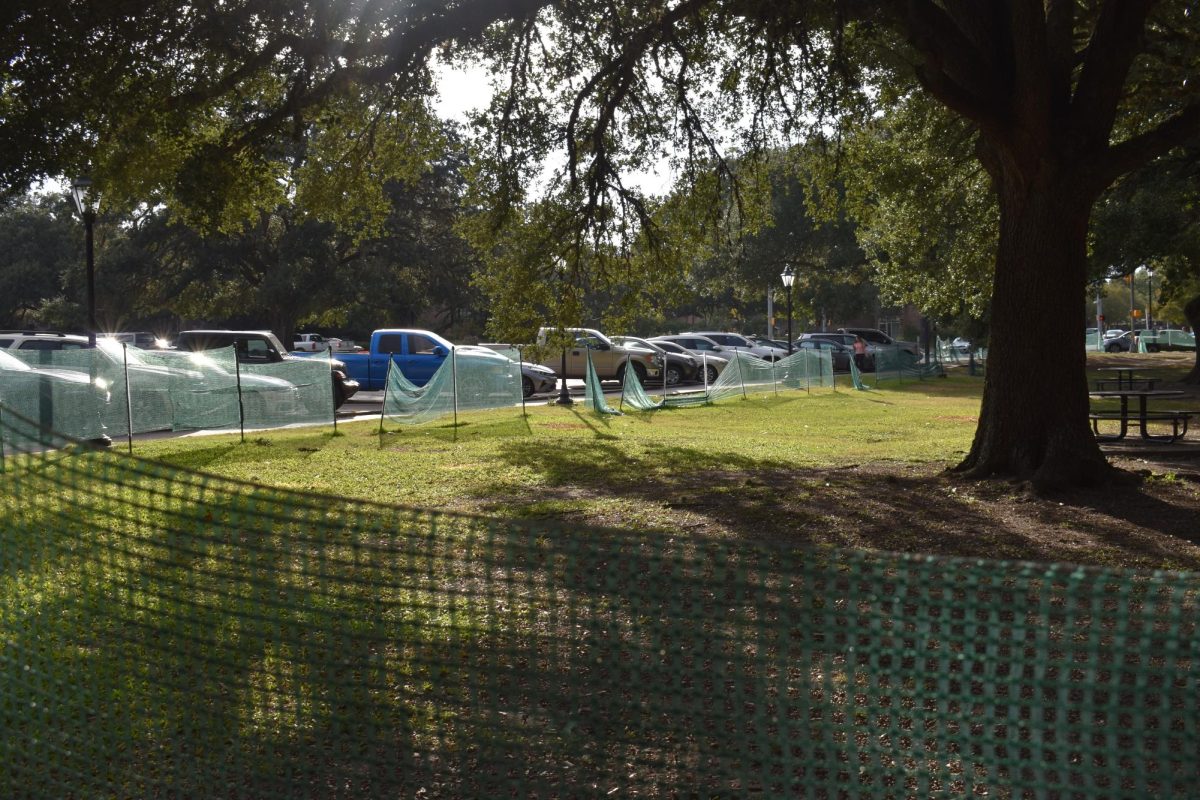
Since Mohammad Tantawi’s first article calling for the banning of Greek Life, he has pointed out the racial division existing in our tailgating traditions here at LSU. The sectioning off of Unity Field from public or student use calls for another reminder of the racial bias that persists on campus.
You may want to believe this is for good reason, but this is a classic example of having little patience or mercy for people who don’t look like you.
The case being made that police have narrowed the origins of the Oct. 11 shooting to “a well-defined geographic area” rings hollow. It was said the decision was for the sake of “safety” and “protection,” it always is, but there are times you must zoom out to judge something more fairly.
So let’s ask ourselves: Would LSU ever shut down the Parade Ground where predominantly white Greek Life congregates? No. LSU wouldn’t dare touch the Parade Ground. Even if these shootings are connected to Unity Field, does it call for the entire field to be shut down when other Greek Life organizations rely on it?
If the closure stands, it’s time to share the Parade Ground between all Greek Life. But we don’t foresee that being the solution, as it erases the importance of cultural space and representation for Black students who are also in Greek Life.
It’s a shame that LSU disregarded the Greek Life organizations that use Unity Field. That disregard would not be the same if the shootings had originated on the Parade Ground.
In addition to the shootings, LSU Board of Supervisors Chair Scott Ballard said he doesn’t want kids walking through clouds of marijuana or hearing explicit music, which happens at all tailgates.
That sounds logical and practical, except when you remember that LSU football games are highlighted by the moment when everyone says, “Suck that tiger d*ck, b*tch.”
As for the marijuana smoke, though recreational weed isn’t currently legal in Louisiana, we need to grow as a society and acknowledge it as an alcohol equivalent. The drug is already legalized in 24 states for recreational use.
Crack open all the cans of beer you want in Louisiana, but God forbid someone lights a joint. It’s redundant and restrictive. Besides, most kids don’t know marijuana smoke from skunk spray.
This is another example of collective punishment on a campus-wide scale. Because some kids decided to bring weed — which tons of tailgates do — and another decided to involve himself in a shooting, we must now punish the Divine Nine chapters. It’s absurd and rooted in racism.
This is a classic example of punishing those who look nothing like you, whilst letting those who do get away with the same things. Interim President Matt Lee and Ballard need to reflect on their motivations, because when someone says, “This is not about race,” it usually is.
Now, we don’t think the blending of Parade Ground is going to be exactly the “Kumbaya” some optimists may hope for. However, we do think that if LSU continues on this path, it will deepen the racial divide among its students. It’s blatant racism that once again, a marginalized group of students — specifically Black students — is getting the brunt of it. Why is that? Because white people need to blame someone.
The crime on campus during game day had no affiliation with LSU students or the Unity Field tailgating area, but for some reason, LSU has decided to close Unity Field indefinitely.
As much as we would love to see a blend of our student body and see Divine Nine fraternities and sororities congregate on the Parade Ground, a commonly proposed solution, but sadly, our university is moving backwards, just like our country.
Students are feeling the effects of this ruling and in our country at large.
“The state the world is in right now and what LSU has been doing recently is all adding up, making me feel like — ‘Do I even feel safe being here anymore?’,” Treazure Jackson, a junior studying theatre at LSU, said.
We’ve both been to the Parade Ground and Unity Field. Without a doubt, the community and atmosphere are different. Unity Field holds such a unique sense of diversity, culture and representation for our Black student body — representation that many students feel is missing elsewhere on campus. The decision to shut down Unity Field reinforces the idea that LSU has no issue with suppressing and blaming its marginalized student body.
Some students feel this discrimination isn’t just witnessed on the grounds of Unity Field.
“There’s nothing that happens at Unity Field that doesn’t take place anywhere else: underage drinking, smoking, explicit music — all of that stuff is seen all throughout places of the student body,” Christian Claiborne, a political science junior, said.
It shows students that even if you prefer a certain genre of music, drink or do anything, on top of being Black, your chances of being scrutinized for it are higher.
Closing Unity Field takes away a safe and cultural space for Black students. It sends the message that LSU knows the school is a primarily white institution and that’s all they will represent.
“It’s a direct overreaction against, honestly, the Black community,” Allison DePriest, a senior at LSU studying theatre, said.
DePriest is right. The decision to close Unity Field is LSU’s way of playing into the harmful stereotype that Black people can’t have fun without bringing violence.
We hope the outrage following Unity Field’s closure inspires LSU’s minority students and Black Greek Life to stand even stronger together — showing the majority and the in-power that no matter how targeted their actions may be, they will never succeed in erasing Black presence or Black culture at our institution.
Though tailgating will continue in another location, what’s most important is that we ensure that we will no longer see incidents like the closure of Unity Field by holding conversations and using our voices to call out racism when we see it.
Blair Bernard is a 21-year-old theatre major from Lafayette, La., and Mohammad Tantawi is a 25-year-old mass communication senior from Smyrna, Tenn.