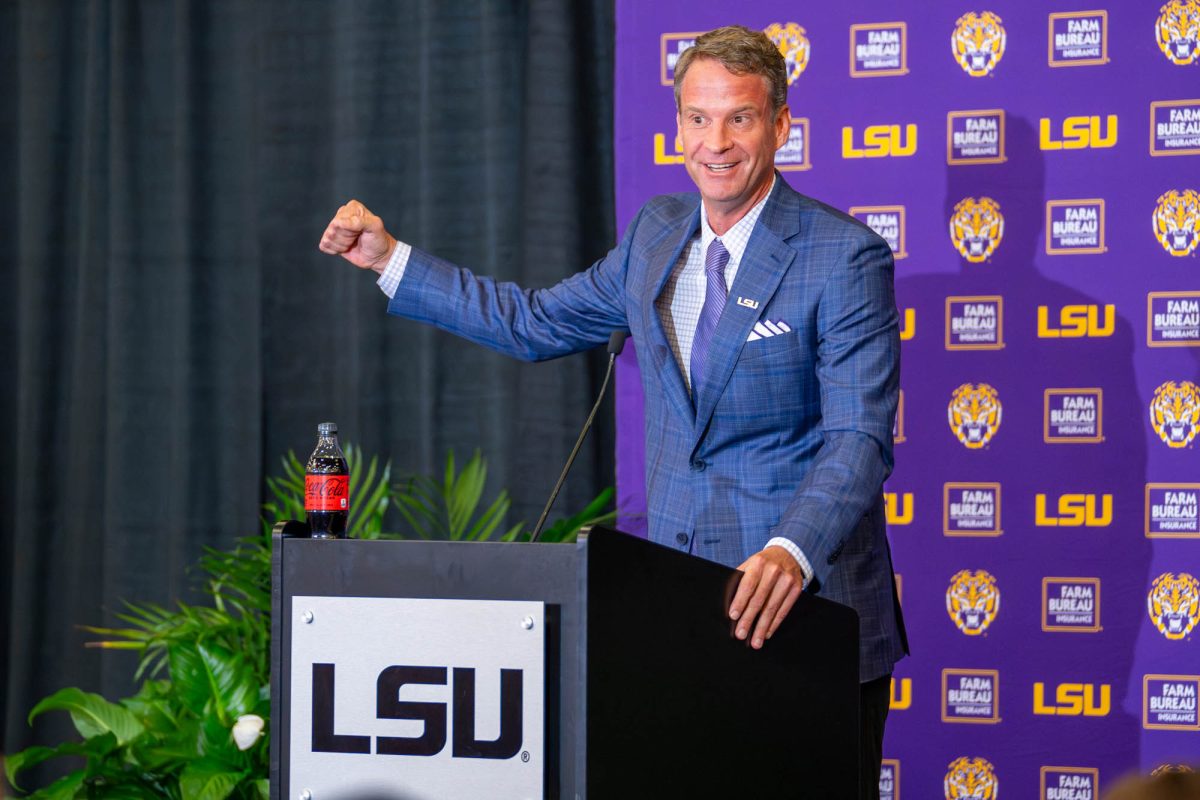
Long before Lane Kiffin stood behind a purple backdrop and called LSU “the best job in football,” LSU’s newly appointed athletic director, Verge Ausberry, was already imagining him in Baton Rouge.
“After we made the transition, we had already been talking about it,” Ausberry said. “We had a list put together … and Lane’s name kept popping up.”
Over the next several weeks, Ausberry built the case. Kiffin called LSU the best program in college football. Ausberry’s job was to make sure he believed that enough to leave a playoff team.
Before he ever brought Kiffin into a room, Ausberry went to people who actually knew him.
He said he reached out to Booger McFarland, Ryan Clark, Marcus Spears and former LSU assistants who had coached alongside Monte Kiffin. They told him who Kiffin was, how he worked and how he’d fit at LSU. Ausberry then leaned on his old coaching Rolodex — Nick Saban, Bill Arnsparger, Jerry Sullivan — to confirm what he was seeing.
He also studied the film himself.
“I’ve been watching his team, how he plays, how he scores, what he does on offense,” Ausberry said.
Kiffin’s play-calling, he said, was rare — the type of natural feel only a handful of coaches ever have.
And for Ausberry, who played linebacker at LSU and has worked in the athletic department for nearly three decades, the stakes were more than professional.
“I thought about, this will be my legacy at LSU,” Ausberry said. “I have to get the right person. Hiring a football coach at LSU is the biggest thing in the state of Louisiana.”
A different kind of interview
When Ausberry did finally sit down with Kiffin, the meeting surprised him with how little it resembled a traditional interview. Ausberry didn’t grill him about third-and-8 calls or coordinator hires. He asked bigger questions — fit, expectations and what Kiffin needed to win.
You don’t interrogate elite coaches, Ausberry explained. You find out whether your visions match.
For Kiffin, the alignment was immediate. He kept mentioning it — the governor, the president, the board, the AD, all pulling in the same direction.
“At some point, everybody I talked to was aligned that the number one thing in this state is to get LSU football back to the championship level,” Ausberry said. “That’s very unique.”
Why NIL became the hinge point
Kiffin said publicly he didn’t know the exact numbers of his contract when he agreed to come — because he didn’t ask. What he did ask about was LSU’s plan for players.
He wanted to know the financial structure around the roster: the NIL blueprint, the support system and how LSU planned to compete at a championship recruiting level.
Ausberry said Kiffin’s arrival immediately energized LSU’s donors.
“With a guy like Lane Kiffin, you’d be surprised at the calls we got from people who want to support this program,” he said.
Donors who had never contributed before reached out. Others wanted to increase their giving.
“There’s a lot of excitement to get behind him,” Ausberry said.
Kiffin went even further, speaking directly with donors to understand the mechanics of NIL. He believed LSU could combine his on-field product with Louisiana’s support network to build one of the country’s most attractive destinations for elite players.
The pitch: LSU’s ceiling vs. Ole Miss’ ceiling
Ausberry didn’t sugarcoat why he believed LSU was the best fit.
He told Kiffin that Ole Miss simply didn’t have LSU’s path to championships — pointing out Ole Miss and Kentucky are the SEC’s only teams never to reach the conference championship game.
“You want to get to the championship game, compete and win that national championship?” Ausberry said. “This is what you’ve got to do.”
To Kiffin, the message echoed what his mentors — Pete Carroll, Nick Saban and others — were telling him.
He said everyone he trusted gave him nearly the same advice: If he turns down LSU, he’ll regret it.
He said Carroll told him that Kiffin’s father would want him to pursue it. Saban told him he respected the decision and the opportunity.
Family, fit and landing a plane in Oxford
Kiffin has been open about how hard it was to leave Oxford — “the best six years of my life,” he called them. Ausberry knew the decision wasn’t just about football. It was about life.
He said it mattered that Kiffin’s daughter, Layla, and parts of his family saw Baton Rouge for themselves — and liked it. To LSU, showing the city mattered as much as showing the stadium.
Even picking him up required improvising. LSU’s plane originally planned to land in Tupelo or Memphis. At the last minute, the destination changed to Oxford.
Ausberry joked with reporters that he thought Rebels fans might “shoot missiles” at the LSU plane, but they landed, met Kiffin and took off.
“When we got in that air, it was game time,” Ausberry said. “We had him here … and he was like, ‘Let’s go. I’m ready.’”