After all roads seemed to lead LSU gymnastics to the national championship in Fort Worth, Texas, the Tigers came up short in their efforts to claim another title as they fell to the runner-up spot behind the Oklahoma Sooners.
If you were tuned into the competition, you know that this meet was a close one, with the difference between the winning score and second place coming down to less than a tenth: 198.1625-198.0750.
“They got a lot to be proud of,” LSU head coach Jay Clark said. “They fought their you-know-what’s off to put themselves in a position to even be in the running, and they got there, and sometimes at the end, stars got to line up.”
With this loss in the rear view, let’s take a closer look at where the stars didn’t exactly line up last weekend.
During the championship competition, the Tigers started the first rotation on the floor exercise, an event where they ranked No. 1 in the regular season. Their performance picked up at the halfway point of the rotation, where they posted three scores in the 9.9000 range, with matching 9.9375s from junior Amari Drayton and sophomore Kaliya Lincoln, and a 9.9000 from sophomore Kailin Chio.
After closing the second half of the rotation on a high note, fans were feeling the momentum as LSU moved onto its second event, the vault, where it ranked No. 2 in the regular season. Yet that momentum wasn’t harnessed by the team as they delivered a series of unstuck vaults, earning nothing higher than a 9.8750 until Chio secured the first and only perfect 10 of the championship.
You could point to this as where things started going wrong for LSU because the Tigers didn’t meet their usual high expectation for their strong vault rotation. Even if the next three highest vault scores behind Chio were 9.9000s, LSU would still have been behind Oklahoma by 0.0250 in the end.
It wasn’t until the Tigers closed out vault that they managed to regain the same momentum as earlier, if not a stronger version of it, as they mounted the uneven bars.
“It was doing really well, but, you know, not setting the world on fire,” Clark said. ”And then she [Chio] lit the match, and things began to take off for us. And so we rode that wave.”
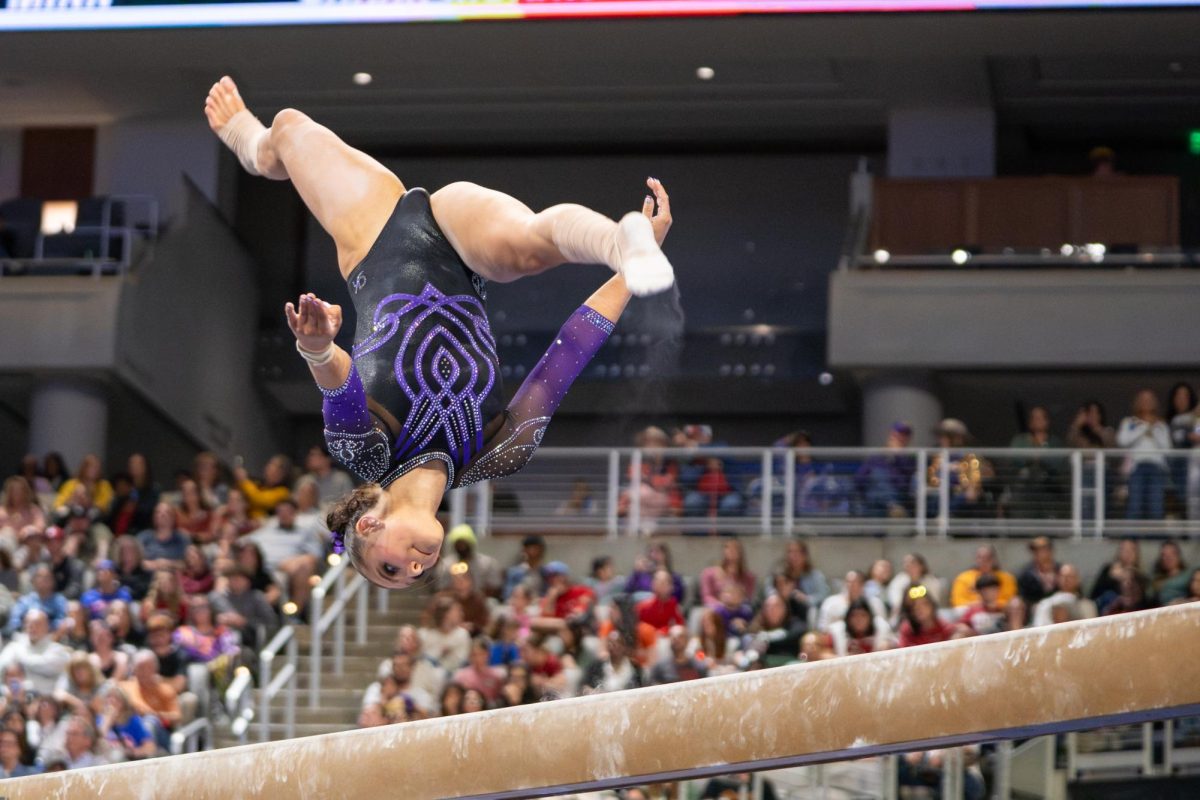
While Clark is undoubtedly proud of his team, things noticeably started to unravel for LSU during the fourth and final rotation on the balance beam.
Senior Kylie Coen kept the heat from the third rotation going with a 9.9125, but the arena fell silent as sophomore Lexi Zeiss fell from the balance beam following Coen’s routine.
From first glance, many viewers would say a fall from an event counts as an immediate setback, given its low score; however, the lowest score of a rotation is dropped, with judges only counting the top five scores.
On top of that, Oklahoma junior Kiera Wells also fell from the balance beam at the start of the third rotation, and yet the Sooners managed to win the national championship title.
So what was the difference?
The Sooners could build off of Wells’ mistakes and come back stronger, having followed suit with a series of scores above a 9.9000, with the exception of sophomore Elle Mueller’s 9.8625. They proved that they could bounce back from that kind of error.
Unfortunately for the Tigers, they couldn’t do the same, only adding two scores in the 9.9000s alongside Lincoln’s 9.8375 and junior Amari Drayton’s 9.8750.
While LSU still managed to close the event with a 9.9000 from Chio, it fell short of its recovery from the fall, costing it the national championship title.
“Even in the midst of all of that, you know, she’s [Chio] been able to maintain a mindset of excellence,” Clark said. “She’s hard on herself. She wants that tenth back, that kid has nothing to be ashamed of.”