LSU researchers at LIGO recently celebrated the 10th anniversary of proving Albert Einstein’s theory of general relativity after over half a century of observations.
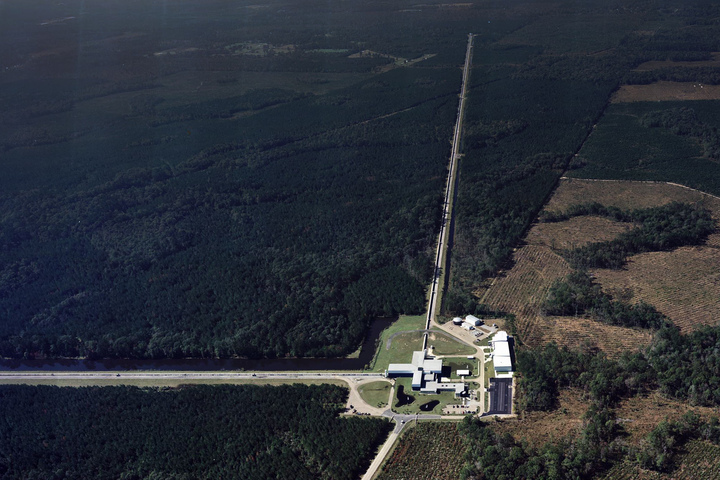
LSU has been studying gravitational waves with the Laser Interferometer Gravitational-Wave Observatory, for 55 years. The theory was proved with the observatory’s laser interferometer, a tool used to study gravitational waves made up of mirrors, lasers and a light detector. When there aren’t any waves, the light and the laser cancel each other out, and the detector is stagnant.
However, gravitational waves will slightly shift the laser, causing the detector to register an imbalance. This indicates a gravitational wave event, which only lasts a few seconds at most.
Joseph Giaimie is a professor at LSU and the observatory head of LIGO Livingston. He works with the interferometer every day.
“It’s particularly hard to do it because the amount of change in length is minuscule,” Giaime said. “Truly crazy minuscule, again, that’s why it took the better part of a century to work out how to do it.”
LSU researchers have been studying gravitational waves since 1970, when emeritus professor William Hamilton came to LSU from Stanford with his bar antenna, a bar of aluminum cooled to absolute zero that could detect gravitational waves. But nature didn’t send any signals strong enough to register on the antenna.
LIGO proved the theory by observing the activities of two orbiting black holes around a billion light years away. As they orbited, they emitted gravitational waves. As the black holes got closer together, more waves were emitted until they fused. Because of the distance between the observatory and the black holes, LIGO can only detect waves in the final few rotations.
The theory of general relativity states that the presence of matter and energy causes space-time to curve, and the curvature, local to the object, tells it how to move and determines how lengths are measured.
“General relativity has been proven true in many other ways,” Giaimie said. “But we hadn’t actually done it, so that was a big deal.”
The event to celebrate the discovery was held on Saturday at the LIGO Science Education Center in Livingston, Louisiana. Inside the main area, the center has a Nobel Prize on display in the foyer. On the left was an auditorium where a presentation was prepared.
LSU Boyd Professor Gabriela González was the main speaker during the presentation, where she spoke about the history of LIGO, the discovery itself and the future of the observatory. Other speakers included Brian Wallace, a senior policy advisor for Gov. Jeff Landry, and LSU Interim President Matt Lee.
On the right side of the building was an exhibition hall of gadgets and gizmos. Various machines showcasing scientific laws adorned the hall, from a giant slinky showing how waves work to an oscillation machine made from an acoustic guitar, with different strings showing various wavelengths. The decommissioned bar antenna will be displayed in this gallery.
Despite the discovery only happening over the course of a couple of seconds, the impact of the observation changed science forever.