LSU is poised to name its next president early next week, almost six months after former President William Tate IV left for the same position at Rutgers University.
The presidential search committee selected its finalists for LSU’s next system leader Wednesday. The Board of Supervisors will now vote on which applicant will become president at their special session on Tuesday.
The committee interviewed five candidates on Wednesday. Of the five, the committee recommended Robert Robbins, James Dalton and Wade Rousse as the finalists.
Here’s what to know about each finalist.
James Dalton
James Dalton, the current provost at the University of Alabama, said he wanted to make his time as the president “student-centric” by prioritizing workforce development, hiring strong faculty and increasing academic and research support.
“We’ve got to make sure that we have a culture that’s getting people in the room where they can express ideas and feel the part of this team that’s going to win,” Dalton said.
Dalton wasn’t initially included as one of the candidates and was introduced as an applicant Wednesday shortly before the interviews began, with some committee members apparently not aware he’d be interviewed. He said he had a “delay in applying.”
Dalton prioritized workforce development for LSU students. He said he wants to do this by adding what he calls “high impact practices” to the curriculum, like smaller class sizes and hands-on learning opportunities paired with strong faculty.
“If we are going to admit a student to LSU, we’ve got to do everything that we can to make sure that they’ve got a path out of here with a degree in hand and an eye on a job,” Dalton said.
Dalton explained that curiosity, hard work and mentorship are what are important on a college campus. He said that not only does he embody these traits, but he looks to hire faculty that do as well. He emphasized that as president he would invest in the people on LSU campuses, including undergraduate and graduate students as well as faculty and staff members.

In addition to hiring faculty, Dalton laid out a plan to recruit graduate students. He said it’s important to offer graduate students an environment they can excel in with strong faculty and increased stipends.
“We’ve got to make sure that we’re investing in graduate education,” Dalton said. “We’ve got to make sure that we’ve got the support for them to do the research, to live on a living wage and to make sure that they can be successful and devote their time to studies.”
Dalton also explained that though he wants LSU to be an elite university, it must also balance the need of making public education accessible in the state.
“It’s our responsibility as the flagship of the state to make sure that we’re keeping that door open and letting any student that wants to come here, come here,” Dalton said. “It’s our other responsibility to make sure that when we open that door that there is another door on the other side of the room that leads out with a degree.”
Dalton explained the importance of the university’s relationship with the governor’s office and the state Legislature, as well as the Louisiana community more broadly.
“As president, I think one of my prime responsibilities, as I did as a dean and provost, is to get out to meet those people, to learn what those values and goals are and to put in the resources to make sure we’re moving in the same direction,” Dalton said.
Robert Robbins
Former president of the University of Arizona, Robbins expressed his excitement to be given the opportunity to apply for LSU’s president. The Mississippi native discussed his accomplishments at his previous school, including boosting research funding from $600 million to $1.2 billion.
“You’ve got to have a leader that expects excellence, expects to be successful, expects for this place to grow,” Robbins said. “What I did at [the University of Arizona], doubling research funding, that is an achievable goal here.”
Robbins expressed the need for a leader that cares. At his former school, he said he would frequently interact with students, getting to know them and even handing out his phone number for if they ever had a question for him. He said his focuses are student outcomes and success and giving students a pleasant university experience while preparing them for their next chapter.
“I think building trust comes from sitting down, having a dialogue and listening,” Robbins said. “I’m big on meeting with students. I will try to meet anytime I can. I hosted them at my home. I walk across campus, they stop me, they want to talk. . . I think that goes a long way.”
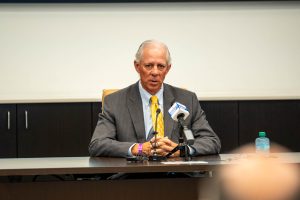
When asked about how he would unify all the schools in the LSU system, he emphasized that everyone should feel valued. With different events and research happening on the various LSU campuses across the state, Robbins says it is important to create a plan that prioritizes all the campuses’ needs.
“We’ve got a team of champions. What we don’t have is a championship team. So I think you’ve got a team of champions,” Robbins said. “You need to come together across the entire enterprise that is the LSU system to be able to be successful.”
Robbins found out about the opportunity to become LSU’s next president through Mark Emmert, a former LSU chancellor.
Robbins resigned from Arizona as the school was dealing with a $177 million financial deficit that stemmed from an accounting error. Robbins assured the committee there was no foul play and that the university was never at risk of default. Daniel Tirone, a member of the search committee and the Faculty Senate president, said he’d also confirmed that by calling his former colleagues at the University of Arizona.
Wade Rousse
The sitting president at McNeese State University, Rousse emphasized a need for LSU to invest its resources in its programs, people and future generations. A part of this investment is the integration of more corporate partnerships, he said. He states that the funding pool in Louisiana has changed over the past 10 to 20 years and that it calls for a dramatic change in strategic objectives for the administration.
“We’re not going to allow them to skew the purity of the research,” said Rousse. “That’s a non-negotiable, but the idea that we need [corporate funding] to be a part of our curriculum, our research agenda, and truly create partnerships, true partnerships that we can maybe monetize together moving forward, I don’t think it’s negative.”
Much of the public comment before the interviews was used to caution the committee against selecting Rousse, with LSU Students for a Democratic Society members saying he would be a “Landry lap dog.” Rousse indirectly responded to these criticisms in his interview.
“There are those, perhaps some in this room, who will make me a proxy for a political or cultural battle that I am not fighting,” Rousse said. “To those individuals, I have one simple request: Look closely. Look to my breadth of experience… Look to the turnaround my team and I engineered at McNeese.”
Under Rousse, McNeese has seen increases in enrollment the past two years after 14 years of decline.
Rousse also said he’d support splitting the role of LSU president back into two: a chancellor of the Baton Rouge campus and a president over the LSU system. The roles were combined in 2012.
“I think it’s all about the metrics and accountability,” said Rousse. “If we don’t have a president of the system, I feel as though the natural tendency is for the head of each one of these campuses to work in their own self-interest. If we’re going to put together a unified vision of how we educate Louisiana differently, the LSU system drives it.”
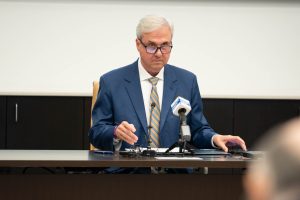
In regards to students and their well-being, Rousse defined trust as the key component to relating to the student body. He said at McNeese, he and his wife moved into the dorms to be closer to the students. He cited the Student Government Association at his current school as his driving force and said he trusts them to guide him on what to do and what not to do.
Rousse also suggested that students who are denied entry to LSU A&M be re-delegated to other campuses in the system with a transfer option still available after a certain time.
“When a young person walks through our gates, they are making an investment,” Rousse said. “Not just in their tuition dollars, but their time, dreams and their faith that LSU would deliver on its promise.”
Rousse has faced criticism for his lack of experience in a research context and at a high-level university. He said though he doesn’t have hundreds of scholarly citations, he understands the process. Rousse said that the biggest leadership challenge he would face would be gaining the trust of the research faculty.
Though they interviewed Wednesday, the search committee did not recommend current LSU Interim President Matt Lee or Giovanni Piedimonte for the Board of Supervisors’ consideration. Lee, who has been a part of LSU for over 20 years and was until recently the vice president of agriculture, only received nine out of 20 votes for recommendation.
Lee had significant support among LSU faculty, letters written to the committee showed.
Each finalist will now have a full day set aside for them to hold public forums and meetings with stakeholder groups. Each finalist will be available to publicly speak with students, faculty and staff.That process will start immediately. Dalton was assigned Thursday, Robbins Friday and Rousse Monday.
View the schedule the candidates will follow on their assigned day here.
Liv Tees also contributed reporting to this article.