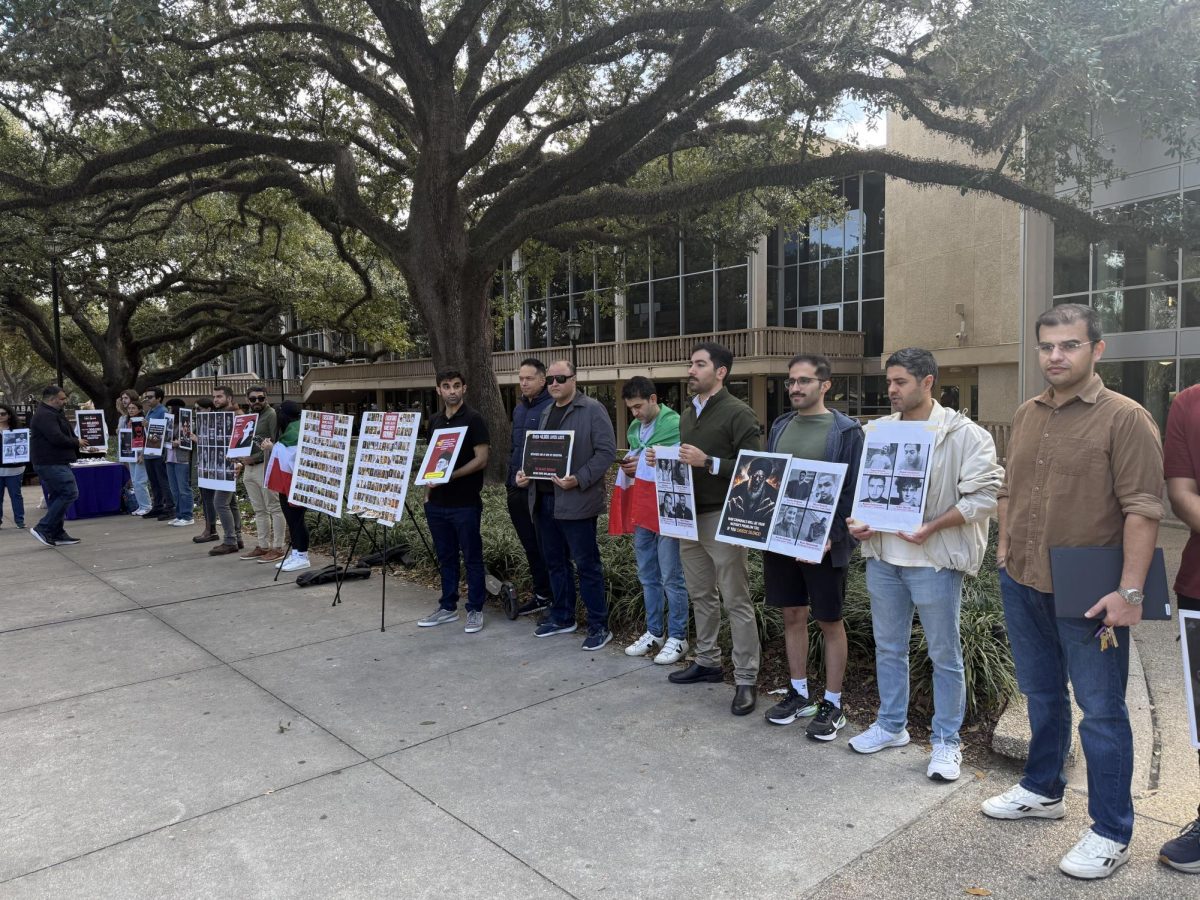
On Monday afternoon, a group of Iranian students and faculty members stood on the edges of Free Speech Alley in silence, some draped with Iranian flags and others holding pictures of dead loved ones.
The group joins a growing list of activists around the world calling for the ouster of Iranian Supreme Leader Ayatollah Ali Khamenei.
On Dec. 28, a group of Iranian citizens took to the streets of Tehran to express frustrations over Iran’s crumbling economy, brought into focus by the collapse of the country’s currency, the rial.
Days later, the demonstrations exploded into violent conflict as the Iranian government began imprisoning and systematically executing protesters. While the official death toll remains in dispute, classified documents from the Iranian government suggest that Tehran’s security forces killed over 36,500 people in the two-day stretch between Jan. 8 and Jan. 9 alone.
“We are here to support the people of Iran, the brave people of Iran who are fighting against this dictatorial, evil regime,” said Amin Kargarian, an associate professor of electrical and computer engineering at LSU. “They are trying to reclaim their country from tyranny. It is really comparable to Hitler and the Nazis, and if you see some of the pictures, you will understand why.”
An Iranian immigrant himself, Kargarian helped to organize the demonstrations through informal communication channels with LSU’s Iranian faculty members and student body.
“There is no organization. This is all volunteer,” he said. “We said, ‘Guys, until freedom of Iran, we are going to get together every Monday and every Wednesday here at 12 p.m.’”
A particularly salient theme in the demonstrations was praise for President Donald Trump.
Kargarian wore a hat with the label, “Make Iran Great Again,” a play on Trump’s famous campaign slogan popularized by an X post from Sen. Lindsey Graham.
Hamed Babaizadeh, an LSU alumnus and an Iranian immigrant, played audio from conservative personality Mike Levin’s Fox News talk show, in which he compares the Iranian regime to North Korea and urges the U.S. to take military action against Khamenei.
He also played a song called “You Promised Us” by the Iranian musician Barbod over a loud speaker. In the YouTube description for the song’s music video, Barbod writes, “I respectfully dedicate this song to the President of USA Donald J.Trump and Primeminister of Israel Netanyahu.”
“President Trump supported the Iranian people and this movement, and many times he mentioned that help is on the way,” Babaizadeh said. “They are fighting for their rights in hope that leaders around the world — especially Donald Trump — will take military action or provide any kind of assistance to the Iranian people.”
Trump recently entered into negotiations with the Iranian government following the regime’s suppression of anti-government protests. He has also sent a military “armada” near Iran and threatened to attack the country if it proves unwilling to negotiate.
Others offered only a qualified endorsement of the president’s actions, opting instead to call for broader support for the Iranian people from the international community.
“There’s always something in it for Trump, you know, he’s kind of a narcissist. But they need help from anybody,” said Aidin Arasteah, a first-year student at the LSU Law Center. “We need more people to talk about this. Talking about this, especially non-Iranians talking about this, can create pressure to act.”
Echoing Arasteah’s sense of urgency, Kargarian urged Trump to take an even more aggressive stance against Iran and to cease diplomatic engagement with Khamenei entirely.
“We request that President Trump not negotiate with this regime. Never trust, do not trust this fanatic regime,” he said. “They are going to create a nuclear weapon and actually attack the U.S. and Israel.”
Instead, Kargarian said the president should negotiate with Crown Prince Reza Pahlavi, a self-proclaimed leader of the Iranian opposition movement who was exiled from Iran 50 years ago.
Pahlavi is also the son of the late Shah of Iran, an American-installed dictator who came to power after American and British intelligence agencies launched a coup d’etat against Iranian Prime Minister Mohammad Mosaddegh to protect Western oil interests. The Shah was later deposed in the 1979 Iranian Revolution.
“We are going to take the country back, and [Pahlavi] is going to lead the opposition,” Kargarian said.
He also said that his demonstration at LSU foreshadows other protests against the Iranian regime in cities across the world.
“Go check on Feb. 14 in Munich, Toronto and Los Angeles. Iranians are going to get together — 300,000 at least in L.A., we expect 200,000-plus in Toronto and a couple of hundred thousand in Munich,” he predicted. “This is the request of not only the people here, but at this rate, the request of every Iranian.”