An LSU professor created the Louisiana Actionable Understanding for Natural Hazard Preparedness program, or LAUNCH, to educate participants on climate resilience.
Nazla Bushra is an assistant research professor in the Department of Oceanography and Coastal Sciences. She received a grant last year through the UCAR President’s Advisory Committee on University Relations’ Community Engagement Fund. UCAR is the University Corporation of Atmospheric Research.
She used the grant money to fund LAUNCH. The program was a series of three workshops with a diverse group of participants.
This included graduate students, professors and community leaders from organizations like the Louisiana Office of Planning and Budget and the Capital Region Planning Commission.
UCAR and National Center for Atmospheric Research scientists also spoke at LAUNCH workshops. Bushra explained the need for workshops like these.
“We live in Louisiana, where all kinds of natural hazards are a part of our lives,” she said.
Most commonly, Louisiana experiences extreme heat and intense hurricanes, Bushra said. But, the climate is changing. She added that Louisiana has experienced snow the past two years, which is unusual.
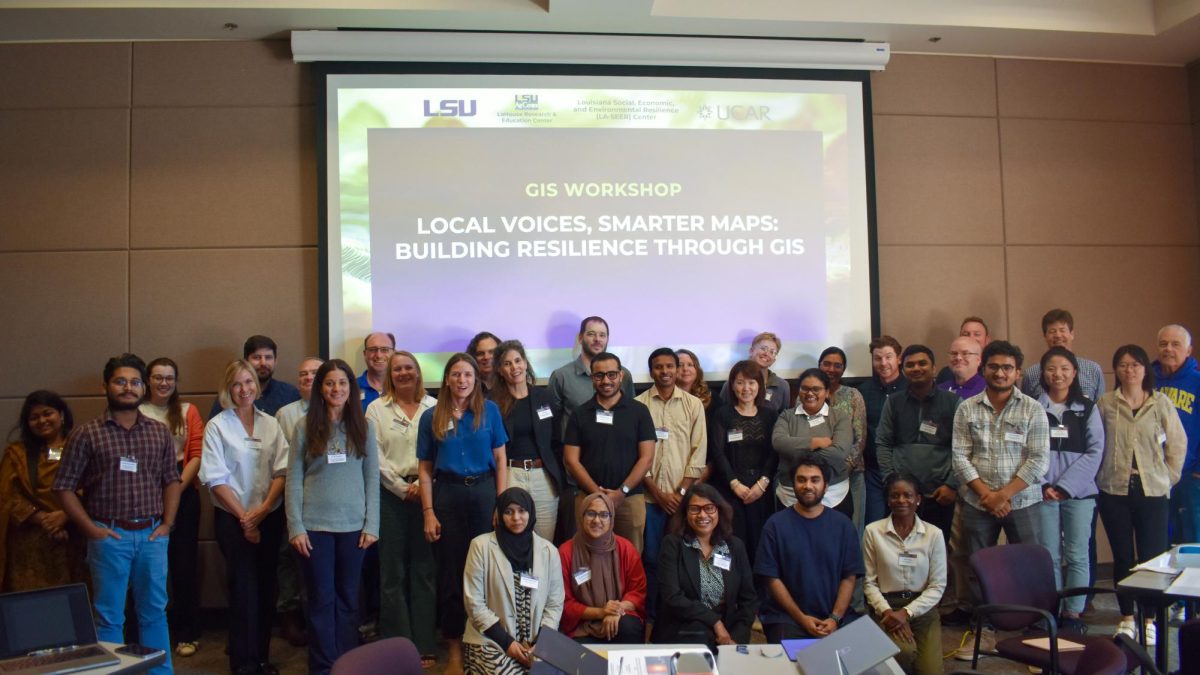
The series started in September with a Geographic Information System map workshop. Participants used GIS maps to analyze areas with extreme heat and flooding risk in Louisiana.
The second workshop was in March and focused on educating K-12 teachers in communities around the Gulf of Mexico on the climate impacts of hurricanes.
The third workshop, “From Models to Action: Community Action Planning for Louisiana’s River and Coastal Systems,” took place on April 20 and 21. NCAR and the LSU AgCenter’s LaHouse program co-sponsored this workshop.
Bushra emphasized the connections that these workshops fostered. She said two faculty members received grants after the first workshop and some graduate students secured summer internship opportunities.
The third workshop ended the series for now, but Bushra said she would like to continue LAUNCH when it is possible.
She said the grant allowed each workshop to have 25 participants, though many more than that expressed interest. She said 64 people registered for the first workshop, so she had to narrow it down.
Mahir Tazwar and Tahmida Muna are two oceanography doctoral students who attended all three workshops. The two wanted to participate in the workshops because they were interested in using model outputs to solve real problems.
Muna said that the last workshop created a better understanding of early warnings and weather predictions.
“People might think, ‘how are they processing this kind of early warning?’ In this session, we saw the simulation and how they are preparing the early warnings or predictions,” Muna said. “So it might tell people how it works but also increase the credibility.”
Tazwar thinks these workshops were a good way to educate people who are not scientists on the impacts of climate change.
“In the next 20 years, what scientists are saying is we have bad days ahead for Louisiana in terms of sea level rise and hurricanes,” Tazwar said. “I think scientists are doing their best to understand the scenario, how the hazard dynamics will change, but [other] people are still not understanding the impacts on the climate.”