When attending a baseball game, certain experiences are assured.
The smell of freshly manicured grass and popcorn wafts through the stands, riding a warm, inviting breeze that feels incredible. The taste of a pretzel or a hot dog. The sight of truly incredible feats of strength and athleticism. The sounds of players’ walk-up songs set the mood for their moment.
These experiences are universal in this great sport. They are all sensations unique to the human experience because they are produced naturally. It’s part of what makes going to the ballpark so special.
Now, that experience is in doubt, threatening to unravel the ballpark-going experience.
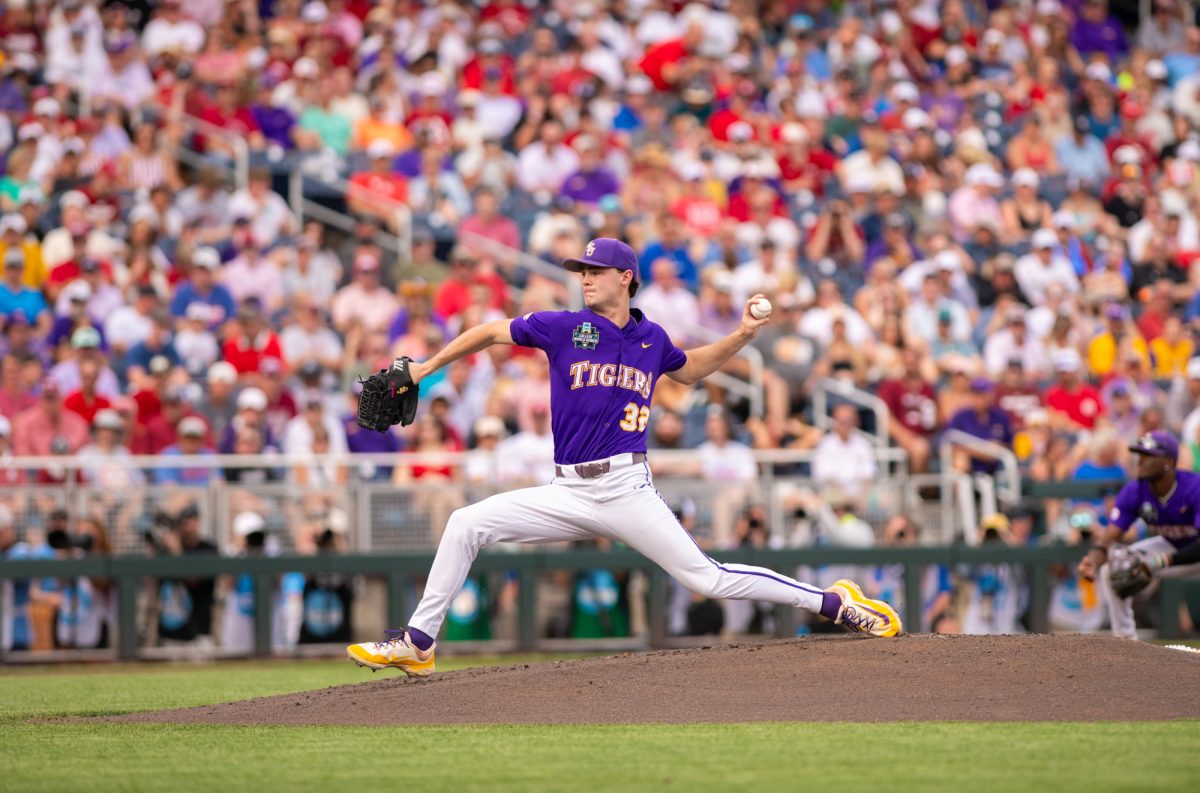
Ahead of the season, LSU released its players’ walk-up music selections. On that list, next to Brayden Simpson’s name, sits “Walk My Walk” by Breaking Rust.
It sounds the part in the stadium. An unassuming, red dirt country track, in which the narrator proclaims that he is a free-spirited type who is unbothered by the perception of others. The bass-forward speakers at Alex Box Stadium hide his tinny inflection that sits in the uncanny valley.
Only when examining online, listening in higher quality and viewing the song’s cover and artist’s branding is the song’s dirty secret revealed: it is entirely AI-generated.
Breaking Rust is a project that was created by Aubierre Rivaldo Taylor. Taylor prompted AI to generate country music that would be released under the Breaking Rust alias, represented by an AI-generated image of a chiseled-jaw cowboy.
This project and the song in question made headlines when it broke through to the top spot of a Billboard digital sales chart. That feat was potentially artificial, and certainly not impressive; with digital sales being a bygone way of consuming music, artists can spend a few thousand dollars buying their own song to get enough sales to top the charts.
Still, it served as relatively easy press for the song and was, perhaps, a factor in it becoming a hit big enough to become a walk-up song at Alex Box Stadium.
It’s probably too late for Simpson’s walk-up music to change, meaning this song, and AI in the ballpark, is here to stay. The question now, as it always is surrounding AI, is where does it go from here?
Has Pandora’s box been opened in the sporting realm?
That answer is hard to determine currently, but it’s imperative that it’s ultimately no. Unfortunately, developments seem to be inching in the wrong direction.
Electronic Arts, the studio behind the massively popular “EA FC” franchise of soccer video games, started developing an AI version of commentator Guy Mowbray earlier this year. Mowbray’s AI clone will be able to pronounce north of 20,000 players’ names.
The staggering number, EA says, will make the game more immersive. It will not be authentic.
What would happen if the late Bob Sheppard were to pass away today?
The legendary Yankees public address announcer recorded announcements for franchise players like Derek Jeter and Mariano Rivera during the time between his retirement and passing, which they played whenever they entered the game.
If that situation were to unfold 20 years later, would Sheppard’s voice be fed into an AI voice tool to make his voice forever the one of Yankee Stadium? If so, would Carl Yazstremski’s comment about not having made it to the MLB until Sheppard announces your name hold the same weight if it wasn’t really him doing it?
Yazstremski’s quote wouldn’t be entirely accurate if that were to happen. “You haven’t made the MLB until an AI-reconstruction of Bob Sheppard spits out your name” would probably be more truthful, but certainly less appealing.
AI-enhanced volumetric capturing is in the works already, attempting to build on limited-range volumetric capturing that was demonstrated during Major League Baseball’s Tokyo Series in 2025. 3D player tracking software is already available in the MLB app.
Will these technologies combine to enhance the suspension of disbelief that makes baseball so magical? Or will it be a peek behind the curtain, taking away the wonder that made so many fall in love with this sport?
Regardless of the answers, one thing is evident: In a time where third places and interpersonal interactions are going the way of the dodo, the world needs spaces to reconnect with its humanity. Under no circumstances do these places need the presence of AI-generated content.
Nobody will sing in unison if a song with origins like “Walk My Walk” comes on at a karaoke night. People don’t gather to worship an AI deity. Libraries don’t house mechanical literature. The same should be said for a day at the ballpark.
There needs to be an extreme effort to preserve how we experience the game of baseball in person, maintaining it for the decades to come. Otherwise, the story of going to a baseball game runs the risk of becoming a tragedy, losing what made it so special, giving up its label as a bastion for human expression and becoming just another thing.