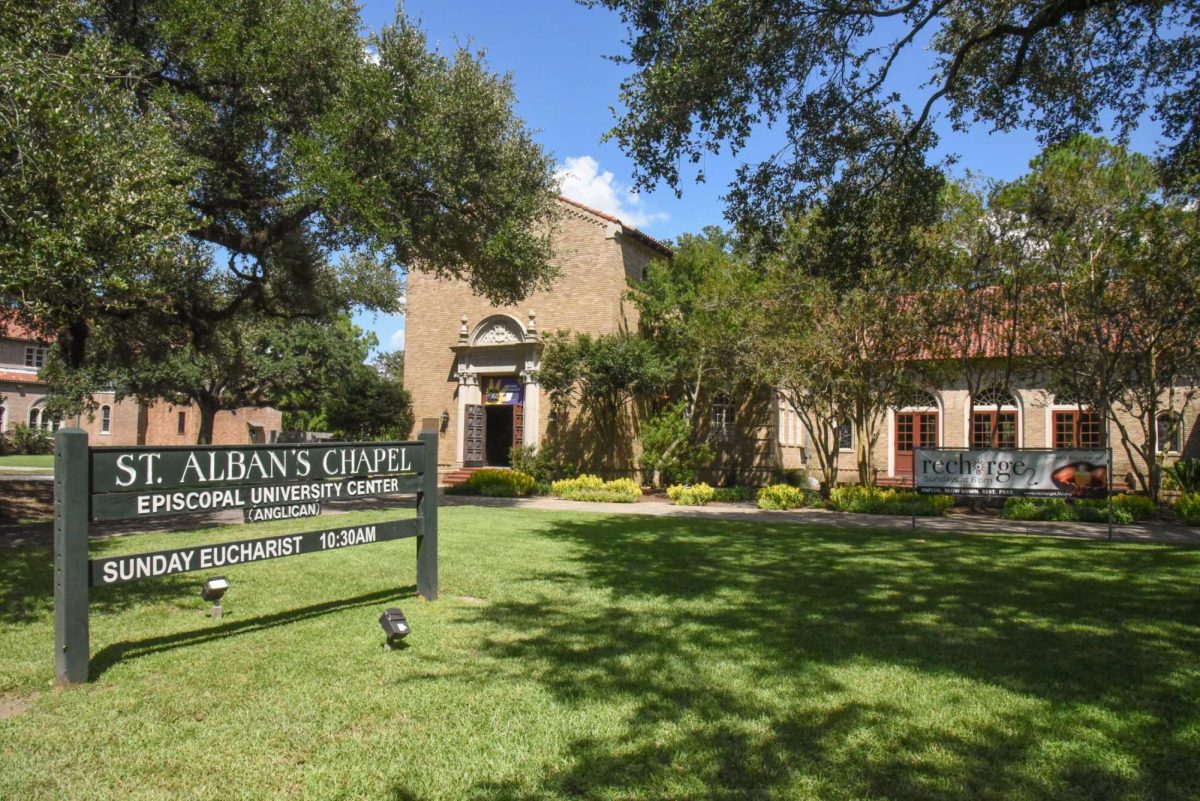
Just outside St. Alban’s Chapel, located on LSU’s campus at the corner of Highland Road Dalrymple Drive, is a new garden filled with Louisiana native plants that are already attracting butterflies and bumblebees just weeks after being planted.
This garden is also making campus history. Certified this June by the Louisiana Native Plant Society, it is the first native plant garden on LSU’s campus.
The project was led by a congregant at St. Alban’s, Emily Stich, who is a licensed landscaper and also the president of the Louisiana Native Plant Society.
With help from fellow congregants Keith Pope and Mike Jacobsen — and under the watchful eye of her supervisor and dog Penny — Stich spent roughly two weeks in February yanking out weeds, sowing the soil and transplanting native plants.
Stich decided to uproot the previous garden for a few reasons, chief among them beauty and education.
“It looked horrible,” said Stich. “[I] decided to yank it all out before the cool ended. And fortunately, our new minister gave me grace. I should have asked permission, but I got forgiveness.”
Beyond beautifying the chapel, Stich intends for this garden to serve as a learning opportunity for visitors.
“All of the plants are labeled with both the botanical and common names, and I’m hoping to encourage the congregation and the many students who go here, who attend services here or eat here a lot, to use native plants on their own properties,” said Stich.
Stich plans to give presentations on the importance of native plants for ecosystems to students, fellow congregants or curious individuals.
The process of becoming a certified garden by the Louisiana Native Plant Society states that the garden must have a certain percentage or the number of native plants, such as 25% or 25 native plants for a bronze ranking.
Stich labels these native plants in the garden at St. Alban’s with both their common names and botanical names on flowerbed signs next to the plant that they denote.
Some of the native plants in the garden include black-eyed Susans, or the Rudbeckia hirta, a flower that blooms in colors from orange to yellow. Also planted is the dense blazing star, or the Liatris spicata, a tall, bright purple flower.
Beyond flowers, there are Rattlesnake masters, or Eryngium yuccifolium; manfredas, also known as Manfreda variegata; and much more.

After Stich submitted a request for certification, a member of the LSU Hilltop Arboretum, which serves as a local representative for the society, examined the garden for the aforementioned qualifiers and awarded the requestee with their appropriate rank. The garden at St. Alban’s was given a bronze certification.
The importance of native plants in the garden at St. Alban’s cannot be overstated, “Because what we do in our landscape, on our property, matters a lot to the ecosystem, to the fauna and the insects that use native plants that are the basis of everything else,” said Stich.
The garden, still in its youth, is already attracting dozens of pollinators and critters, from bees and butterflies to caterpillars and geckos, demonstrating the impact of native plants in inviting these species to campus.
However, the garden was not planted just for its own sake; it was planted with community in mind. Stich said that the congregation of St. Alban’s Chapel has already responded positively to the inclusion of the garden. She imagines that this engagement will only increase as the garden grows.
In the future, Stich plans on sharing the seeds with others to encourage them to plant native flora themselves, which directly benefits local environments and ecosystems.
“The first year it sleeps, the second year it creeps, and the third year it leaps,” said Stich about the garden.