LSU Libraries’ Special Collections, with its latest exhibition, showcases materials curated by library staff.
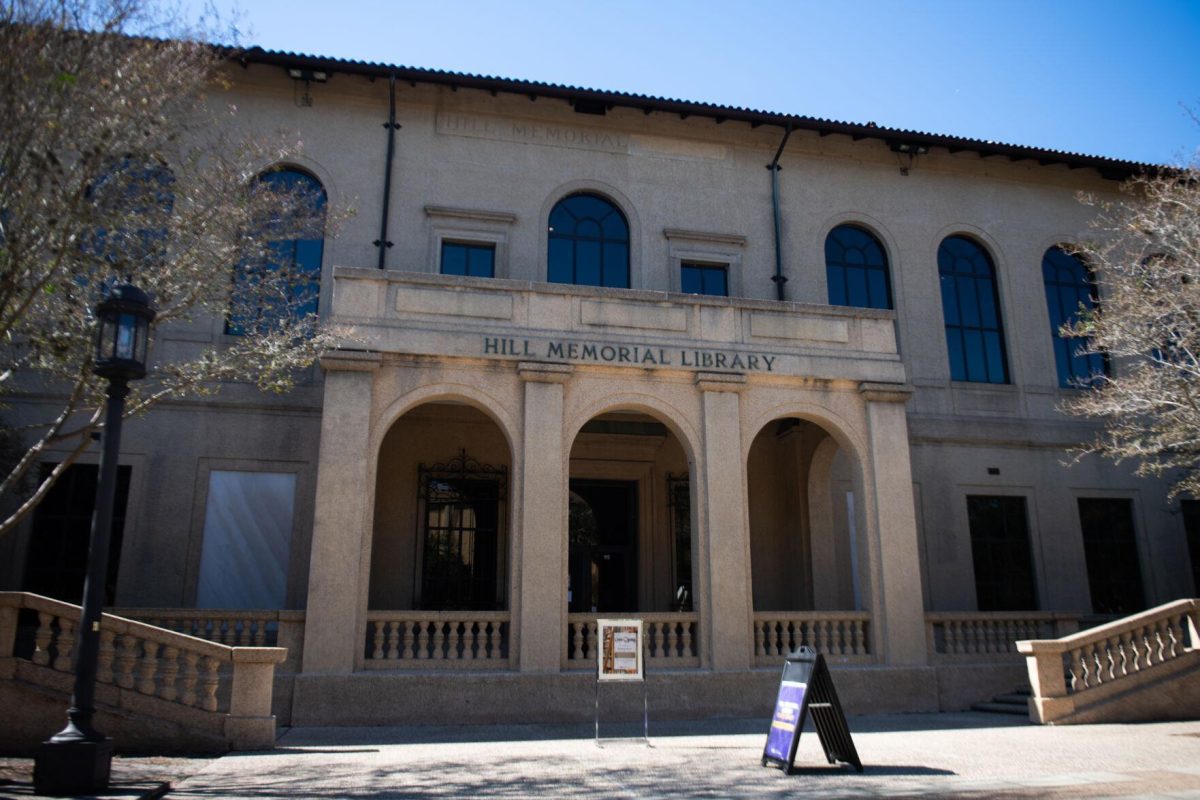
“Unlocking Special Collections: A Selection of Staff Favorites” is the latest exhibition at Hill Memorial Library, featuring an array of archival collections, including poetry, illustrations, photographs and more.
The exhibition opened on the Hill Memorial Library’s first floor on April 6, and it will remain on display until July 31. The exhibition’s hours align with Hill Memorial’s open
hours of 9 a.m. to 5 p.m. on weekdays only.
“This is for the public. It’s pretty incredible that we get to be stewards of this material,” said Meredith Contreras, the outreach and events coordinator of Special Collections. “I think that all of the people who participated in this and all of the people in this building really care about the work that they do.”
Contreras said that the concept for the exhibition began as a social media campaign this past summer in an effort to promote the different items Special Collections has to offer. She detailed how the campaign highlighted an LSU Libraries staff member every Friday, along with their favorite item from Special Collections.
Exhibition manager Leah Wood Jewett emphasized how besides those who chose their materials for social media, she opened up the option for all staff members to participate in unveiling other parts of Special Collections.
These different perspectives open up the archives even more to the general audience, showcasing the human hands and minds that make viewing the materials possible at Hill Memorial.
“It’s a long list of people who don’t get their name put out there, but it’s a good thing to remember that it’s a lot of work,” Jewett said. “There’s a lot of love put into it over all these years so that we can all benefit from it.”
Jewett recounted how she and Contreras were trying to find a common thread between the staff selections to find a coherent theme for the exhibition. Ironically, there was no connection. However, that proved even better as the exhibition serves a purpose as a microcosm of Special Collections in its entirety.
One staff member who picked his favorite item to be shown in the exhibition was Operations Coordinator Andrew Loyacano. His responsibilities with Special Collections involve supervising student workers and setting up for events in the Hill Memorial Library lecture hall.
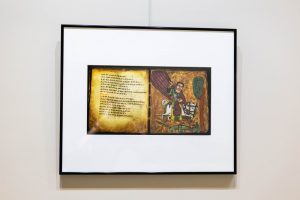
Loyacano chose to shine a light on a volume from the archives’ Amharic Bible manuscripts for its drawing of St. George slaying the dragon.
He said his choice rested heavily on both his fascination for the illustration itself and his Catholic upbringing. As a child, Loyacano read many books about Catholic saints, and he always loved reading stories about knights slaying dragons.
He also said that reading further into St. George as a figure made him think of the diversity in how the saint is depicted throughout Catholic tradition. He observed that the Ethiopian Orthodox Church had an affinity for the figure that other churches did not.
“It also probably looks so much older than it is, but it’s actually only from the 1800s. It’s still entirely handmade,” Loyacano said. “Every single letter in there was handwritten, every illustration handmade, and so I mostly picked it for that tie to history.”
Loyacano hopes that after seeing this illustration, visitors will be inspired to do further research for themselves. He expressed his own passion about free access to information, and the exhibition reminds individuals that Hill Memorial Library is able to provide that with its resources.
“I hope that objects like this show that religion is extremely diverse. You’ll have no idea what a tradition is until you look at that specific culture,” Loyacano said. “I really hope that it brings people down rabbit holes to learn about places they would have never thought about beforehand.”
Another keyholder is processing archivist Camille Boechler. Her responsibilities involve arranging, describing, preserving and making historical materials accessible to the public and researchers.
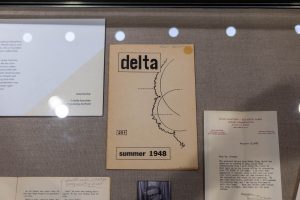
Boechler chose the James Coleman Prewitt Papers for her staff pick. She said Prewitt was a writer from Louisiana and LSU alumnus; he also co-founded LSU’s student literary magazine, The Delta, which is now known as The Delta Literary Journal.
Boechler discussed Prewitt’s bad luck in getting his work published, despite writing countless poems and stories. The Prewitt Papers she chose offer visitors a glimpse into a more personal side of the writer’s life, and Boechler believes people can take away insight that will push them to look closer at the literary side of Louisiana history.
“I can’t explain exactly why, but I quickly felt a strong sense of familiarity toward him when I processed his papers last year, almost as if I knew him personally,” Boechler said. “The overall impression I got of him is that he was a bit of an eccentric; he was somewhat of a misfit and highly obsessive over his craft.”
Boechler also believes that visitors can walk away from the exhibit knowing that the staff members behind the picks are just as unique as the materials themselves.
Brandon Layton, the exhibition’s digital engagement and pedagogy librarian, helps facilitate class visits to Hill Memorial and corresponds with professors to incorporate archive materials in their teachings.
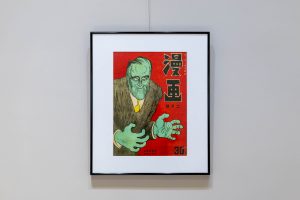
Layton’s choice was a series of World War II comic books from Japan, and visitors can pick out the manga clearly — the cover is President Franklin D. Roosevelt portrayed as Frankenstein’s monster.
Layton said the imagery drew him to the collection, and he has always noticed how students tend to gravitate to the specific type of material. He said it shows a glimpse into a foreign perspective that is usually not as easily accessible in regular research. These comics serve as both an example of foreign politics and a paper trail to what would become a defining literary form of the region.
“This is state propaganda, so it’s not necessarily going to be telling us what an average person was thinking, but at the very least, it gives students a different way to look at World War II,” Layton said. “It’s cool that it is really the first example of the styles that would eventually become manga.”
Layton then said there are different interpretations of the manga cover, as people can look at it from a foreign, political context that revolves around studying how the U.S. was depicted during wartime or from an artistic mindset that focuses more on the drawing and shading methods that go into creating cartoon-like characters.
Layton stressed the amount of material available at Hill Memorial and how these collections are better for understanding, research and even promotional purposes.
“We have 200,000 books, 1.5 million manuscript items. It’s a ton, and oftentimes, as you’re working through this stuff over the years, staff will develop their favorite things that they really like,” Layton said. “We all have these lists in our own minds. These are the things that we think are really awesome, so it’s fun to share that stuff with the public.”