



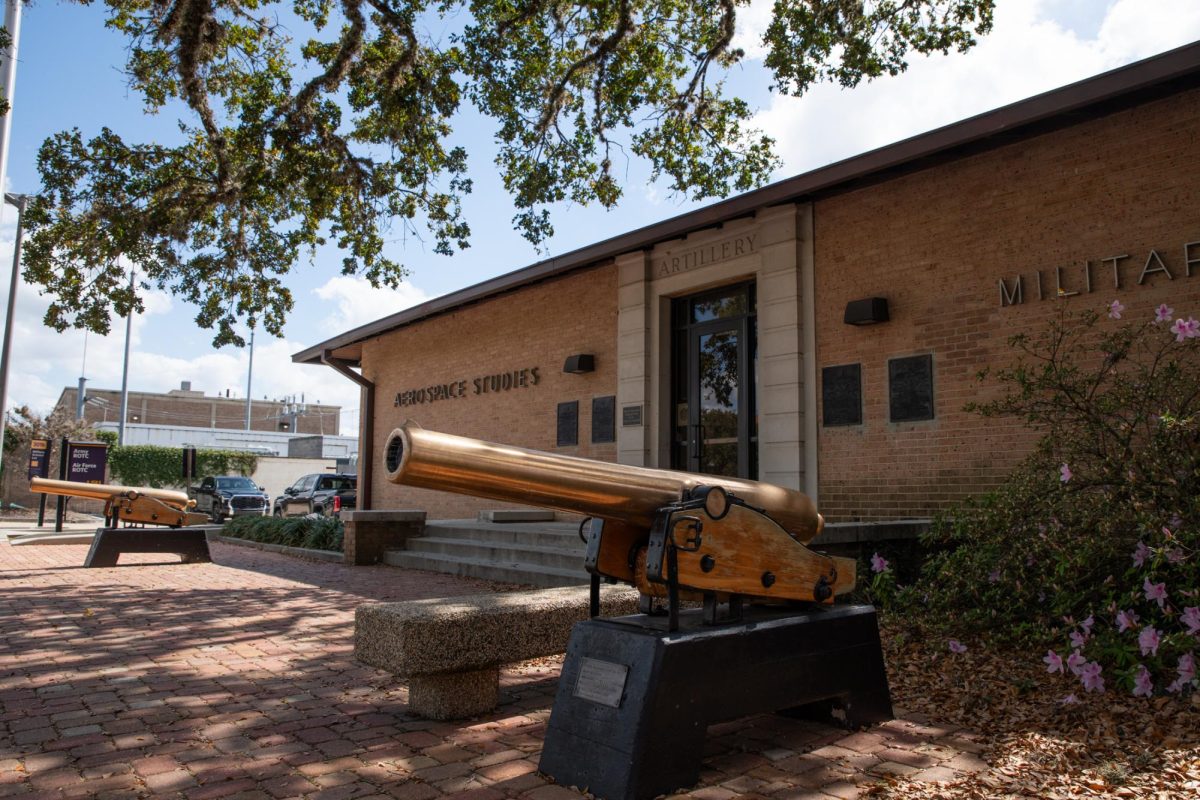
Guarding the entrance to the LSU Military Science Building are two bronze cannons, which, according to their plaques, once saw action in the Civil War.
The story goes that these cannons were used to fire upon enemy ships at Fort Sumter before eventually making their way to LSU’s campus as a gift from Union General William T. Sherman.
However, according to historians, this is almost certainly a work of fiction.
“There’s a story on the cannons that is wrong,” said Paul Hoffman, retired professor emeritus of history at LSU, who wrote the university’s history. “They were supposedly used to fire on Fort Sumter. Well, that’s not true.”
The cannons are in fact genuine 19th-century artifacts: 14-pounder James Rifles, cast in Massachusetts by the Ames Manufacturing Company in 1861. But their connection to the siege of Fort Sumter does not hold up.
Hoffman’s research points instead to a more mundane origin. The cannons were likely purchased in the early 1870s by David F. Boyd, then superintendent of LSU, for use in cadet training or display.
Fort Sumter, the coastal fortress in South Carolina, was bombarded in April 1861 in one of the opening engagements of the Civil War. The artillery used there typically consisted of larger, longer-range guns designed for siege warfare.
“These are field artillery,” Hoffman explained. “You bring soldiers into battle with them, shooting at short range.”
While Sherman did serve as superintendent of LSU, then called the Louisiana Seminary of Learning and Military Academy, there is no clear documentary evidence that he donated the cannons.
Instead, Hoffman said Boyd may have intentionally obscured their origin.
“He sort of fudged the question of where they came from,” Hoffman said, noting that Boyd sometimes credited acquisitions to “a friend of LSU,” a phrase that could have been interpreted as suggesting Sherman donated the cannons.
At the time, LSU was struggling for funding, and Boyd frequently used his own money to buy equipment, attributing the gifts to anonymous donors to make the university appear more financially stable than it actually was.
“Was LSU founded to be a military school? The answer is no,” Hoffman said.
Instead, he explained, the military structure came later as a practical solution to rowdy, young LSU students.
“The idea was that these kids would be basically confined in a single building and being taught basic memory work,” Hoffman said. “So the question was, how can we maintain good order with these kids?”
From there, LSU gave students uniforms and hired officers to use drills as disciplinary tools.
“After the Civil War, it was possible to get a military officer to come and do drill,” Hoffman said. “It was a position for which LSU did not have to pay, which was an important consideration in that period.”
In the years that followed, military training became more embedded in campus life.
“They began to push for much stronger curricula in military science and discipline, and that eventually led to the creation of the ROTC acts during the period of the First World War, and after that, yeah, LSU is a military school in the sense that all freshmen and sophomores who were not physically disabled were expected to be in the Corps of Cadets or army officers,” Hoffman said.
This shift led to the use of practical training tools, including field artillery used for instruction.
“Dr. Hoffman is right about the cannon,” Barry Cowan, LSU processing archivist, wrote. “They were inaccurate and had a limited range.”
After the war, large numbers of surplus weapons were left in storage.
“It’s possible that many were sitting in warehouses and could have been gotten for free,” he said. “LSU’s cadet weapons were on loan from the War Department, and each piece had to be accounted for upon their return. That could have been the case with these cannon as well.”
LSU doctoral candidate and historian Logan Istre said the Fort Sumter story has long been contradicted by the historical record.
“Hoffman looked into them while he was writing the history of LSU,” Istre said. “The upshot is that they were not used at Fort Sumter but were purchased by David F. Boyd in the 1870s for use by the cadets.”
Istre added that the cannons have been part of LSU’s campus landscape for well over a century, and even appear in archival photographs from the university’s earlier campus.
“I know for a fact that there are some cool old pics of them from the 1890s on the old campus, where they used to sit outside the president’s house,” Istre said.
Over time, the cannons have shifted locations along with the university itself, moving from LSU’s original downtown campus to their current place along South Stadium Drive.
Today, they signify LSU’s roots as a military academy. Even without a direct link to Fort Sumter, the cannons show the ways institutions like LSU built their identity in the years of reconstruction following the Civil War.
Their real history may be less dramatic than the story etched into their plaques, but it is no less worth telling.


