
If you’ve ever turned the page of a book too quickly, you know how easy it is to accidentally rip it.
Now imagine the page belongs to a fragile document that’s thousands of years old and which, if destroyed, would be lost to history.
That’s the reality for the workers of LSU’s Hill Memorial Library digital lab, one of the leading historical record digitizers in the state. There, workers carefully handle, scan and digitize hundreds of thousands of documents per year in an effort to preserve the primary sources of the past forever.
“The things that history texts are written from are the things that we have here,” said LSU Libraries Digitization Lab Manager Gabe Harrell.
Hill Memorial Library holds LSU’s Special Collections, which is the largest special collection in Louisiana, according to LSU Libraries Interim Head of Digital Programs & Services Elisa Naquin. In 2023, the digitization lab produced 124,840 digitized images.
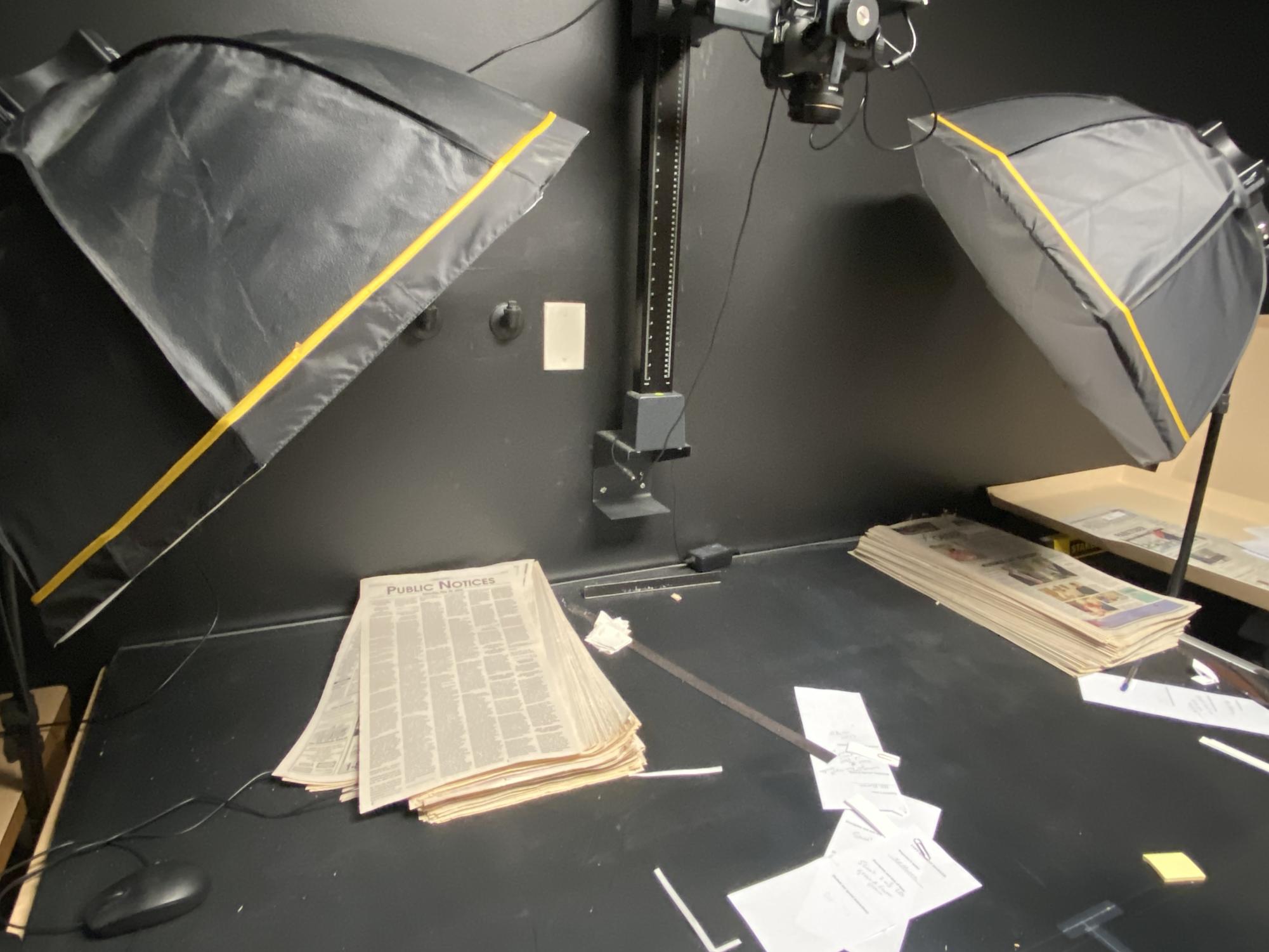
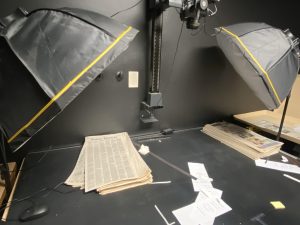
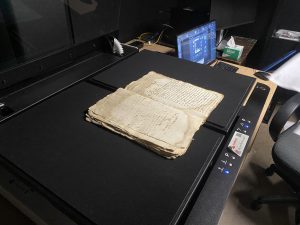
The lab is in the basement of Hill Memorial Library and holds a collection of scanners that costs more than $200,000. The walls are painted black to control color reflection during photographic scanning.
After a document is scanned, the file is run through software so the text is recognized and searchable. The image also undergoes meticulous edits like cropping, rotating, color correcting or sharpening, all of which is done manually.
The painstaking process can’t be replaced by automation, Harrell said, because each record is non-uniform. The operation requires caution, attention to detail and unwaning dedication.
“The things we do are often so irregular that automation makes it worse,” Harrell said. “Non-industrially produced paper, it’s never squared at the corners. Anything that is torn, [automation] doesn’t know how to interpret that.”
The physical records in Hill Memorial Library are stored away to avoid air and light pollutants. Still, they often deteriorate and need repair before digitization, leading to a frequent back-and-forth between the digital lab and the conservation department, headed by Conservation Coordinator Caroline Ziegler.
On Ziegler’s desk sits a colorful cross-stitch with the words “well, it depends.” The motto is apt for her line of work, she said; no deteriorating record she encounters has the same solution, and every fix is uniquely challenging.
When she first started in the conservation field as a student volunteer handling these fragile, valuable documents, Ziegler was fearful of making mistakes.
“You kind of treat it like you’re scared of it,” Ziegler said. “You handle it with kid gloves, and you’re kind of afraid to breathe on it.”
Ziegler now oversees three student workers who she helps navigate through that same fear, though they don’t do any repair work.
Records with tears, water damage, rusting and more come to Ziegler to be mended. The vast majority of Ziegler’s fixes are reversible so that potential mistakes can be undone. A tear might be fixed with paste, which is removable with water, or water damage might be solved by placing a record in a nipping press, which compresses and binds books.
Ziegler said the most nerve-racking job of her career was her reparation of a torn title page on one of John James Audubon’s famous “Birds of America” books because of the record’s significance.
The digital lab also works to digitally preserve historic newspapers, which Digitization Specialist Jennifer Michel said is a particularly sensitive task because the material is brittle and breaks down quickly, making it hard to handle and store.
LSU Libraries’ Digitizing Louisiana Newspapers Project, started in 2009, has grown to include records from 128 different papers in the state that were published between 1836 and 1922.
Even with the digital lab’s work, not every record in Hill Memorial’s extensive collection can be digitized. The priority for digitization mostly depends on research value, Harrell and Naquin said.
“If a collection is used frequently, then we know that that collection has research value to a greater number of people, so that would move it up the list,” Harrell said.
Also considered in selection is if a record is badly deteriorated and needs to be preserved before it’s too late, as well as if a record has recently become topical. For instance, when a controversy unfolded in 2020 over the namesake of Troy H. Middleton Library – now the LSU Library – because of newly discovered racist statements made by Middleton, Harrell said the lab moved to digitize records related to Middleton.
Once these pieces are digitized, many of them are housed on the Louisiana Digital Library, a website administered by LSU that has hundreds of thousands of digital records available to browse freely. Naquin said the site, a vast resource, deserves greater awareness from university students.
Naquin said the two most essential parts of the digital lab’s work are preserving these historic records for future generations and increasing access to the aspiring researchers on LSU’s campus.
“If we didn’t preserve these records, no one would,” Michel said.