In a world of video editing and soundtracks, music plays a part in our lives so large that it’s difficult to account for every melody.
The same can be said about sports; it’s hard to keep track of every recruit, every game, every win.
Yet something fans never forget is when these two worlds collide and create traditions passed down from one generation to the next. For LSU, that takes form in the popular Garth Brooks’ cover of the song “Callin’ Baton Rouge.”
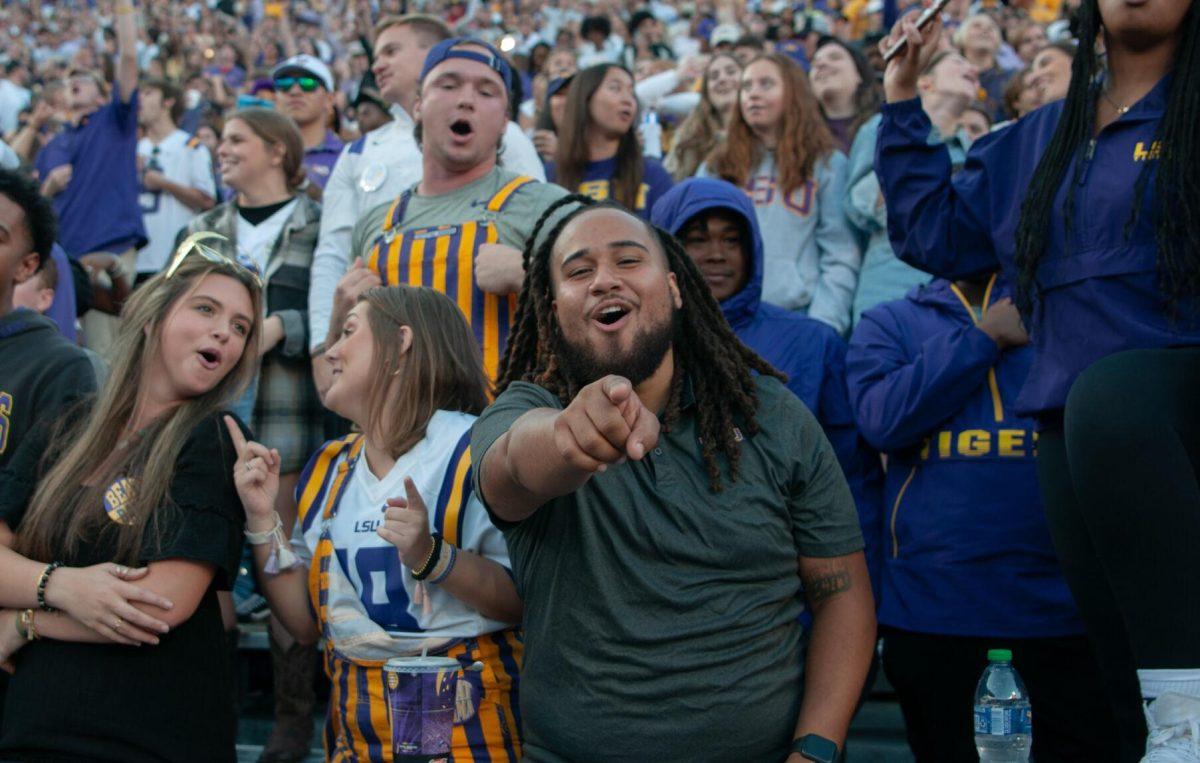
“It brings all of us together,” biological sciences sophomore Shala Hopkins said. “Whether we’re winning or losing, everybody’s gonna stand up when that song comes on.”
If you aren’t familiar with the tune, it dates back to 1978, written by Dennis Linde and later recorded by the Oak Ridge Boys. While it’s been recorded time and time again, the version that Tiger fans know and love was covered by Brooks in 1993 and has been used by LSU since the mid 2000s.
It’s played at the beginning of athletic events in promotional videos as a way to get the crowd on its feet, but if you’re in Death Valley, you’ll hear the song twice, once before kickoff and again before the start of fourth quarter.
“I tell people, ‘You don’t get it till you come here and experience it hands-on,’” political communications junior Alex Sheesley said. “I feel like everyone kind of gets in a trance where you’re letting the music guide you, and it’s really something special to be a part of.”
Yet the thrill of the song goes beyond just sports — it’s a celebration of being a part of LSU.
Sheesley shared what that means to him through a memory in which the lyrics carried themselves all the way to London while he was studying abroad this summer.
On a late-night walk back to their hotel, Sheesley found himself singing various ABBA songs to entertain his friends. Once he ran out of those, he had to think of something else.
“What other stuff will people know?” he asked himself.
Then it hit him.
“We’re all LSU students, so we all know ‘Callin’ Baton Rouge!’”
Sheesley started singing and was quickly joined by the rest of his friends, chiming in on the lyrics that most Tiger fans know by heart.
Another time fans chimed in on this celebration was in April 2022, when Brooks brought a concert attended by more than 102,000 people to Tiger Stadium, in which the movement during the iconic song registered as a small earthquake on LSU’s seismograph.
Present that night was longtime LSU football and Garth Brooks fan Dan Stringer, who described that opportunity as a “bucket list” experience.
“The stadium was in such high anticipation for him to sing that song,” Stringer said. “It was basically bursting at the seams by the time he started to play the notes for ‘Callin’ Baton Rouge.’”
Stringer also reflected on what it was like to share that moment with his family, specifically with his daughter Amelia.
“Just to let her feel the energy of LSU, that was pretty special,” he said. “I don’t think she’d ever witnessed an LSU game at that point, but that show kind of ignited her desire to go back down and see a game, and afterwards she did. I think that’s kind of what ignited her passion to experience that culture.”
Stringer regarded the song as an “anthem for LSU,” which isn’t an exaggeration.
In 2023, Louisiana senators declared the song as the “Official Welcome Song” for LSU football, legally embedding it into LSU’s culture.
The liveliness of that culture is getting ready to rise again in Death Valley as the Tigers first home football game against Louisiana Tech approaches, and students can’t wait to get back to making memories forever stitched together by Brooks’ song.
“I’m just ready for the lights,” Hopkins said. “I’m ready to feel the vibrations of the stadium when the music starts coming on. I’m ready to be hopping up and down on the stands with my friends singing these songs.”
Whether it’ll be your first time hearing “Callin’ Baton Rouge” this weekend or if it’s your first time in Death Valley, just know you’ll be joining in on something that goes beyond football, beyond music, beyond purple and gold, but within a chapter of LSU’s history.
“It’s more than a song. It’s a tradition,” Hopkins said.