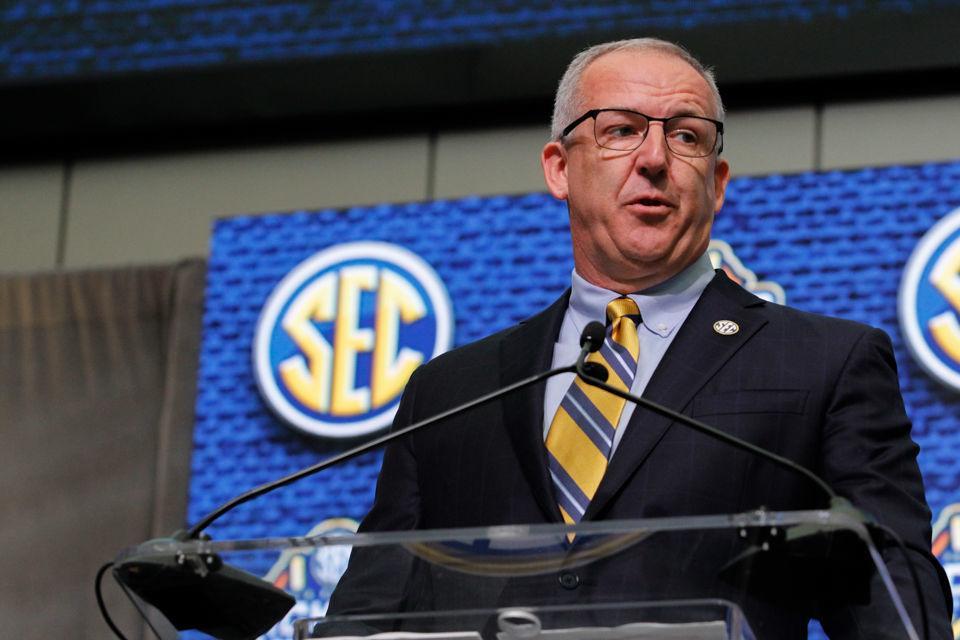
Before LSU and Alabama kicked off Saturday night, SEC commissioner Greg Sankey met with the media inside the Bryant-Denny Stadium press box, delivering one of his more revealing midseason updates.
While the questions covered a variety of topics, three central themes were the stalled College Football Playoff negotiations, the league’s crackdown on fake injuries and the SEC’s evolving approach to officiating transparency.
In a season marked by uncertainty — from roster churn to shifting national policy — Sankey’s comments offered a snapshot of where the SEC believes the sport needs clarity most.
Playoff expansion: “We agreed to 12 … now we have to see if we can change.”
Sankey’s most pointed answers came when discussing the future of the College Football Playoff.
“You were at 12 until we didn’t agree,” Sankey said. “We agreed to 12, and we got to process and see if we can change. We haven’t changed yet. Still time.”
The line “until we didn’t agree” acknowledged what has stalled progress for months: conferences remain split on format. Several leagues have floated eight and 16-team models, while others insist on automatic qualifiers or AQs. Sankey reiterated his long-held opposition.
“I’ve been amazingly consistent,” Sankey said. “I’m not a fan of AQs. We have no Group of Five representatives in the top 25 — maybe one. That’s problematic.”
Sankey emphasized that playoff expansion must be grounded in competitive legitimacy, not political compromise. He also pointed to the league’s strength to explain why the SEC is not in a hurry to adopt solutions that weaken competitive standards.
“We’re in good shape because they’re pretty good teams,” Sankey said. “A lot of football to play. It’s always this interesting month.”
It was clear that Sankey wants a format that preserves credibility, not one that protects conferences.
Fake injuries: A major problem that has finally improved
When asked about the SEC’s November 2024 memo discouraging fake injuries, Sankey offered one of his firmest assessments.
“Been much better,” Sankey said. “I don’t think we’ve seen the same kind of shenanigans as widespread and as frequent as we saw. Precipitous drop in incidences.”
But Sankey shifted quickly from officiating abuse to safety. He said the danger is not merely the manipulation of stoppages, but the creation of a culture in which players’ injuries are doubted.
“There is a player-safety issue,” Sankey said. “The notion that we would question injuries is troubling, and the notion that we would have processes that create questions about injuries is even more troubling.”
He said responsibility falls on everyone involved.
“If there’s an injury, take care of it, you can go down,” Sankey said. “If there’s not an injury, but there’s a need for a timeout, you’ve got three timeouts. Injuries aren’t the way to do it.”
His remarks suggested the SEC believes last year’s memo worked, but that deeper rules-committee work is still coming. Eliminating the incentive to fake injuries, he said, is only half the equation.
Rebuilding trust is the other.
Officiating and transparency: “The complaint box is always full … the solutions box is pretty empty.”
Sankey spent the longest stretch of his availability addressing officiating, the annual lightning rod every single season.
He rejected the idea that the league hides decisions.
“We put plays up on the screen,” Sankey said. “There are no secrets there.”
He cited a recent, centrally released explanation of a “hideout play” as proof that the SEC is not opposed to public clarity when warranted.
Sankey pushed back hard against calls for more detailed disclosure, including publishing officials’ grades.
“Do I think we should be putting grades out publicly?” Sankey said. “No. Our officials, by and large, perform at a very high level in a situation where they’re outnumbered 22 to 8.”
He said officiating is inherently reactive and that criticism often outweighs constructive feedback.
“The complaint box is always full this time of year,” Sankey said. “The solutions box is pretty empty.”
He said he has kept a running list of possible rules changes since Week 1 and that the league will continue discussing ways to communicate decisions more effectively. He noted that the SEC has even talked about using a weekly television segment to explain specific calls, though he cautioned against turning officiating into a public spectacle.
“When the camera lights turn on, I talk differently to all of you than I do when the lights are off,” Sankey said.
Altogether, Sankey was not defending the SEC. He was outlining what he believes must change next: a playoff format grounded in competitive merit, a cultural shift away from gaming injury stoppages and a realistic, responsibility-driven approach to officiating transparency.
His message was consistent. The sport works best, he said, when rules are clear, responsibilities are shared and integrity is a collective effort — not just a complaint after a close finish.