As LSU grew into the institution we know it as today, there were countless forerunners who challenged the status quo. Many of these trailblazers were women who worked hard to earn degrees, play sports and prove that women were just as capable as men.
Early trailblazers

One such pioneer was Rebecca Olivia Davis, the first female student to graduate from LSU. She applied to transfer from another institution in 1904, then finished her master’s degree and received her diploma in 1905.
According to “Thomas Boyd’s Vision: The ‘Greater University,’” Davis was initially only allowed to attend since she was older and therefore not considered a distraction to male students. Still, Davis proved that women could reach the academic standards of the institution just the same as men.
Davis’ success paved the way for the first female freshman admits. In 1906, a group of 15 to 17 women approached the university president, Thomas Boyd, and asked for the ability to study at the institution. After considerable deliberation, the women were allowed to join the incoming freshman class, with the stipulation that they would be considered “special students.”

According to the “William Wallace Garig and Family Papers,” two of these women were sisters Mercedes and Louise Garig. Mercedes, the older of the two sisters, went on to become the first female faculty member of the university in 1909. Her sister soon followed in her footsteps, with both becoming professors in the English department.
The two sisters didn’t just teach, but also worked toward bettering the subject of English as a whole. During their time as professors, Mercedes wrote the textbook “Drill in English,” while Louise wrote the books “Grading and Promotion in the Elementary School” and “Geographic Influences in Southern History.”
Mercedes and Louise proved that women were capable of teaching at the university level, creating an opening for women in a space previously closed off. The university recognized the dedication from these sisters, especially that of Louise. Shortly after her death, LSU constructed the Louise Garig Hall in her honor.
From “special students” to equal integration
Although women were allowed to attend the university, their status as “special students” prevented them from receiving the full college experience. In the 1916-1917 academic year, this would change with the creation of the dean of women role.
The first person to stand in this position was Mamie Lewis. In this role, she worked to integrate LSU and transform the university into a coeducational experience, ensuring women had access to housing and organizations on campus. This reflected the increasing population of female students, who deserved the same college experience as their male peers.
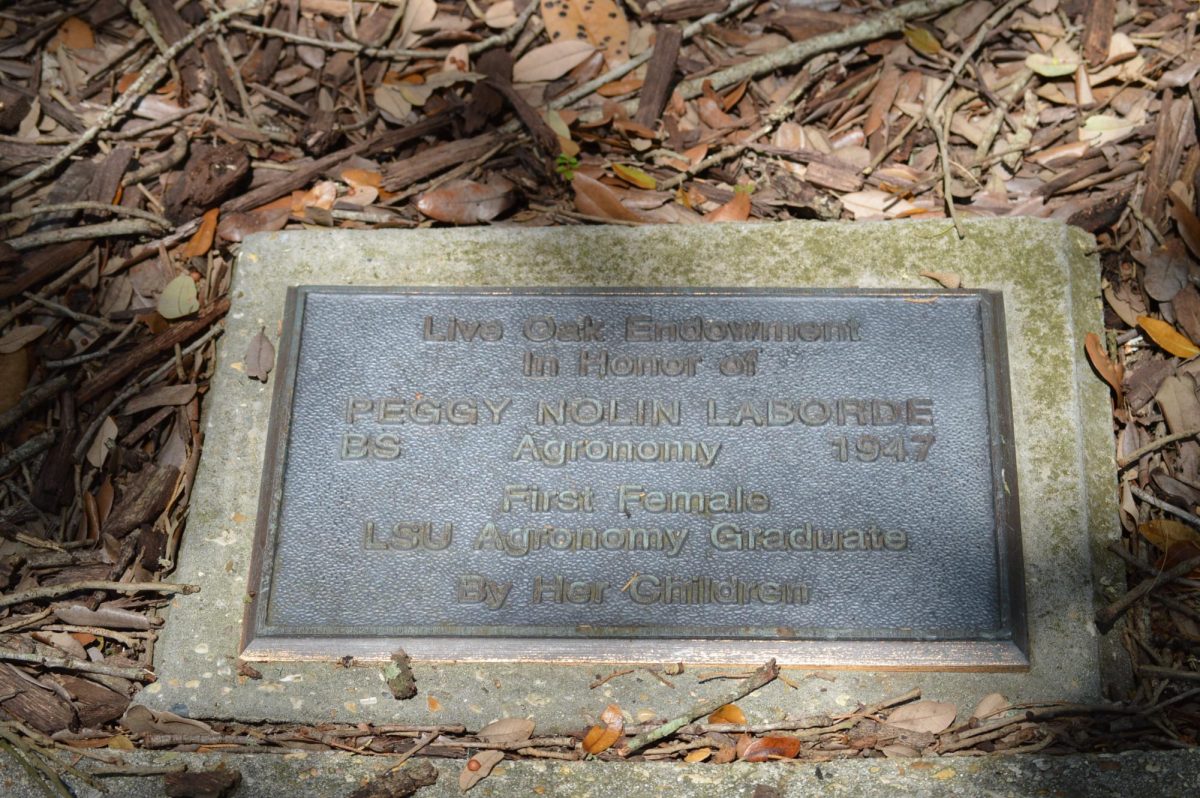
When women first began attending the university, many of them pursued a degree in home economics, where they were taught how to care for their families and homes or become good teachers. However, Peggy Laborde, a female student at LSU in the 1940s, decided to forge her own path.
Laborde was the only child of Louisiana farmers. She knew that one day it would be her job to care for her parents’ land, which led to her decision to pursue a degree in agronomy at the LSU College of Agriculture. In 1947, she became the first woman to graduate with this degree.
Laborde never ended up taking over her parents’ farm, but she still went on to lead a successful life alongside her LSU alumnus husband. The couple sponsored scholarships for the university and even set up a professorship. Their four children went on to earn their degrees from the university as well.
A fight for civil rights
In 1953, Pearl Payne, wife of LSU alumnus Lutrill Payne, became one of the first Black women to graduate with a master’s degree from the university. This feat was met with many challenges, as Payne was fighting for admittance due to both her race and gender.

To attend her classes, Payne commuted a seven hour round-trip from Natchitoches to Baton Rouge each week. She went on to earn her master’s of education from LSU, teaching for 37 years following her graduation. To honor the dedication of the Paynes, the Lutrill & Pearl Payne School of Education in the LSU College of Human Sciences and Education was named after them.
Although Payne pushed boundaries for Black women, the work was not done. To continue the battle for equal opportunities, civic activist Freya Anderson Rivers filed a lawsuit against the university to fight for the admittance of Black women into freshman classes, including herself.
Rivers gained admittance to LSU in 1964, becoming the first Black woman to enter a freshman class at the institution. During this time, she continued fighting for equality while simultaneously earning her degree. She was awarded a bachelor’s degree in general studies in 1971.
In it to win it
Although women were making headway in the area of academics, sports were still only open to the male students of the university until 1974, when the first female varsity team was formed. Under the coaching of Jinks Coleman, the women’s volleyball team set the standard for women’s athletics at LSU.

Coleman led her team to victory in their inaugural season. The hard work and dedication of the team’s players showed the university and viewers that women belonged in the sphere of college athletics, shaping the beginnings of LSU women’s sports as we know it today.
In the following year, women’s athletics expanded to include basketball, also under the coaching of Coleman. On this team was Joanette Boutte and Thelma “Pepper” McCoy, the first Black female varsity athletes at LSU. The team also had a fierce starting season, making sure people knew women’s athletics at LSU were a unit to fear.
Notably, McCoy went on to earn a doctorate at the University of Texas at Austin, becoming an adjunct professor at many universities and the founder of a nonprofit. She advocated for equality and inclusivity, ensuring women who followed in her footsteps would have equal or better opportunities than she had.
The women today shaping LSU’s tomorrow
The dedication of these women to earn equal opportunities at the university level built LSU into what it is today. Currently, LSU is home to many notable women who are working to not only continue improving the university, but the world as a whole.
Of these women is College of Engineering Dean Vicki Colvin. Appointed to the position in 2024, Colvin is currently the first female dean of this senior college. In a field typically dominated by men, she is breaking boundaries and excelling above her peers.
Colvin currently holds five patents and has published over 200 peer-reviewed articles. She has received many awards for her groundbreaking work.
In the world of sports, Kim Mulkey has created waves through her success as the head coach of the LSU women’s basketball team. Mulkey began as a player herself, taking her experience as a successful player and transforming it into a strong foundation for her leadership.
Mulkey was appointed to the head coach position in 2021. She did such extraordinary work returning the team to a force to be reckoned with that in 2022, she was named the AP National Coach of the Year for the third time in her coaching career.
In 2023, Mulkey led her team to a national championship, consistently supporting her players along the way. Many of her players have earned awards under her coaching and have gone on to have successful careers on and off the court.
These success stories are some of many. Since they began attending LSU, women have accomplished amazing feats, despite odds stacked against them. Although the university began as a place for men, it has grown into a place for all.
The incoming class of 2025 was 58.6% female students, slightly outnumbering the male students.
This stark contrast from the university’s beginnings shows that the hard work of pioneers such as Davis and the Garigs paid off. The push for equality in the academic sphere has transformed LSU into a place where diverse perspectives and voices can be seen and opportunities can be accessed.