The 1%. You may have heard of them. But who actually makes up the 1%? And why do the masses adore them?
The top earners in the U.S. who also hold 20.4% of total wealth in this country, according to Princeton Economics. Who are these top earners, you may be wondering?
You may think it’s top executives, financial professionals, entrepreneurs, investors, athletes and celebrities, when in actuality, the 1% is being driven by “owner-managers, mostly of small and medium-sized companies — specifically S corporations, partnerships, and limited liability companies.”
These companies are mostly financed by hedge funds and private equity, as shown in the Chicago Booth Review.
How were these companies able to make so much money, you may be asking?
Well, since the 1980s, income growth has favored upper-income households. Meanwhile, the U.S. middle class growth, which originally was considered the majority, shrunk. Now, most of the nation’s income goes to upper-income households.
One household in particular started me on a class crisis escapade. An influencer by the name of Becca Bloom, known by some as the queen of #RichTok — a hashtag for all things luxury and gauche — said, “Given that everyone on the East Coast right now is iced out by snow, I thought I would get myself some ice too” whilst showing off diamonds she purchased.
I couldn’t help but gawk at the audacity to even utter the words as if anyone under her tax bracket would find that funny or even charming. Then, I remembered they most likely wouldn’t even care and instead would flood her comment section with “I love when rich people rich right.”
What is “riching right?” According to The Billionaire Playbook: India’s Elite Who Are ‘Riching Right’,” it is an internet term “dedicated to the ultra-wealthy who don’t just hoard their billions but spend them with taste, purpose, and flair.”
The spending is more on luxury items that display sophistication, style, purpose, and philanthropy rather than loud, flamboyant and flashy items that show how much you really care.
I couldn’t help but be reminded of “quiet luxury” and the ongoing battle between old money versus new money. There is intrigue in individuals consuming goods in an inconspicuous manner without logos or symbols to communicate status in a more understated manner.
As the topic started to bridge a gap, I ended up in the old moneyversus new money debate. Old money chooses to convey status horizontally, amongst peers, and new money needs to signal their status. All of these terms bring me to a question. No matter whether it’s new or old money, why do we praise the wealthy?
Writer and editor Lewis Lapham once said, “What’s valued is wealth. And what we pretend to value is virtue. The more heavily we value wealth, the more ostentatiously we pretend to virtue.”
I believe this, among other traits, is why the rich are seen as an aspiration and an inspiration. If they worked for it, then they are hardworking Americans, the examples of why the “American Dream” can and still works, and they are going to reach back and pull us all out. If they were born with it, they have access to clubs, schools, luck and handshakes you will never see, and we have to get in those rooms.
Then, with this attitude, you would assume the poor would be seen as individuals who were less lucky or had the odds stacked against them and shouldn’t be condemned because they couldn’t “make it.”
No. In reality, we “other” them. As Arthur C. Brooks and John A. Powell state in “America Can’t Fix Poverty Until It Stops Hating Poor People,” “Othering uses bonds of shared identity to deny empathy and a sense of belonging to others. It gives elites and dominant groups an excuse to see social problems as distant.”
We give rich people outs for why poor people are where they are. It’s common to come across comments and think pieces saying, “It’s not the rich buying twelve collectibles, it’s us” and “overconsumption core,” but wouldn’t having 15 rooms in a house be the exact same thing?
The rich then are able to turn this around on the less fortunate because we allow them to. They say “They just haven’t worked hard enough” or “they just need to stop buying coffees.”
If most entrepreneurs are a part of the 1% and instead it was made from hedge-funded companies, wouldn’t that mean they found loopholes in the system, not hard work?
Is this the goal? You’re not rich if you aren’t cheating and running people over to grow what you have?
This is how the wealthy keep others stuck, and most Americans are fine with the system being this way because of exceptionalism and a commitment to capitalism. It was once a belief that communism wouldn’t be able to take root in America because of how hard we hold on to capitalism.
As Matt Stoller states in “When American Capitalism Meant Equality,” “the conventional wisdom of American markets as a force for equality and against aristocracy represents a long-standing trend, not necessarily of economic equality but of the self-perception that economic equality among citizens was foundational to the American experiment.”
This is why Americans are so committed to it; they believe that though the beliefs have changed for the worse, and have placed corporations in the driver’s seat, to want change would be going against the foundation of America. And it’s just not true, it may have been a priority before, but it’s just not now.
American Exceptionalism, according to Johannes Thimm, in “American Exceptionalism – Conceptual Thoughts and Empirical Evidence,” “is the widely held belief in the U.S. that its values and institutions are the best yet devised, the conviction that the world needs to adapt itself to American ways rather than vice versa.”
It tries to cover up anything wrong you may think about this country by reminding you that this is the best it could ever be, because no other nation is better than this one. You may have seen firsthand that this is not the truth, and with ideologies like this one, you keep people from thinking for themselves, therefore wanting change.
We won’t fix the wealth gap in the United States by praising the wealthy for giving poor people scraps, and we won’t get it by aspiring to be them. We have to realize the amount of money they have is too much, and they won’t even out the playing fields if they don’t have to. We have to do our part to destroy the “American Dream” mindset and forge a new path for wealth equality for everyone, because we won’t get it with what we’re doing now.
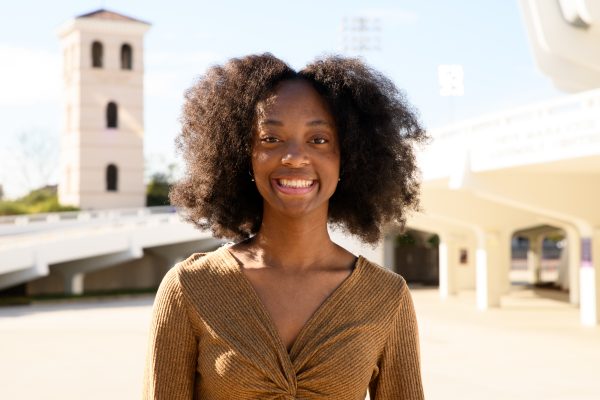
Michaiah Stephens is a 22-year-old English major from Durham, N.C.