Louisiana is known for its rich mix of cultures, each with its own traditions and practices. Holidays are no different, and every town has its own traditions rooted in history to celebrate these special days.
One such holiday is Easter. The differences in celebration span all the way to through the observance of Lent, a practice in many Christian denominations.
Lent is a 40-day fasting period that ends on what is known as Holy Thursday. Those who participate fast in many different ways. For example, some people only give up meat on Fridays, while others give up meat altogether. Some even continue fasting into Good Friday.
According to Erin Segura, the LSU Louisiana French program director, one superstition that many people believed to be true on Good Friday was the abstinence from any sort of labor, including cooking.
This meant that meals on Good Friday needed to be prepared ahead of time, a difficult feat before the advent of refrigerators. To solve this problem, pies entered the picture.
“People made pies because a sweet pie, like a fruit pie, has a lot of sugar in it,” Segura said. “So that would act as a preservative. It would stay good overnight on the counter.”

These pies also helped the people participate in their fast, since some believed only one meal was allowed each day through Lent.
“Their thought process was as long as they didn’t really stop eating pie, they could eat the pie as long as they wanted to over the course of the day, and it still counted as just one meal,” Segura said.
This led to the birth of Pie Day, a celebration that is most often observed in Scott and Catahoula, Louisiana.
In Scott, the tradition is upheld by the Begnaud family, which has hosted the event for over 15 years now. The family members bake every pie themselves on Holy Thursday, each slice eaten on tableware.
“They don’t eat on disposable stuff,” Segura said. “There’s constantly a few people in the kitchen washing dishes because people are just sort of in and out all day eating pie.”
Guests are welcome throughout the day, but any pie they bring as a gift is not served. The Begnaud family prides itself on its ability to serve the community.
In Catahoula, the tradition differs, with anyone who participates in the day welcome to bring a homemade pie to share with everyone. The pies here are sometimes not as sweet, with dishes like crawfish pie making their way into the mix. Although not as extravagant, it is still a tradition that has survived throughout the years.
Pies served at Pie Day events are typically sweet dough pies, a dessert that originates from southern Louisiana. Sweet dough pies vary from family to family, with recipes passed through generations. It is a cross between sugar cookies and pie crust, making for a soft and sweet casing for fruit or custard fillings.
Besides pie, many families in Louisiana celebrate the ending of the fast with a final major seafood boil of the season, diving into crawfish, crabs and shrimp all through the day. In a way, these boils work in the same way as the pies, with trays filled throughout the day serving as one technical meal.
However, some families ensure that they catch their crawfish on Holy Thursday, as one superstition states that the ground should not be broken on Good Friday. This includes disturbing the bottom of ponds, stirring up silt and mud.

“There’s this superstition that blood can come out of the earth on Good Friday, and it’s like the blood of Jesus,” Segura said.
In some towns, this superstition is highly regarded, with some believing the breaking of ground will lead to themselves getting injured on Good Friday.
This superstition goes hand in hand with the abstinence of labor, meaning people cannot garden or farm for food. People must instead complete all preparations for Good Friday on Holy Thursday.
At the close of Good Friday begins the preparations for Easter Sunday, with meals to be prepped and eggs to be dyed.
A tradition that some still celebrate on Easter is the pâqueing, also known as pocking or knocking, of eggs. The game derives from French settlers, as the word Pâques in French means Easter.
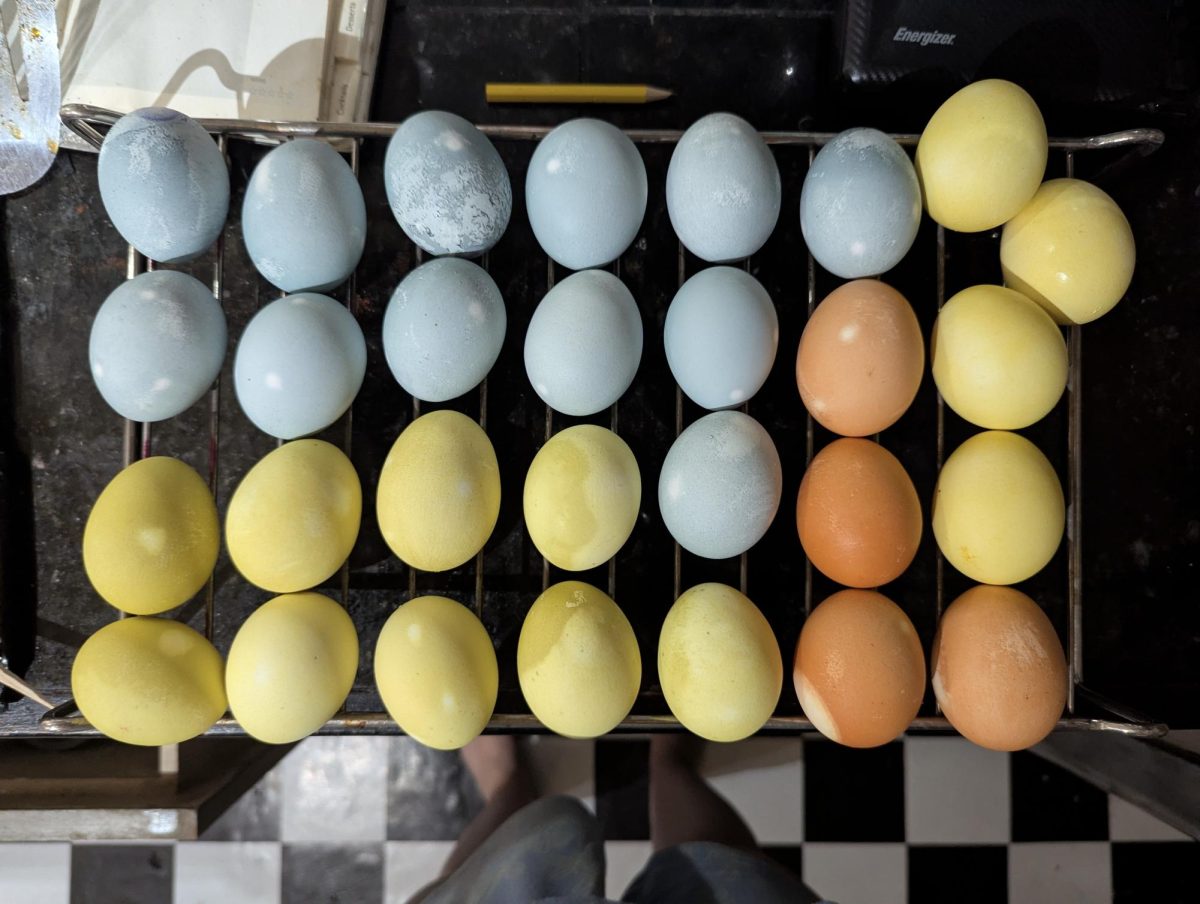
People first hand dye their eggs, which was traditionally done with natural materials. Segura shared this with her class, dyeing the eggs for her students to try the game.
“I used purple cabbage, which makes blue eggs,” Segura said. “Tumeric makes yellow eggs, and then if you mix the two, you get green eggs. Onion skins make orange eggs… Somebody told me certain kinds of fabric when you boil it will bleed out dye, and so they would take old clothes and boil the clothes to get dye.”
Once the eggs are dyed a variety of colors, the game commences.
The rules are simple. Two players each take an egg, with the pointed end of the egg facing upward. One person then takes the point of their egg and taps it to the point of the other egg. After a couple of brisk taps, one egg will break. The person whose egg does not break wins, sometimes keeping both eggs.
With large groups, the game works in a tournament style, with winners continuing to play until their egg breaks. The last person left with an unbroken egg is the overall winner. This person either wins all the eggs or some other prize.
One town that still hosts a community egg knocking tournament is Marksville, Louisiana. The town holds the tournament annually, bringing the community together in a celebration of both Easter and sportsmanship.
Although other towns participate in this tradition as well, it is not seen in many places around the state that were settled by people from places other than France. Regardless of where a person is from, they are welcome to join in the game and have some fun.

The word “Pâques” is pronounced similarly to the word “park.” This similarity is rumored to be how the village of Parks, Louisiana, got its name.
Kyle Crosby, the creator of the history-focused Louisiana Dread social media channels, explained how a simple language barrier may have led to the complete renaming of an entire settlement.
“It was an American that had arrived via railroad and would have said, ‘Where are we? What stop is this?’” Crosby said. “And whoever heard them say that obviously didn’t understand English as much as they understood French. So they were like, ‘C’est Pâques,’ [meaning] ‘It’s Easter.’”
From then on, the town was called Parks, or so the story goes. Whether fact or fiction, this tale shows how different cultures have changed Louisiana over time, turning it into the place we know today.
The biggest tradition seen on Easter is the breaking of Lenten fasts. Families get together and celebrate with meals filled with a variety of meats. In Louisiana, you can often find pig roasts serving up food for friends and family.
Although not specific to the state, you can find many families hosting Easter egg hunts, giving out Easter baskets and enjoying a day of celebration with their loved ones.
The traditions of Louisiana have survived through generations, passed down from loved ones. Without continued participation, they become history rather than a yearly affair. With so much of Louisiana’s Cajun French culture dying over the years, it is important to keep traditions alive.
If you are looking for a way to spice up your holiday, try one of these cultural customs. It might just become a family tradition.