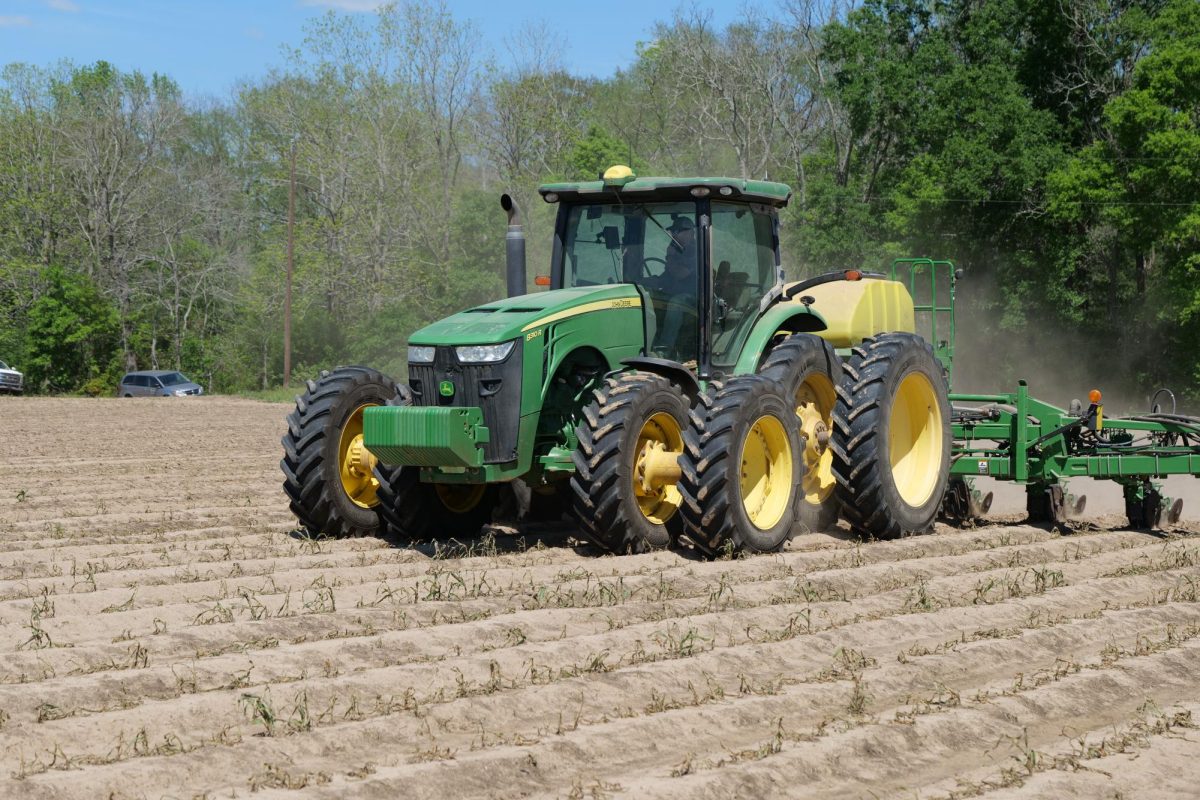
Planting season for several major row crops in Louisiana including rice, corn, cotton and soybeans is underway.
Campus crop specialists serve as the main point of contact between the LSU AgCenter and Louisiana crop industries.
Tyler Musgrove, the AgCenter’s rice extension specialist, explained that this year’s warm and dry winter allowed rice farmers to plant early. Musgrove said Louisiana usually experiences more rainfall in February, preventing farmers from getting an early start.
In south Louisiana, rice planting usually takes place from mid-March to mid-April. This year, Musgrove said some farmers started planting as early as the end of February.
He said south Louisiana produces 90% of the state’s rice, but north Louisiana produces some too. Rice planting in the southern part of the state wrapped up last march, but farmers in northern areas are still planting, Musgrove explained.
Musgrove said the cost of producing rice this year is at a record high, so some farmers are avoiding planting it. He predicts that there will be about 50,000 less rice acres in the state this year than last year.
HE added that north Louisiana’s farming practices contribute to the variability of rice yield. Unlike farmers in south Louisiana, northern farmers do not rotate rice with crawfish, allowing them a wider variety of crops.
Musgrove said the first rice harvest lasts from July to August. He pointed out that Louisiana is different from other states because farmers here harvest rice twice a year.
He said harvesting the first crop by mid-August allows the crop to regrow. Farmers can harvest again in October or November.
“For a lot of producers, that second crop is what gets them across the finish line financially, especially if they’re not going to crawfish the field that year,” Musgrove said.
The dry weather helped rice farmers, but it did not help cotton farmers. This is because cotton requires good soil moisture.
Shelly Kerns, the AgCenter’s corn and cotton extension specialist, said the cotton planting window started off dry, but should pick up as rain comes in.
Kerns received the earliest reports of cotton planting in the state last week. Most of the cotton harvest will happen in October.
She also explained that corn planting in Louisiana got off to a rough start this year.
Corn farmers usually begin planting in late February or early March. Kerns said some farmers planted before Louisiana experienced a freeze mid-March. Many farmers had to replant their acres.
Kerns said corn planting is finished now but could have been finished one or two weeks earlier if it were not for the replant acres. The farmers will begin harvesting the corn in August.
Some corn farmers who lost acres to the freeze decided to replant with soybeans instead of corn. Soybeans are also major row crop in Louisiana.
According to a report from Craig Gautreaux, the AgCenter’s communication specialist, soybean prices have increased but so have input costs. Therefore, it is important for farmers to maximize yields.
Timely planting maximizes yields. Louisiana soybean farmers are approaching the end of the ideal planting window, and soybeans planted in May will not yield as much.
Jill Trepanier, a professor and chair of the Geography & Anthropology department, said that all major threats for plants regarding cold should be over, but there might be some drought concerns from the recent dry weather.
“Seasonality is changing just a little bit, and it is very much related to when farmers should or shouldn’t plant certain things,” Trepanier said. “And the last date of freezing and when things set in is a little different now than it was 50 years ago.”
Trepanier also has expertise in hurricane climatology. She emphasized that hurricane season is next. She said the latest forecasts are slightly below normal.
Last year, Louisiana experienced almost nothing during the season. She thinks two years of that is unlikely.
“I don’t anticipate a big year, but I still think one year of not getting any might lead to people being like, ‘Oh, we’re okay.’ But no, always be ready for hurricane season,” Trepanier warned.