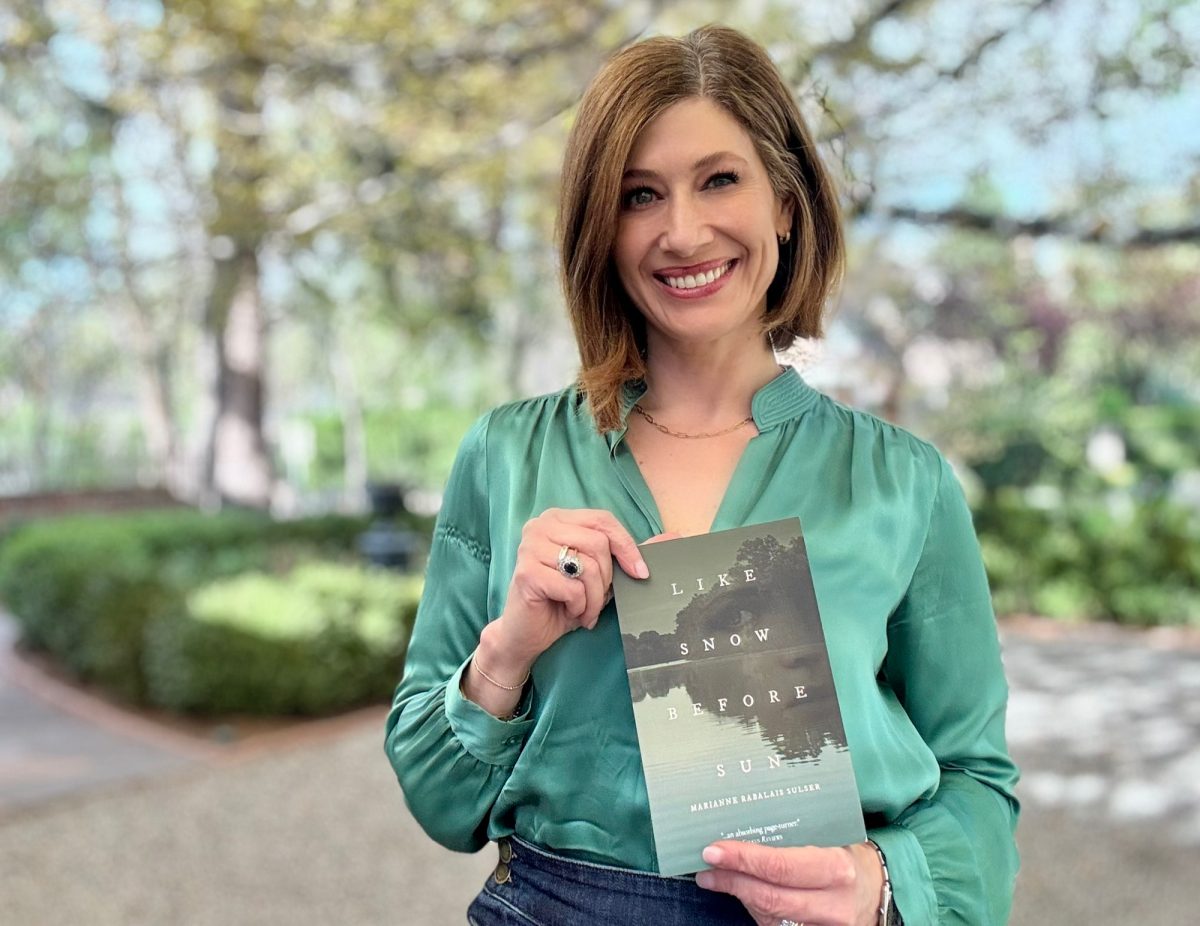
LSU alumna and author Marianne Rabalais Sulser reflects on her road of research and storytelling journey ahead of her debut novel that releases June 9.
Set in Acadia, 1755, “Like Snow Before Sun” follows Jeanne LeJeune, a young, mixed-race woman born to a French Acadian merchant and a Mi’kmaw woman. After the arrest of her father, Jeanne embarks on a journey to free him from English soldiers.
The novel centers around the historical period about Great Britain’s forced removal of Acadians from the North American region, and Sulser described Jeanne as having an immense amount of animosity toward the British because of this political occupation.
With that animosity comes an even greater outcry in Jeanne’s outspokenness, more so than what was deemed lady-like at that point in time.
Sulser explained how the character’s identity as clever and headstrong puts her on the path she takes in the novel, which forces her to also rely on a British soldier for help. She must reckon who she is as a person and what she must do for the country and people she loves.
While her novel’s release is set for the coming summer, Sulser’s writing process for the book began during the COVID-19 pandemic lockdown, and she finished the story just three years ago.
After setting up her children on their virtual learning, she would sit down and write as undisturbed as she possibly could, with only her husband checking in to offer any food or drinks.
She began with research before actually putting pen to paper, which was both the most enriching and difficult part of tying the story together.
“I did a lot of research, then basically wrote this book,” Sulser said. “And then I had some research questions that I had to go back and answer, and it caused me to have to rewrite about a quarter of the book because I wanted the book to be as historically accurate as possible.”
Sulser said the most fascinating part during her research was reading about the day-to-day life of the Acadian people, from working with inadequate farming tools to being diligent in not encroaching on Indigenous hunting grounds. She highlighted how these everyday details are what major history books tend to leave out.
In reading about the smaller details, Sulser also challenged herself to see more of the bigger picture of history — what is true regarding historical assumptions and how many areas of life are affected.
“What we’re taught or what we learned in our history classes is such an oversimplification of what history really was,” Sulser said. “It was very eye opening to come and to learn differently.”
Sulser explained how she always wanted to write a story as a child, as she had a love for historical fiction, and the research she completed made her think about certain aspects that would work well as scenes.
Before her research, she first learned about the forced expulsion of the Acadians when she was about 10 years old, and she remembered it as simplified in comparison to when her research for her novel itself began. In learning about the story at such a young age, it pushed her to look closer.
“When you’re looking back hundreds of years, there are very few records, so you’re just sort of piecing stuff together based on baptism records or marriage records,” Sulser said. “As I kept going farther and farther back, I realized what was happening, that they were being persecuted and basically pushed out of these areas.”
Sulser also graduated from the Manship School of Mass Communication during her time as an LSU undergraduate student and then went on to graduate from the Paul M. Hebert Law Center.
Sulser was then a corporate defense lawyer for many years before writing her novel. During that time, she accumulated an exceptional amount of experience in writing. She said that as a lawyer, one was able to exercise her brain through calculating arguments in defense of her clients, but it was not feeding her soul.
Sulser determined that fiction writing filled that gap. She believes it is never too early or too late to start. For Sulser, it is even more crucial for people to start writing, even if there is only a sliver of an idea in their head.
“Being open to what that evolves into is sometimes the best course of action,” Sulser said. “Sometimes you don’t know what you don’t know, and you know you’re starting to do research, it might open you to new possibilities.”