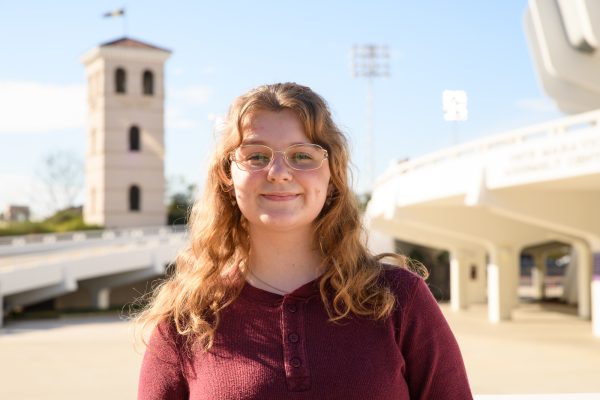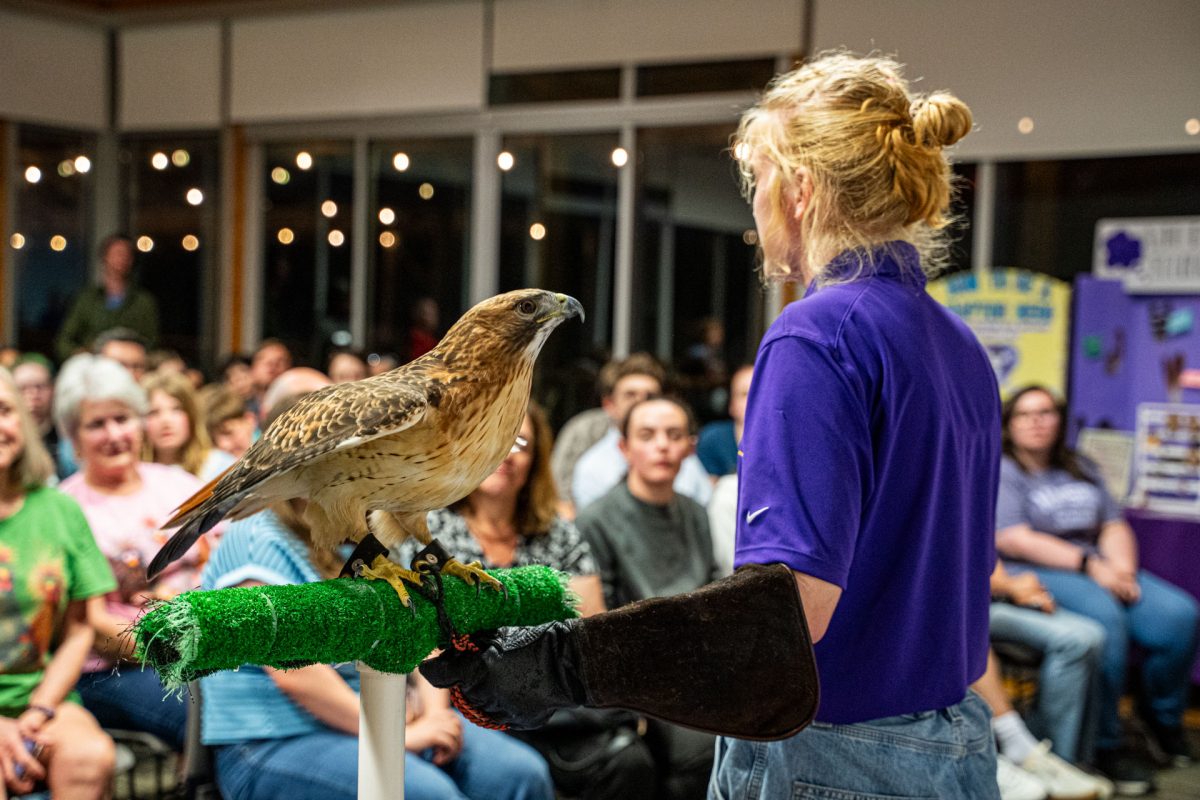
The LSU Raptor Rehabilitation Team visited the LSU Hilltop Arboretum, bringing the Baton Rouge community a close-up view on the relationships between wildlife health and community health.
The team visited on March 24 from 6:30 to 8 p.m. for the Hilltop Arboretum’s monthly Discover Nature program The visit featured a lecture, appearances from the LSU bird ambassadors and a fundraising sale to raise money for the new wildlife hospital expected to come to the LSU School of Veterinary Medicine.
During the lecture, Professor of Zoological Medicine Dr. Mark Mitchell spoke about the importance of wildlife rehabilitation and how research on animal health can directly impact human health.
“We have to make sure we continue to protect the environment and our wildlife,” Mitchell said. “And while there’s lots of talk about protecting the environment, I’d like to repeat, if our wildlife fails, we as a species can potentially fail.”
This connection can be seen in the effects of a species becoming endangered or going extinct. One example Mitchell focused on was the loss of owl species, which typically prey on mice and rats. When owls eat these rodents, which can carry dangerous diseases, it controls the rodent populations, lessening the chances of the diseases spreading.
“I read about the 1500s and the Black Death and all that,” said Mitchell. “I’m good without the Black Death, OK? I want to stay where it’s a little bit nicer.”
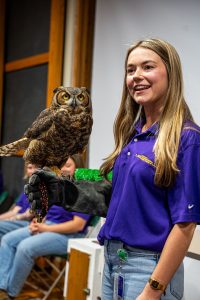
To reinforce the concepts Mitchell spoke about, members of the LSU Raptor Rehabilitation Team presented some of their bird ambassadors. Of the 13 members on the team, six students were in attendance.
The first-year LSU Vet Med students on the LSU Raptor Rehabilitation team in attendance were Emerson Lejong, Ashleigh Godke, Sarah Vielee and Anne-Marie Elser. The second-year students in attendance were Holly Casper and Abigail Gunby, who are head co-chair members.
The bird ambassadors that were presented included Marty the barn owl, Shelly the great horned owl, Bruce the red-tailed hawk and Cypress the barred owl. Each of these birds went into the Wildlife Hospital of Louisiana with injuries such as fractured bones and vision impairments, making them unsuitable for release.
These birds were all given a second chance at life from the staff at the Wildlife Hospital. Without programs like this, these birds would have struggled to survive in the wild.
Mitchell expressed the importance of getting injured wildlife to the hospital for care rather than attempting to rehabilitate the animal on one’s own. He explained the best practice is to get a blanket or towel over the bird, then place it in a container such as a cardboard box with ventilation holes cut into it.
Once birds are brought to rehabilitators, they can be assessed and a health care plan of action can be made. However, rehabilitators are few and far between in Louisiana, making it difficult to get animals into the hospital’s doors.
“This state…is a place that has one of the most diverse groups of animals in the country because we sit at the base of the largest continental flyway,” Mitchell said. “We have 13 rehabilitators across the state of Louisiana that are licensed. We need more rehabilitators and people who want to be those things.”
The biodiversity seen in Louisiana benefits the students, as they get to learn about a variety of species and how to care for them. The team at the Wildlife Hospital do everything they can to help out small animals in need of care, especially when their health issues are related to human activity.
“The goose that has the six pack around its neck, the duck that’s covered in line,” Mitchell said. “We get turtles that have three or four hooks. The U.S. Fish and Wildlife [Service] recently brought us a snapping turtle who’s estimated to be over 85 years old. He’s about 137 pounds and he has a hook that’s in him that’s probably been in there for 20 plus years.”
Even though the staff at the hospital do everything they can to help any wildlife in need, they are severely limited by the hospital’s size. Mitchell expressed that the space is just not enough. They can care for animals such as birds and opossums, but animals like the black bear are forced to be transported elsewhere for care or, in some cases, suffer in the wild with none at all.
To expand their operations and help more wildlife, the LSU School of Veterinary Medicine is looking to build a new wildlife hospital. This will not only expand the hospital’s scope of care, but also improve the students’ learning experience.
“What it actually does is it has massive opportunities for education,” Mitchell said. “These are all classrooms. This is all the working hospital. There’s glass everywhere, so people can see what’s happening in there.”
Mitchell hopes that by showing the impact the wildlife hospital has on humans, Louisiana residents will understand the importance of caring for these animals and their habitats.
For community member Skye Davidson, this talk was a learning opportunity to help educate her community at home.
“I grew up in a rural area where we sadly were taught ‘if you see a red-tailed hawk, shoot it down,’” Davidson said. “Now, if anything, this has kind of taught me to educate my family — to educate more rural members — and be like, ‘this is not the problem.’”
For LSU alumna Emma Fair, this event expanded her knowledge of conservation and better positioned her to push others to get into the field and work towards a more sustainable environment.
“Both our environment and our wildlife play a huge part in our Earth’s health and our own health,” Fair said. “So, conservation in general, I wish more people would research it. I wish more people would look into it and actually dig a little deeper because they would see that there’s a lot that could be done that isn’t being done.”
The Friends of Hilltop Arboretum President Colette Dean enjoyed the opportunity to host the team and bring this education opportunity to community members. This event is one of the many hosted at the arboretum, with the goal of promoting the organization’s mission at the forefront of each one.
“We’re just here for the community,” Dean said. “So many people drive by us on Highland Road and they see the sign and they don’t really know too much of what it is. So, it’s really thrilling to me tonight.”
Learning about wildlife conservation and wildlife rehabilitation practices is good for community members, but telling others about it is what really makes these education opportunities succeed.
“When you come up to this arboretum, you learn about it,” Mitchell said. “The idea is, don’t hold on to that information for yourself. Get out there and share that with others. Get others interested because that’s how you protect these things.”
Those looking to attend future events like this one at the Hilltop Arboretum can visit its website or social media accounts for more information.
If you would like to support the building of the new hospital for the LSU School of Veterinary Medicine, you can donate by visiting https://www.lsu.edu/vetmed/giving.