The long-anticipated Emerald Fennell adaptation of “Wuthering Heights” has finally hit theaters. Is it a love story for the ages or another misguided outing?
Paul’s review
The original novel is one of my favorites. I will try not to talk about the book in relation to the movie, but this review would be incomplete without comparing the two. It is a gripping and tragic story of trauma, abuse and how they manifest in interpersonal relationships, whether they be romantic or familial. Through this story, Emily Brontë also expertly touches on themes of race, class, love and death. With how explicit and bleak the depictions were, it was quite a controversial book at the time of its publishing.
An 1848 edition of Graham’s Magazine said, “How a human being could have attempted such a book as the present without committing suicide before he had finished a dozen chapters, is a mystery.”
Controversy appears to be Emerald Fennell’s M.O. At least, she desperately wants it to be. Even at her best, “Promising Young Woman” proves incredibly shallow with the ultimate message being that the main character should leave justice in the hands of the same system that failed her friend.
Her sophomore outing, “Saltburn,” delved deeper into bad writing and weird politics. Although, most of the conversation surrounding this film was more concerned with the pretty cinematography and shock value moments. Premium style over substance.
Fennell’s “Wuthering Heights” is only different in the sense that it is much worse than both of these films.
What works for me is what has worked in pretty much every Emerald Fennell film thus far: it looks really good. Thank God for cinematographer Linus Sandgren; if it were not for him, this movie would have suffered greatly.
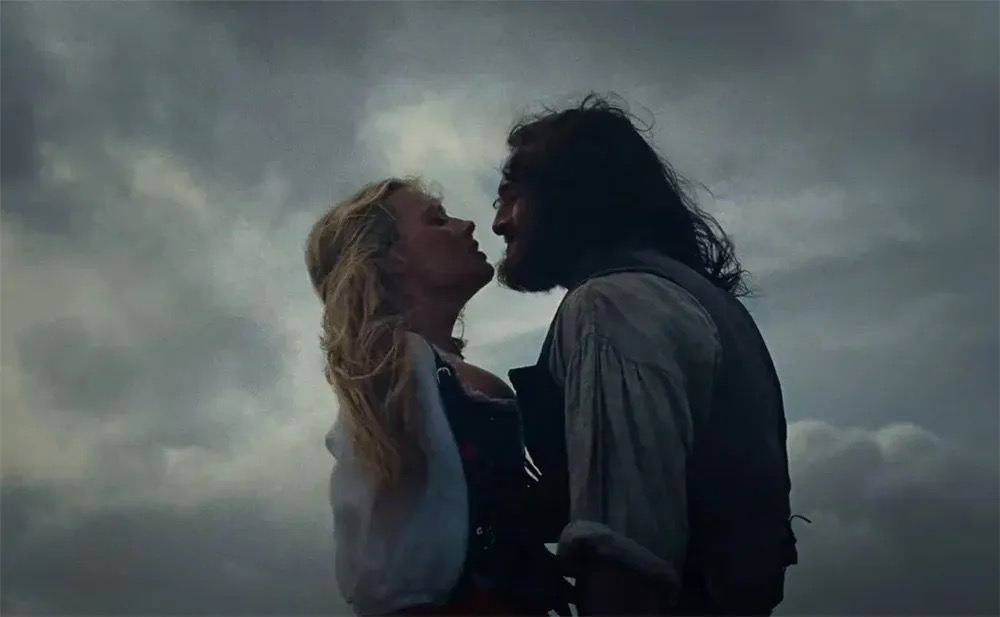
Every shot is so rich with texture and color that it feels like the scene is popping out of the screen. One of the best sequences in the movies is when Jacob Elordi’s Heathcliff is leaving after hearing Margot Robbie’s Cathy say that it would degrade her to marry him. What follows is a dream-like sequence of Elordi escaping against a blood red sky as Robbie sobs on a checkered floor, her red dress spilling across the tiles.
When the story passes into more wintery imagery, it is striking. Blues and oranges fight for dominance when Cathy leaves the warmth of Thrushcross Grange to meet Heathcliff outside in the cold darkness of the snow. We might have lost Greig Fraser for “Dune: Part Three,” but Sandgren will do just fine.
I also appreciate the ridiculously anachronistic and excessive production design. Everything is larger than life, from the houses to the strawberries. The building of Wuthering Heights is this garish, obsidian black house that is so sleek and out of place that it looks plastic. To drive home the point of how cold and oppressive the residents feel there with the abusive Mr. Earnshaw, it is surrounded by this over-the-top jagged rock formation.
For the first half of the movie, this is enough to keep it afloat in spite of the flaws. It feels like Fennell’s absurd setup might just work with what appears to be a subversive story intertwining sex and death.
Along with many other departures from the source material, the very beginning shows a public hanging being cheered on by children and adults alike. The eventual twitching end of the hanged man is celebrated by the couples of the crowd spontaneously engaging in sexual acts across the town square. As we go on, though, it becomes clearer that Fennell will not do anything with this.
Time to address the elephant in the room: the casting. All of the slander surrounding Jacob Elordi’s casting is understandable. It is unfortunate that in the nearly 100 years of “Wuthering Heights” adaptations, we only get one non-white actor in a role that is explicitly racially ambiguous. This aspect of his character is integral to the story, and it loses a lot of depth when you remove that.
To be fair, I do not trust Fennell to handle that story with any care or nuance. And even if this movie’s Heathcliff was played by a more accurate actor, that would not be enough to save the script.
Fennell being at fault is the only explanation why Elordi and Robbie are uncharacteristically terrible in this. I expect to hear a slide whistle or a “well, that just happened” after every line read. It genuinely feels like a parody. These are both actors who have shown that they know how to act well, so why are they so stilted? Why do they have no chemistry? Why does it feel like they are on autopilot this whole film?
In one of the most poignant moments of the book, Heathcliff lashes out in anguish upon seeing Cathy dead postpartum. The prose is beautiful and the display is tragic; it is one of the most iconic moments of the book. Fennell knows this and it is why parts of it are used in the marketing, such as the “drive me mad” tagline.
It could be the less-than-stellar performances. It could also be the lack of chemistry throughout. It could even be Fennell’s poor directing and writing. Whether for one or all of these reasons, this moment rang hollow in the film.
Very little of Cathy and Heathcliff’s relationship is believable. Owen Cooper and Charlotte Mellington work wonders getting you to buy into young Cathy and Heathcliff’s dependence on each other. As soon as we transition into adulthood, it just feels off. Especially when the story begins to boil their relationship down to sex.
I am not here to say that movies should avoid being sexy. Far from it. The unending discourse of people whining that sex scenes in movies are unnecessary is childish. The problem with “Wuthering Heights” is that it is not sexy.
This film was marketed as a sort of deviant sexual thriller that would have you clutching your pearls. Maybe this would have been true if the film came out the same year the book did. I have no idea why Fennell believes that putting fingers in someone’s mouth is the freakiest thing ever, but she has to get a new thing stat.
Most of the sex that does happen is pretty tame or offscreen. Part of why it feels so sexless is that much of the pent-up desire between the two leads is superficial. If you want these star-crossed lovers to feel tragic, you cannot have a full-on montage of their sexual escapades. There is nothing to yearn for when Cathy and Heathcliff essentially have a whole relationship, even if it is tied up in infidelity.
It is more or less sexy for people who just figured out what sex is.
The sole moment I would consider sexually transgressive is the one that is the most distasteful in relation to the book. I know I should not keep comparing the two, but it is inescapable how Fennell adapts Isabella Linton.
Alison Oliver as Isabella Linton leans in to the feelings of parody tenfold. For the most part, I was enjoying her transformation of Isabella into the weird, geeky younger sibling who falls for the mysterious brooder. Her performance is honestly the only one I can appreciate. However, how her story plays out in the latter half of the film annoys me immensely.
In the book, Isabella is smitten with Heathcliff. She eventually marries him and moves to the Heights, where she endures untold levels of physical and mental abuse. It is a triumph that she is able to escape into London with her life. This was a bold move by Brontë in a time where marriage was seen through the lens of property.
Fennell boldly changes this dynamic by making “abuse” Isabella’s kink. She is chained up to the wall, acting like a dog, but this situation is in service of her and Heathcliff’s roleplay. The abuse found in the book is virtually nonexistent. Why make Isabella a layered character that exudes agency and defies the horrid system she lives in when we can have her engage in puppy play as a plot device?
As a whole, the second act falls apart at the seams. Once again, Fennell attempts to do something interesting or stylistic but crumbles under her hubris as a writer. If the first half of the movie feels like parody, the second half becomes what she is parodying. It is “Wuthering Heights” by the way of Colleen Hoover. The story hits all the notes of the typical dark romance while still trying to adapt the book.
This second half exemplifies the ultimate crime of this adaptation: it is flat-out boring. Save for the way she handles Isabella Linton, nothing in this film is that controversial or transgressive. What is the point of stirring the pot when there is nothing to stir?
I expected to have a stronger reaction to this film, but I find myself feeling more underwhelmed by the day. For a romance, it is not romantic. For a drama, it is unbearably dull. For a sexually explicit reinterpretation, it plays it frustratingly safe.
Emerald Fennell’s “Wuthering Heights” helped me realize how much potential she has as a filmmaker. Yet, the only way it seems she will succeed on that front is by hiring a new writer. I cannot recommend this to anybody unless they are morbidly curious. The best parts of this film work as a music video for the admittedly great soundtrack, and nothing else.
Paul’s score: 2.5/10
Sarah’s review
Compared to most, I walked into Wuthering Heights with an open mind, heart and high expectations for Emerald Fennell’s third feature film. Though I am very aware it is a controversial take, I loved this film for everything that it is, despite its inaccuracies.
I feel as if those who revere the text so highly are so blinded by their need for accuracy that they miss what this adaptation is trying to do. And whether or not you like what Fennell has done with the text, no one could ever say it was uninteresting or uninspired.
Fennell’s is not an adaptation. Rather, it’s an impression of her mind and style onto a centuries old text. The film, in its own way, gave a perfect metaphor for how it functions. Isabella Linton, the sister-in-law of Cathy has a dollhouse in the film. She creates miniature versions of everyone in the house, and she creates her own imaginary fantasy of everyone in the home.
“Wuthering Heights” is an imagined fantasy for not just the director, but also its intended audience. To the chagrin of many fans of the novel, Fennell plays a lot with ideas of sex, but she also looks at ideas of class, female identity and gender relations.
What intrigues me the most about the text is what this film says about modern Western women, their fantasies and how they deal with identity through period pieces. I could spend all day talking about how this film tells Cathy’s story through costumes and set.
The weight of poverty and the need to survive is a prevailing theme in the story, and Catherine’s need to marry and the lack of agency over her identity are present. The costumes are used incredibly well to distinguish not only Cathy’s rise in class, but the constraints, emotional and physical, that are placed upon her once she is separated from Heathcliff.
When images for the costumes originally dropped, I was put off. As a costume designer who loves history and the way fashion communicates, I was quite skeptical, but I warmed up to it. There is such an eccentricity to the pieces, and knowing that this film leans toward a stylistic surrealism, I’ve slowly become a fan — except for that extraordinarily odd bouquet dress.
But I think that is part of the true charm and character of the film. “Wuthering Heights” has such a specific style that works well, leaning toward a surrealist and impressionist way of moving.
There is just something about Catherine and Heathcliff’s relationship that is so enveloping. Whether we are talking about the book or the film, the couple’s semi-codependent emotional relationship in the book, and the forbidden attraction in the film, is enticing.
In the book, Catherine says, “He’s more myself than I am. Whatever our souls are made of, his and mine are the same.” There is just something so alluring, albeit unhealthy, about their relationship and how connected they are.
Emerald Fennell shifts the way their relationship works by adding in a sexual affair, but it still allows the story to be interesting. There is great pining in the film, but not with the same insanity and intensity the book has.
Speaking of the style, the set design is beautiful and thought out. Going back to the idea of the dollhouse and control, the way the set is for the Wuthering Heights estate and Thrushcross Grange is so intriguing, and they communicate the tone of the storytelling well. The cinematography is excellent, bringing the dark air of the book to screen. With sprawling shots of the haunted landscape and great camera work, there is something truly enthralling about this film.
This interpretation is quite separate from the original book, removing and shifting characters in monumental ways. Heathcliff is miles less vengeful and violent compared to the book, and Cathy feels like somewhat of a caricature at times. The wild child and bratty nature described at the beginning of the book is all that appears, missing the caring lady she grew to be by her end.
My greatest criticism may be the shift in personality for many of the characters and the loss of depth for others. And yet, I can understand where they were going.
There is something compelling about “Wuthering Heights” as a text; these horribly mean, lonely and violent people reenacting abuse and terror in such a haunted place. To see how modern women and creatives translate it to their own lives, experiences and tastes will always have some worth to me.
“Wuthering Heights” as a film misses quite a few of the themes of the original book, but brings its own. With countless other adaptations accessible to the public, Emerald Fennell created something incredibly distinct.
I would be remiss not to mention one of the best features of the film, which was the sound design and the music. I got the chance to see “Wuthering Heights” in a Dolby Cinema, and to experience that level of sound quality is stunning.
Charli XCX created an album in conjunction with the film, with her song “House” making rounds on social media. After the monumental success that was the “Brat” album, Charli shifted to a new challenge of bringing a book’s themes and characters to music. But in her own way, Charli created an incredible soundscape that brought the haunting tone of the book to life.
Though I did read the book — and I have a long history with classics and gothic media — I am not as attached to the original text as others. The shift from the original text is odd, but I enjoyed myself, and it was an interesting take. So, whether or not you love the book, if you’re looking for something to really transport you to a different world, take the leap and watch “Wuthering Heights.”
If there is one thing true about me and how I interact with art, it is that how a piece makes me feel becomes the most important thing. With all things, time will tell how art holds up. Maybe I’ll change my mind, and maybe the world will soften to Fennell’s vision.
At the end of the day, creativity won. Emerald Fennell’s “Wuthering Heights” is a beautifully stylized piece that may be a hypersexualized ideological misstep, but honestly, I love seeing women in men’s fields.
Sarah’s score: 8/10