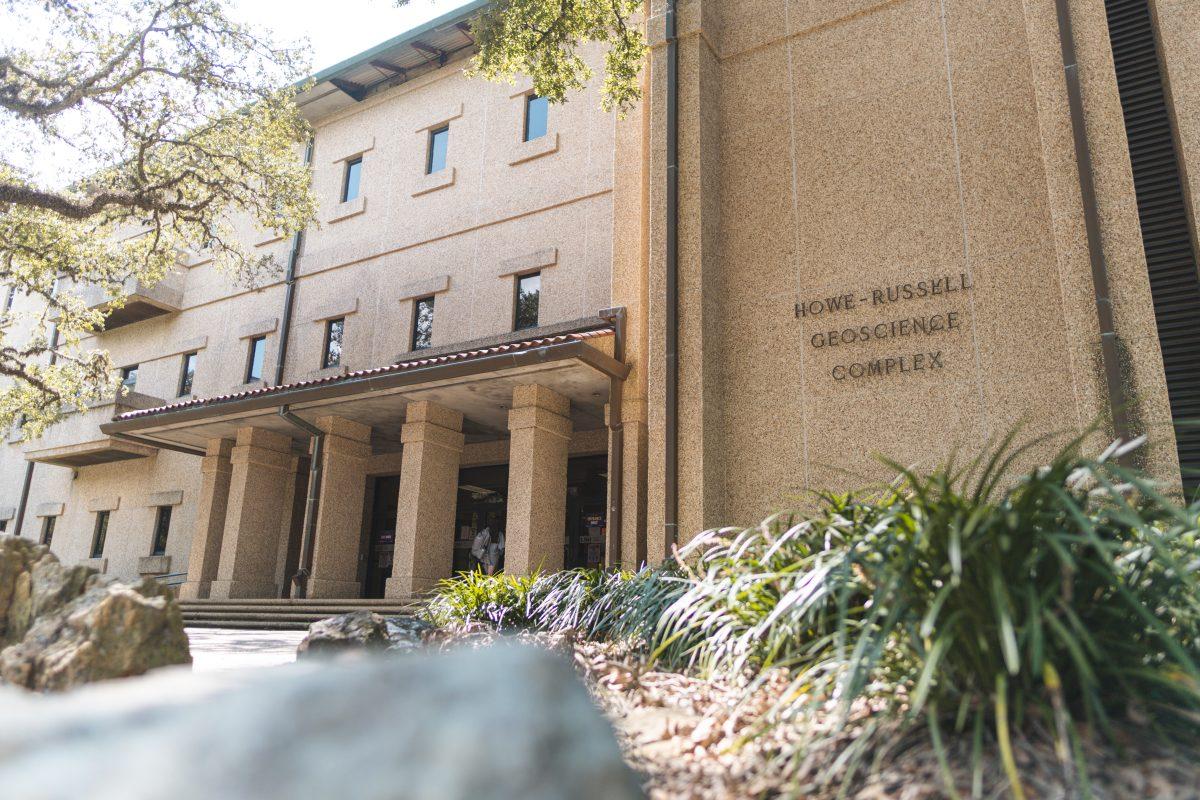
Two LSU researchers applied two major software upgrades to the school’s scanning electron microscope, opening the doors to further geological research and information.
Brandon Shuck and Erini Poulaki are the two researchers who helped gather the $26,000 for the upgraded AZtec software, a program that improved the microscope’s ability to collect energy-dispersive X-ray spectroscopy data and electron backscatter diffraction data. Both Shuck and Poulaki are researchers in the geology department at LSU.
EDS is a term for elemental analysis that fires a beam of electrons, causing the elements to emit characteristic X-rays, while EBSD analyzes the internal crystal structure of grains of elements.
“Electrons hit the sample, and then the electrons are reflected on the sample and onto the EBSD detector,” Poulaki said. “Then these scatter the electrons, hitting the sample and reading it by the plate on the detector. They have very specific patterns. They have a funny name: they’re called Kikuchi Bands.”
The researchers are able to extrapolate how mineral crystals are oriented in the samples, telling them how a sample could be misaligned or possibly even deformed.
Poulaki said they’ll be happy to be able to use the microscope for their research and to share usage with the engineering departments.
“The microscope, so far, was used mostly by engineers,” Poulaki said. “They only look at metals that are very homogenous… For our materials, because we look at very heterogeneous rocks that have a lot of different minerals and their spatial extent within it is really important for us, we needed a way to collect this data, these elemental and deformation data on a very large area.”
The machinery itself hasn’t changed. The upgrades are purely software-based, and now the geology department can have a better understanding of what elements are in each of their samples. The researchers said it was a much-needed upgrade.
“It sounds trivial,” Shuck said. “Like, ‘Oh, it’s just software. But this is, the software that’s running, the acquisition, collecting the data and processing it, I mean, it was a very expensive piece of software. It’s not like you just need to download some tiny upgrade or something.”
At first, they reached out to the company who owns AZtec, Oxford Instruments, thinking that acquiring the software would only cost a few thousand dollars. But learning all the data collection and processing it does, the researchers quickly learned that the upgrades would come at a hefty price.
The microscope can now create a clean processed map of a large area of a heterogeneous mineral, a task that would have been impossible before the upgrades.
“If we didn’t have this software upgrade, you would have to sit there the entire 24 hours manually, basically move it yourself, you collect it and then you would have to stitch it together, which pretty much wouldn’t work,” Shuck said.
In order to get funding for these upgrades, Shuck had to write a proposal to the LSU Board of Regents. He asked for the Board to siphon money from the equipment repair fund, which covered a bulk of the cost of the software, along with a generous number of funds from both the geology and geophysics departments.
The electron microscope has gone from a specialty piece of equipment with very few practical applications to being able to process, study and collect data every day.
“For the geoscience department, it was basically a fancy piece of equipment that we couldn’t really use for our research applications,” Shuck said. “Now with this investment, it unlocks a lot of cool research potential. So yeah, I guess it’s just cool to highlight that LSU is investing in these sorts of things and is able to help us in the research programs succeed.”