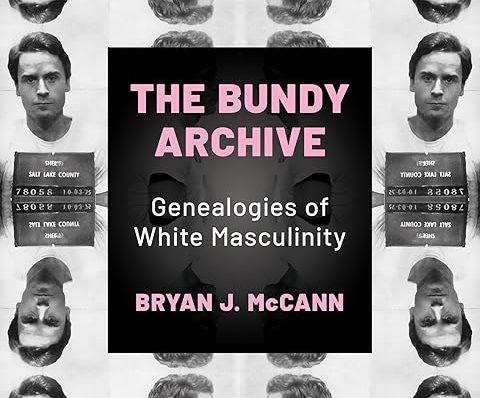
In his new book, this LSU professor connected the dots on how culture shaped Ted Bundy’s murderous rampage.
Bryan McCann, professor and chair of the Department of Communication Studies, released “The Bundy Archive: Genealogies of White Masculinity” this year. The book delves into how the allure Bundy had on the public may be tied to his familiarity to American culture.
“The surprising thing about Ted Bundy was actually not how strange he was, but was how ordinary he was,” McCann said.
McCann first became interested in the intersection of culture, politics, crime and society while studying in Illinois for his master’s degree. He noted the effect that 9/11 and the decision by former Illinois Gov. George Ryan to commute all death sentences in the state at the time had on his studies.
Although he described himself as having always been interested in pop culture and communication, his studies combined his interests with issues surrounding the criminal justice system.
“I found myself fascinated with the emotional intensity of those topics that tended to limit the public’s capacity for critical engagement with them,” McCann said.
Six years after becoming a professor at LSU, McCann began working on his Bundy project after noticing the excitement serial killer topics would bring to his classes.
He started to ask the question, “What does this tell us about ourselves that serial killers are so ambiguous and persistent?”
The start of this project also coincided with the 30th anniversary of Bundy’s execution. McCann said as old media related to the case resurfaces, new media such as “Extremely Wicked, Shockingly Evil and Vile,” a movie starring Zac Efron as Bundy, gets created.
He continued his critical and interpretive work for seven years before publishing. By applying conceptual frameworks to cultural artifacts, such as the trending movies or top songs at the time of Bundy’s murders, McCann began to understand why Bundy is so compelling in American culture.
“At a base level, we have this guy who is obsessed with violently processing and controlling women; and unfortunately, that is not that weird or out of the ordinary in our culture,” McCann said.
McCann also took a different approach to his recent publication by understanding how his personal experiences relate to bigger concepts related to Bundy.
As McCann’s arguments on culture and community grew, the book began to take shape.
“The critical sensibility of white masculinity became a good way to make sense of Ted Bundy as a cultural phenomenon,” McCann said. “But, Ted Bundy also became a good way to make sense of white masculinity and my own experiences with it.”
McCann acknowledges that he is not the first person to write a book on a serial killer, but that’s the point.
“The idea is that multiple people can bring unique insights into something to in turn help us better understand us as a culture,” said McCann.
McCann encourages students to develop their own insights through the classes he teaches on campus including Crime, Communication and Culture; Serial Killers and U.S. Culture; and Rhetoric of Social Movements.
His classes focused on serial killers have been a campus favorite amongst students of all majors, including Rhys Borders, an anthropology graduate.
“His class was an amazing application of academic study into everyday life and the things we take for granted,” Borders said. “The crux of the class, to me at least, was how the most vagrant, deviant or monstrous people of our society are a direct reflection of what we consider normativity.”
McCann said that everyone can learn critical thinking skills from the coursework and discussions that take place, as well as enter the many rabbit holes of American culture.
“The majority of my classes go best when people are enthusiastic to just show up twice a week and geek out,” McCann said. “My favorite part of my job is getting to just sit in a room with people and getting kind of weird, talking about big topics in interesting ways.”
Isabel Willems, a communication studies graduate, explained that she got the most out of McCann’s serial killer course by engaging in student discussions. She said that these conversations allowed her to develop her own ideas on topics and get feedback from her peers.
“If we understand the communicative devices integral to the mythologizing of criminals, victims and crimes, we can have much more nuanced, helpful discussions about them,” Willems said.