As LSU’s enrollment swells, the university has made a conscious push to expand its campus with modern facilities that accommodate its growing student body.
Construction on LSU’s new Interdisciplinary Science Building has concluded, with furniture now moved in and classes beginning in the fall, planning officials said.
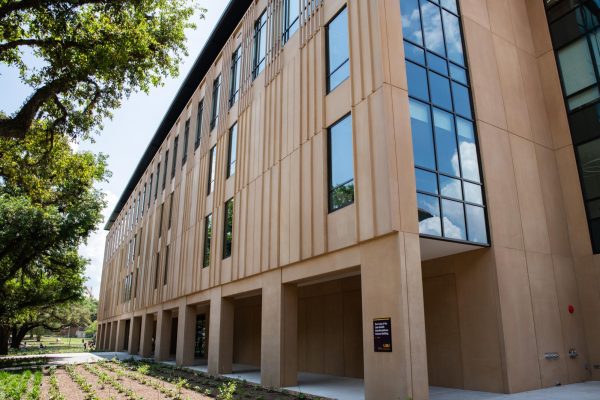
In December, LSU broke ground on $215 million South Quad dorms that will house over 1,200 students. A new library to replace the oft-criticized LSU Library, built in 1958, is also coming. The list doesn’t end there.
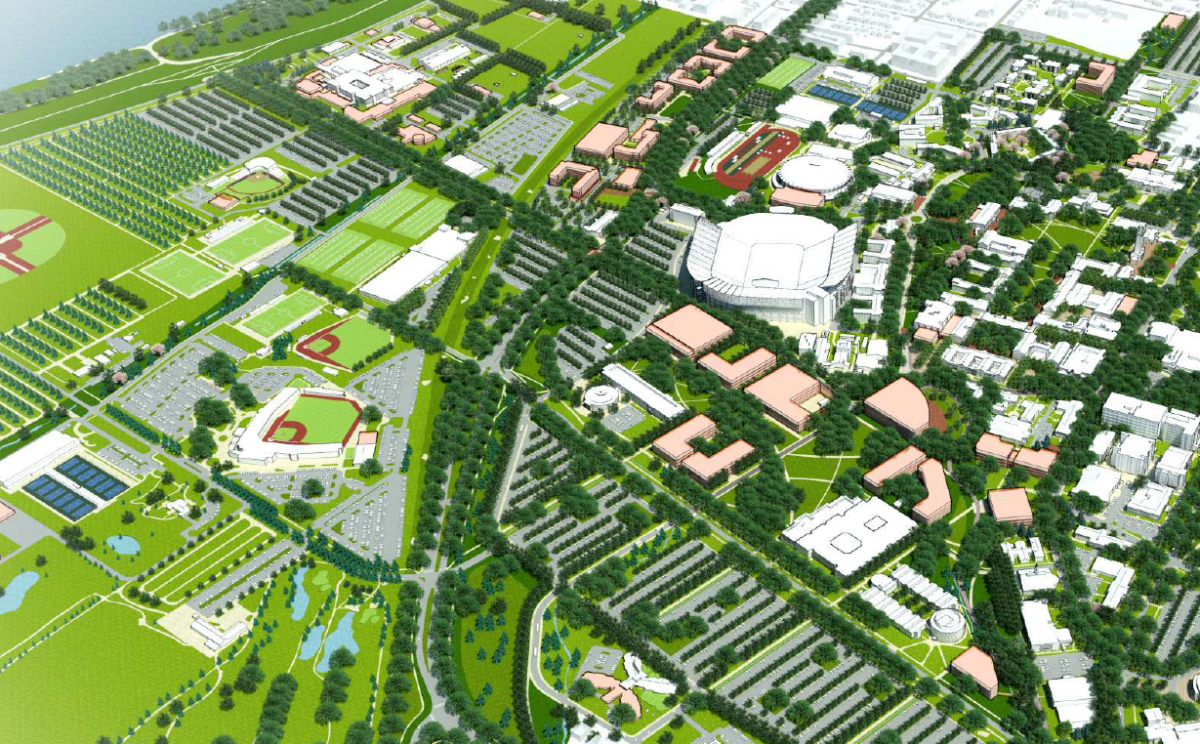
The expansion is being done with the guiding hand of LSU’s Master Plan, written in 2017. It’s a document that proposed sweeping changes to align LSU’s campus more closely with its academic priorities and make it more pedestrian-friendly.
Among those changes is a phasing out of parking from LSU’s central campus with the goal of eventually making LSU’s core nearly car-free.
Years later, campus planning officials are still progressing on that same plan. Here’s where it stands.
The Master Plan
The Master Plan was formulated through a lengthy process of consulting with different stakeholder groups, said Tammy Millican, the executive director of facilities and property oversight.
Millican, who’s worked at LSU since 1997, was the chair of the Master Plan’s facilitation committee and organized town hall meetings and other outreach initiatives.
“It’s never been about one person’s voice,” Millican said.
The result was a 163-page document meant to stand the test of time and chart LSU’s path forward as its campus evolved. Officials call it a “living document.”
“It’s not a snapshot of 10 years ago. It’s current,” said Dennis Mitchell, LSU’s landscape architect and assistant director of campus planning. “We are changing, modifying, updating daily this plan.”
A main focus of the Master Plan is creating a secondary Quad to account for the increasingly large segment of the LSU population that spends its day in the southern part of campus.
Patrick F. Taylor Hall and the Business Education Center house students in two of LSU’s most populous senior colleges, and the Interdisciplinary Science Building and the new library will add to the number of students in the area.
The proposed South Quad would be located directly to the west of Patrick F. Taylor Hall between South Stadium and South Quad drives.
The Master Plan will also restore the original Quad to its historic state, taking the shape of a cross with the future demolition of the LSU Library.
Tureaud and Lockett halls are also eventually slated to be demolished to make room for Master Plan changes.
Effects on parking
However, what will likely be one of the Master Plan’s most controversial impacts will be its effects on parking. Parking has long been a point of frustration for students on campus, and commuter permits are becoming more scarce. LSU Parking & Transportation told the Reveille in October it anticipated selling around 1,500 fewer commuter passes this year compared to last year.
Campus officials, though, believe there’s plenty of parking — just not close to campus.
“There’s enough parking for everybody on campus,” Mitchell said. “What we don’t have is convenient parking for everyone.”
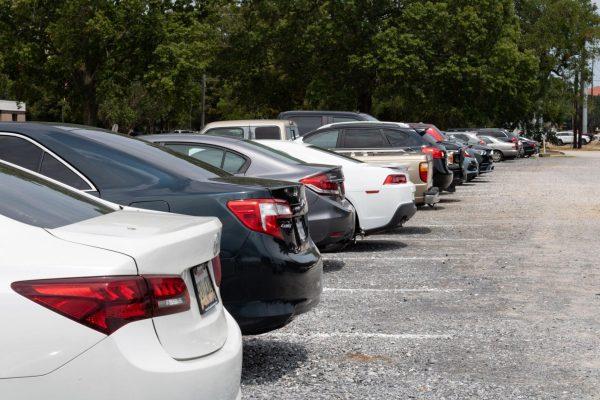
According to the Master Plan, LSU has significantly more parking spots per affiliate than other universities of similar size.
In 2017, LSU’s numbers indicated that 45% of its parking spots — 14,000 spaces in total — were unused at peak times. Numbers compiled by Parking & Transportation in 2023 indicated that LSU has over 40 parking lots with at least 40% of their spaces available at peak time.
Still, student and faculty parking frustrations remain, and more changes could exacerbate the issue. The Master Plan intends to turn the majority of parking spots within LSU’s gates into green space and plazas and remove some street parking for bike lanes.
Planning officials don’t believe the solution is parking garages, which in theory could add parking spaces without encroaching on more land. Parking garages were included in the original 2017 Master Plan.
However, it costs an estimated $5,000 per vehicle to build a parking lot compared to around $25,000 to $30,000 per vehicle to build a parking garage, said former Director of Campus Planning Greg LaCour, who retired in January. That price would likely be passed onto students through more expensive permits, LaCour added, making it an unrealistic solution.
That’s why, according to officials, LSU’s Park & Geaux system is the key to the Master Plan. The shuttle system makes it feasible to park in the readily available parking on the outskirts of campus and “efficiently get to campus,” Mitchell said.
Mitchell said moving parking spaces is a course correction from past mistakes in campus planning.
“What happened in the 1980s is that there was a different philosophy, which was, every green space possible, let’s park every possible space,” Mitchell said. “The planning was not good … The decision was knee jerk.”
Mitchell also said future students will adjust to the parking system once it becomes the norm. The 2005 Master Plan, he said, instituted LSU’s roadway gate entrances to limit the number of cars on central campus. That, too, faced opposition but is now accepted, Mitchell said.
Mitchell also emphasized the focus is on moving and modifying parking, not eliminating it. That was something LSU did for the South Quad Dorms that broke ground in December; though the dorms are being constructed on one of LSU’s largest commuter lots, Mitchell said that after LSU added more parking spots elsewhere, the net loss was just 14 spaces.
What’s coming up
One of the next steps for the Master Plan is the completion of the Mobility Hub in the Park & Geaux lot.
The hub, which will be open in the fall, will provide a central location for students to comfortably wait for Park & Geaux buses. It will also allow for buses to make just one quick stop instead of driving all through the parking lot.
Many students complain about the wait times between Park & Geaux buses. Mitchell said the amount of buses could increase based on demand.
Another existing issue for the Park & Geaux lots is the lack of shade covering the walk to campus. Officials said they’re looking at how they can make that walk more feasible for pedestrians, whether by adding trees, moving the walkway or another method.
After the hub is completed, the next step would be to convert the Park & Geaux lots to hard surface limestone parking, Mitchell said, which would add some spaces. The new lots would also include trees for shade.
LSU officials estimate construction on the new library and a proposed construction management building would both begin in spring 2027, with the library taking about two years and the construction management building taking about 18 to 24 months.
It’s necessary the process be gradual, Mitchell said, especially because some of the projects must first require the demolition of Tureaud and Lockett halls, which will take time. Those buildings are also two of the most commonly used for classes, meaning LSU must add more classrooms elsewhere before it can move forward.
Campus Architect Danny Mahaffey said LSU is hoping to do another official update on the Master Plan in the next year or so. The timelines for many of these changes, however, are unsettled.
“We know about when things would happen, but it all depends on money,” Mahaffey said. “When we get funding, then we can take the next step. If we had a billion dollars, we could do a lot of that right now.”
Another complicating factor is shifting university leadership. The Master Plan was formulated under former LSU President F. King Alexander and survived without major changes under President William Tate IV. Now, new President Wade Rousse has taken over.
Rousse had not been named president at the time the Reveille spoke with planning officials. They said the next president would of course have his say on the Master Plan and the university’s priorities but expressed confidence that the Master Plan had staying power.
“The purpose of a master plan is not to have one person’s vision, right?” Mitchell said. “That would fail because that person is going to work for us for a while and then move on to another university, and then we’re stuck with that person’s vision.”