The Reveille sat down with LSU Interim President Matt Lee for an exclusive interview. The following article and all quotes within it come from that interview.
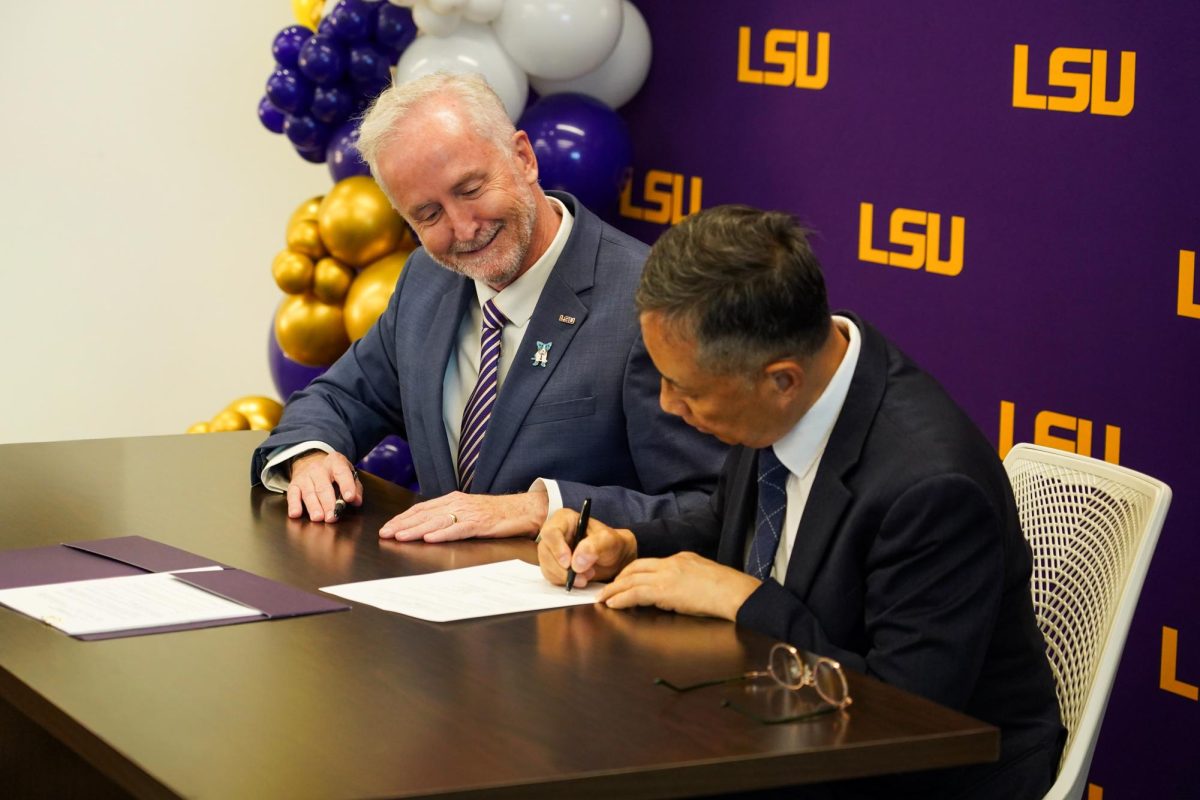
LSU Interim President Matt Lee moved into his new office two days ago.
After it was announced in May that former president William Tate IV would depart to take on the presidential role at Rutgers, Lee was the man chosen to lead Louisiana’s flagship university. He started the job, which he described as an “intimidating ask,” on Monday, his first day moved up a month from the original timeline of July 1.
Lee’s tenure is just five days in, as evidenced by his office, which is mostly bare aside from a few pieces of furniture and the quintessential LSU “win” bar.
“We’re here to win,” Lee said, pointing to the bar.
Much of his first few days, Lee said, has consisted of him reaching out to major stakeholders and assuring them that LSU won’t slow down with him at the helm.
“Even though we’re in a period of transition, we have stability. We have continuity,” Lee said. “The overall momentum and direction of everything we’re doing is going to remain stable.”
Lee also dispelled the misconception that, as an interim, he won’t have much of a say on major LSU decisions.
“People who haven’t had experience in these matters often feel like, well, the interim person shouldn’t really be making decisions,” Lee said. “That’s just not the way it works… I’ve become more comfortable with the understanding that you can’t really hesitate because you start losing momentum.”
Lee has plenty of experience holding an interim position, having been named the interim provost in 2021 and the interim vice president of agriculture and dean of the College of Agriculture in 2022 before he earned the permanent job.
As the agriculture dean, Lee stepped into a role in which he had little familiarity – his background is in sociology, in which he earned a master’s and Ph.D. at LSU. He said the “very intensive learning curve” he underwent will aid him as he makes another leap to the role of interim president.
“The thing you learn very quickly is you have to be a listener,” Lee said of his time as agriculture dean. “You have to respect the experts you have around you and lean on them and listen to their thoughts as they help inform your decision-making.”
As Lee’s tenure begins, LSU will soon engage in an aggressive national search for its next university president. A search committee will be announced, and LSU Board of Supervisors chairman Scott Ballard estimated the process could take roughly six months, the Louisiana Illuminator reported.
Lee declined to indicate if he’d pursue the permanent presidential position when the search begins.
“I’m doing the job right now, and then we’ll see what the future holds,” Lee said. “What I want is the person who’s going to be the best fit for LSU to move the institution forward.”
As interim president, Lee said he’ll maintain many of Tate’s major initiatives, like the Scholarship First agenda and the five Pentagon Priorities: agriculture, biomedical, coast, defense and energy.
He’ll also continue to aim LSU toward becoming a top-50 research university and earning accreditation from the Association of American Universities.
“Being a ranked research university is like being an SEC football team. You’re on the field with the big dogs, and we can’t let up,” Lee said.
LSU spent $543 million on research during the 2023-24 academic year, the most in its history. As the university continues to expand research efforts, Lee said it’ll need to continue to invest in bringing in talent and improving facilities and infrastructure.
However, LSU’s ongoing research push faces roadblocks in the form of unsteady federal funding. The Trump administration has cut back on research grants to universities from agencies like the National Institutes of Health as part of an effort to reduce spending.
The New York Times reported Wednesday that $1.7 million of NIH grants sent to schools in the LSU system had been canceled, with another $700,000 delayed.
“Our intention is to remain fully engaged as a key recipient of federal investment for funding,” Lee said. “We’re going to stay at the table.”
Another challenge Lee will deal with is the voids left by LSU’s higher-up departures in the last few months. In addition to Tate leaving, Provost Roy Haggerty has taken a job at Oregon State, and Chief Administrative Officer Kimberly Lewis also resigned.
An interim will soon be named in Lewis’ place, but choosing full-time senior leadership will likely be on the plate of the future permanent president, Lee said.
In the meantime, the focus will be on maintaining the status quo so as to not “cause people problems” and hiring mid-level management.
Lee has worked at LSU since 2004, starting as a professor before moving into the office of research and economic development. He was named the vice provost of academic programs and support services in 2015.
He’s quick to mention that he’s LSU through and through; his family’s pug, Boudin, even sometimes sports a purple and gold bowtie.
“LSU, frankly, has just kind of become my life,” Lee said. “I would do anything for this institution.”
Citing his own academic career in which he sometimes lacked support from the educators around him, Lee said he wants students to know, above all, he believes in them.
“You are admitted here because we know that you’re capable of being successful,” Lee said. “Our job is to help you find that intersection of your interest and your aptitude and put you on that mark.”