LSU graduate student Serena Corson imagines an eco-feminist paradise with her new exhibition “Touching Grass: Reimagining the Commons.”
Corson has always had a bit of an artistic bone in her body, along with a supportive household to utilize it. Both her mother and grandmother worked in creative fields, showing her the wonders of expression through music, poetry and painting.
“Everybody paints and draws growing up, but only a lucky few get to continue on,” Corson said.
Even today, her mother is a huge champion of her work, showing up to Corson’s exhibitions to support her. These relationships in particular serve as a strong inspiration for her art to this day. Corson said that part of the feminist angle of her work comes from growing up in a single mother household.
“I saw her struggles and kind of metabolized them and spit them out into the work,” said Corson. “But this body of work, and a lot of my paintings, are about world-building and thinking about possible ways forward through dystopia into other worlds, and I base them in the love and experiences that I have with friends and lovers.”
Her worlds are not only inspired by her real-life experiences and relationships, but also a love for nature. Growing up all over the South, Corson was exposed to a plethora of greenery and different critters.
One gentle giant found its way into her heart as a muse for her series: the Southern live oak tree.
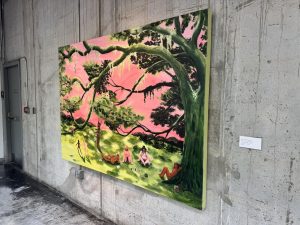
Two of the biggest paintings in the series feature this tree as a main character. Corson said that she fell in love with the trees for their beauty and how they feel connected to so many parts of the environment, including humans. Corson’s painting “the protective embrace of Mother Oak” draws from this sense of connection.
“I always think about how many different beings she’s home to: The squirrels, which you can see; and hawks and different birds and insects; and the Spanish moss and the resurrection ferns and the cicadas,” Corson said. “She’s so important to so many different beings.”
The Southern live oak is emblematic of Corson’s views for an idyllic future — one where the natural world and humanity live in tandem; every being has a place to live and everyone takes time to take care of themselves.
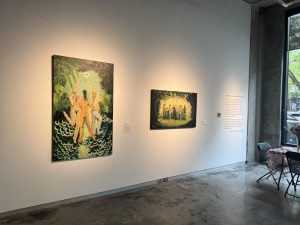
Leisure is a big part of this outlook. Many scenes in the gallery feature women and some men lounging in the grass, reading, dancing, eating and embracing. This style is in conversation with the Neo-Impressionistic movement, but for a modern era.
It does not get quite more modern than a phrase originating on the internet: “touching grass.”
This saying has been a part of internet culture for some time now, gaining more popularity as an insult in the late 2010s.
Corson initially believed the phrase was purely humorous. However, she does not want to view it as an insult, especially in relation to her art. It more represents what she wants to do and what she thinks everyone should be doing.
Community is something that is integral for not just her art, but her life at large. She would be lost without her family, partner and friends who make up her circle.
Corson is reclaiming “touching grass” as an ironic call to action and showcasing her close relationships in response to a wide sweeping loneliness epidemic in the United States. She said many factors go into this and social media plays a big part.
“I’m not blaming people,” said Corson. “We’re all busy, but then we come to think we’re socializing online, but I don’t think that replaces in-person connection, and now we’re losing so much of that.”
If you would like to touch some grass and see Serena Corson’s exhibition, it is open until April 25 from noon to 7 p.m. at the LSU School of Art Glassell Gallery.