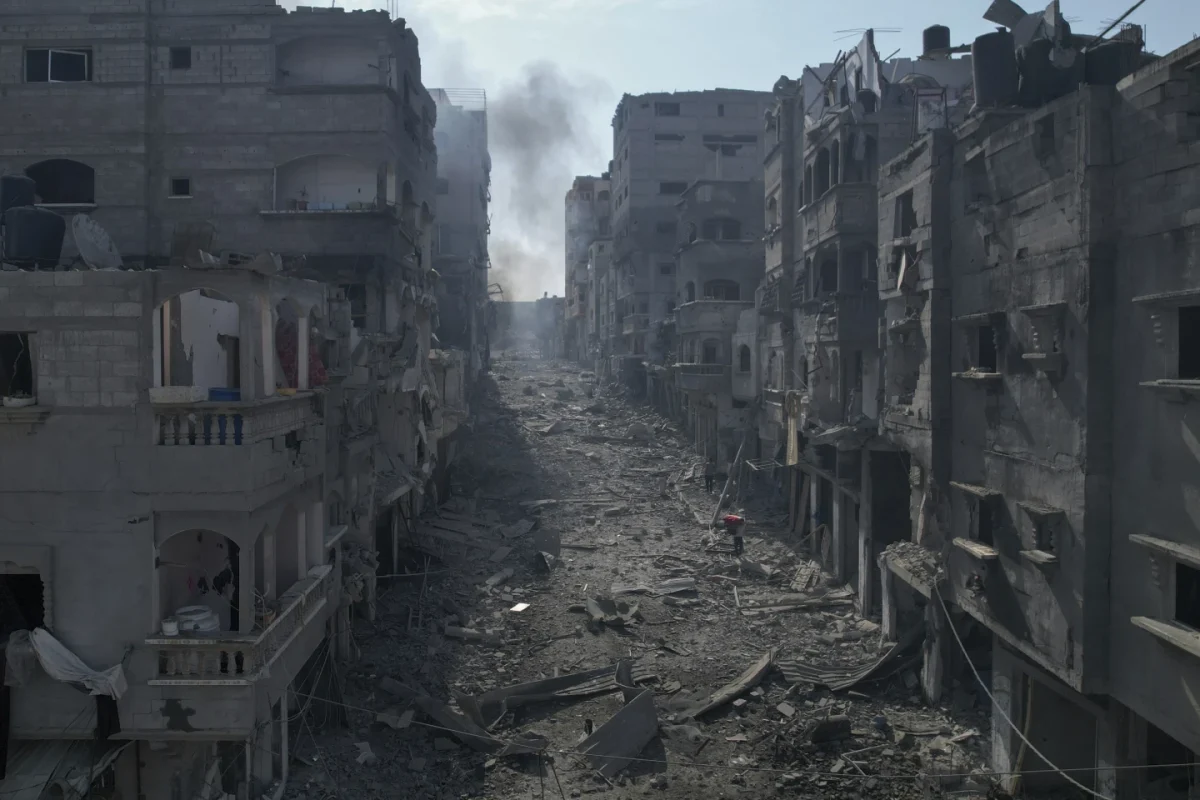
As tensions escalate between India and Pakistan, the world’s attention is shifting once again. News cycles will be dominated by images of border skirmishes and threats of war. But while another human rights crisis unfolds, it is imperative that we do not lose sight of another ongoing humanitarian catastrophe: the suffering in Gaza.
The media often moves from one conflict to the next, driven by what is most immediate, most dramatic. Yet justice demands consistency. We, as civilians, must stay informed and committed to the cause of human rights in Palestine, even as the global spotlight turns elsewhere.
The United Nations Relief and Works Agency for Palestine Refugees reports that the current humanitarian crisis in Gaza is the worst it has been since Oct. 2023, the start of the conflict. Gaza has suffered under an Israeli-imposed blockade for nearly two decades, severely restricting its citizens’ social and economic liberties. As a result, close to 80% of Gazans rely on international aid for survival, even before the current conflict began.
But if social and economic deprivation were all that Gazans faced, they might even consider themselves fortunate. Inside the blockade, civilians endure daily bombing raids, starvation, dehydration and the steady destruction of their basic humanity. The Saudi-backed news station Al Arabiya recently reported a series of stories highlighting the continued assault on civilian enclaves by the Israeli Defense Forces — not by rogue militias, but by a nation-state military.
Under the laws of war, countries are afforded certain margins of error. If a military force kills enemy soldiers after they surrender, it is indeed a grave violation — yet public outrage is often muted because the victims were still, in some sense, combatants. But when a country directs its violence against civilians (by starving them, bombing their homes or cutting off their access to water and medicine, for example), the crime is more grotesque. Such acts demand universal condemnation, regardless of which new conflict dominates the headlines.
This is not to say that the escalating tensions in the Kashmir region should escape our view either. Both conflicts are equally important, as human rights matter in every country. The Pakistani military is tightly connected to the political regime and is known to employ repressive strategies on its civilians, such as forced disappearances, torture, wrongful imprisonment and extrajudicial killings. India’s military also has a stained track record, with extensive allegations of similar abuses in Kashmir, as well as rampant corruption that even Amnesty International and Human Rights Watch have called out. Both the conflict in Gaza and the escalating crisis in Kashmir need to be observed by the international community, so that we may determine the proper course of action for civilian aid.
Despite the need for media coverage on the escalating tensions between India and Pakistan, we must make sure that we do not disregard the humanitarian crisis in Gaza. It is not necessarily our fault that we find it hard to focus on both situations at once. Research published in journals indexed by the American Psychological Association has found that people struggle to perform even two simple tasks simultaneously, let alone juggle complex moral crises unfolding across continents. That is why we must actively seek out the realities of each crisis, and that is why we must ensure that the older topic of Gaza does not slip from our minds because of Kashmir.
This would not be the first time an international conflict allowed Gaza to slip from the world’s focus. When the war in Ukraine began in Feb. 2022, international media coverage overwhelmingly pivoted to Eastern Europe, even as Israeli-led airstrikes continued in Gaza. That shift was deeply felt by the people of Gaza, who rely overwhelmingly on international aid to survive.
With such a recent reminder of how easily suffering can be eclipsed, the need to sustain our attention on all victims of human rights abuses is clear. It is critical that we do not make the same mistakes of the past, and that we remain attentive to all ongoing humanitarian crises. We cannot afford to be lackadaisical on this subject. Psychological research reminds us that distraction is a natural human tendency, but forgetting is a choice. As new conflicts erupt, we must resist the easy drift of attention. The world does not lack the ability to care about multiple injustices at once; it only lacks the will. This time, let us choose better.
Zachary Chaney is a political science and criminology sophomore at LSU.