Freshman year of college is a tumultuous time for students; adjusting to college life can be difficult, especially being away from friends and family.
LSU professor and Rector of the Mass Communication Residential College, Roxanne Dill, is there to provide support in the transition for freshmen. Her office is in South Hall, so students can come in during the day for guidance. She also teaches MCRC exclusive sections of media writing and intro to mass media.
“I really like what I do,” Dill said. “I think students are amazing people.”
Dill graduated from LSU in 1977 with a bachelor’s degree in journalism. After she graduated, she worked as a photographer for a bit.
Dill then worked briefly as a reporter, covering police and local government. Of the stories she wrote, her favorites were the feature stories. Eventually, Dill became the managing editor at The Daily Comet, a small, former New York Times affiliate newspaper based in Thibodeaux, Louisiana.
Then, life took a turn. Dill married one of her co-workers, and they moved when they had kids. He died in a car accident when their kids were young, so Dill stopped working in media, instead opting to work part-time jobs, like teaching grammar at schools and public relations consulting, so she could spend more time with her kids.
Once her kids were older, she returned to LSU to get her master’s degree. While in school, she worked with the communications department of LSU’s Center for Community Engagement, Learning, and Leadership.
Dill graduated in 2006 with a master’s degree in mass communication, concentrating in public relations. Afterwards, the Manship School asked her to be an adjunct professor while she still worked for CCELL.
“I was working full-time and being an adjunct,” Dill said. “So a lot is going on there, but even that, I was like, I could do this all the time.”
The previous media writing professor retired, and someone from Manship called her, encouraging her to apply.
“I was, literally, fell on the floor just shocked,” Dill said. “Because all the holes in my job [history] and the things that had happened, like surely they need to rethink this. But I applied anyway and got the job.”
Dill has now been the rector for over a decade. She said being a rector is a lot like spinning plates on sticks: chaotic and intense. Dill has to have her day planned in a notebook, or something may slip her mind, metaphorically breaking a plate.
Like many in the education field, her days are longer than the typical 9 a.m.-5 p.m. job, as she has to take her work home with her to grade papers, make homework and write lesson plans.
Things rapidly change in the world of mass communication, so Dill has had to keep up to date with the newest AP style rules, something her journalism students know she takes seriously. Her media writing class has changed several times throughout her tenure.
Networking is vital to the field of mass communication, and the MCRC helps connect students. The smaller residential college makes college life feel less isolating.
“I’m here because I knew somebody, right?” said Dill, “The dean at the time was on my master’s thesis committee.”
One of the most rewarding parts of being the rector of the MCRC is observing the growth of students through college and even post-graduate and like she says in class, seeing them make more money than her and being able to buy nice things.
“It’s fun to see students get excited that they’re doing things,” Dill said.
Dill believes that everyone is a student. She hopes the students in her class are going there with an open mind, the same way that professionals will go to conferences to learn. As much as Dill loves her job, she does not want to waste students’ time, as she knows they have more classes than just hers.
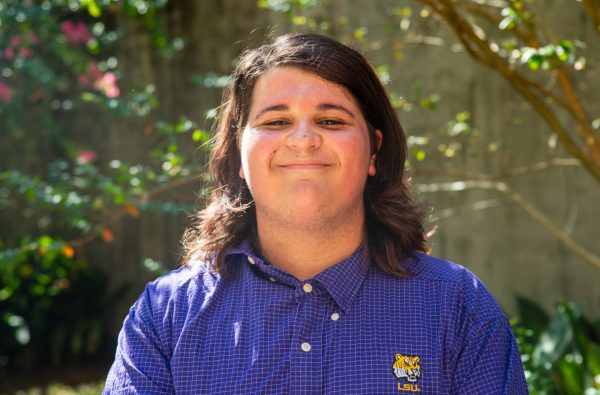
Nicholas Edmonson, a mass communication sophomore, took Dill’s media writing and intro to mass media classes. He remembers her kindness to be familial.
“I’d describe her as an extra grandma to all students in mass comm, but especially in media writing,” Edmonson said. “It was just like what, 15 of us? And she treated us all the same, all with love. She would have snacks and a candy bucket in class. She would bake cookies for us. She even brought king cake for us to try.”
Religion is paramount to Dill’s view of people. As a Christian, she believes that God created everybody separately and that no two humans are the same. Her faith helps guide her to assist each of her students individually in their mass communication journey.
“At the end of the day,” Dill said, “everybody has unique value; nobody else is going to be like that person.”