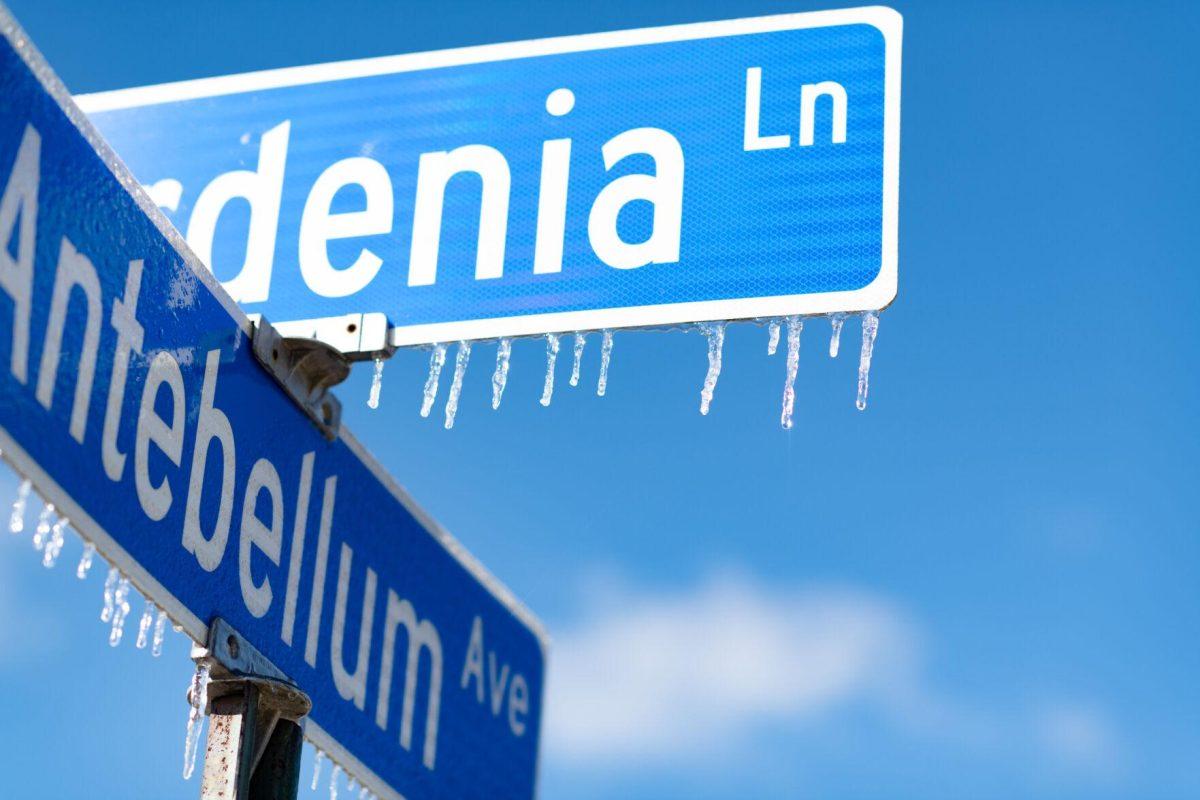
Since Jan. 23, a major freeze has swept across Louisiana, prompting the National Weather Service to issue an extreme cold warning to residents of Northwest and North Central Louisiana. LSU issued text messages and emails about the icy conditions to students on Jan 21 through the Office of Emergency Preparedness.
The freeze came as a shock to many students, and some may be wondering what caused the sudden change in the weather.
Dr. Jill Trepanier is a professor for the Department of Geography and Anthropology and an expert in extreme weather patterns.
She explained that weather on Earth is controlled by wind patterns called jet streams. Sometimes, jet streams can meander, bringing cold bursts of air from northern states down as far south as Baton Rouge.
“The jet stream is just like a dreidel. As the top starts to slow down, it starts to wiggle, and the jet stream becomes a little bit more unbalanced and starts to meander,” Trepanier said. “If it wiggles, it will bring with it really cold air from the North and it kind of pulls it to the South.”
Jet streams carrying lower temperatures to traditionally warmer climates is not new; according to Trepanier, it is a symptom of ongoing climate change.
Earth’s climate has always undergone gradual changes in temperature, but its climate has changed more rapidly over the past two centuries. The Arctic has warmed faster than any other region on the planet, leading to fluctuations in the jet stream.
This isn’t the end of the cold like Punxsutawney Phil predicted. Trepanier projected that Louisiana is set to experience more freezes over the next few months.
“This year, the pattern that we see for this year is locked in. And so we’re going to have one or two more of these [freezes] before it finally backs off,” she said. “I do not anticipate it happening every year.”
Professors in LSU’s Department of Construction Management are currently training students to help Louisiana adapt to extreme weather events, like freezes.
Dr. Flavia-Ioana Patrascu is an assistant professor in the department who specializes in disaster risk management and resilience. In her courses, she teaches students how to keep up with the unknown and adapt efficiently. “In Louisiana, we adapt to hurricanes, high moisture and heat. Those are the things we already know,” Patrascu said. “We prepare students to adapt, and that’s proven by our alumni.”
Since warm-weather states’ infrastructure is not designed to account for extremely cold weather, freezes can have a cascading effect on public utilities. For example, when roads freeze in Louisiana, life practically stands still because they are not built to withstand the cold.
“We are not traditionally built for these events, and that’s okay — but we are learning,” Patrascu said. “You might have pipes burst, flooding, transportation issues — and then economic impacts follow.”
Louisiana’s ability to adapt to cold weather is also constrained by material shortages. Since Louisiana contains substantially more wood than stone, builders tend to make houses that do not store heat.
“In humid climates, concrete structures can create serious mold issues,” Patrascu said. “Material availability plays a huge role… Concrete would have to be shipped here, which raises the cost of building. So wood makes more sense in this environment.”
People living in Northern Louisiana are still experiencing power loss. These types of situations are what Patrascu is training her students to help prevent.
“These [freezes] are low probability, high-impact events, but they are becoming more frequent,” Patrascu said. “If this kind of cold persists, we would have to adapt our codes. We need to think outside the box to minimize uncertainty.”
The nature of construction management is so vast and covers multiple areas. It allows professors to analyze a problem such as the freeze from different perspectives.
“All our systems are connected, and understanding those connections is how we minimize uncertainty and build a better future.” Patrascu said.