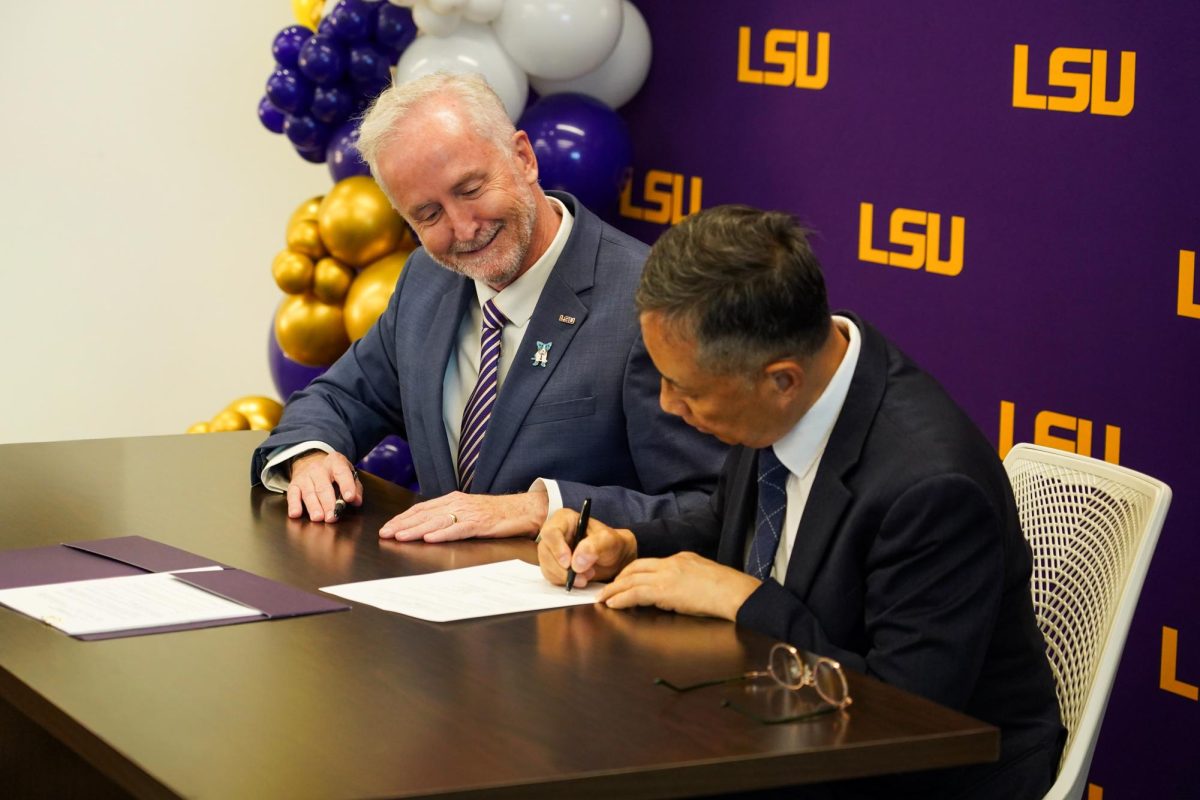
When James Dalton first interviewed to be the next LSU president, he owned just one purple tie.
He knew he’d need more after being named one of three finalists for the position.
After his first interview, he went back to the University of Alabama, where he held the office of provost. While in Tuscaloosa, he stopped by a local menswear store. There were no purple ties to be found.
That is, until he went to the clearance section, which had plenty of purple and orange, representing Alabama’s two biggest rivals, LSU and Auburn. Dalton bought four purple ties at a stunning discount.
Days later, in a sweeping redrawing of LSU’s existing leadership structure, the university’s Board of Supervisors restored the president role to two positions: a president, Wade Rousse, and an executive vice president and chancellor over the Baton Rouge campus, Dalton.
As Dalton served out the last of his time in Tuscaloosa before heading to Baton Rouge, he kept his collection of crimson ties on his desk, up for grabs for anyone who came in for a meeting or a chat. He didn’t need them anymore.
Setting goals
When former LSU President William Tate IV left LSU to take the same job at Rutgers University, the opening caught Dalton’s eye.
Unlike Alabama, LSU is a land, sea and space-grant university with a variety of scientific, academic, patient care and community service facilities, Dalton noted.
“It was a really great opportunity to take my experience from working in an academic medical center like in Michigan and Alabama and bring it to a place that’s in a state that I love and would love to learn more about,” Dalton said.
Two of LSU’s top goals under Tate were becoming one of the top 50 research institutions in the country and gaining membership to the prestigious Association of American Universities. As LSU pursued those aspirations, it increased its research spending to a record $543 million in the 2023-24 academic year.
Rousse and Dalton’s administration has stood by those goals, though Dalton added a qualifier.
“I don’t think about AAU as an aspiration as much as I think about the qualities of an AAU institution as the aspiration,” Dalton said.
He said that pushing more research on campus starts with creating a culture where research is appreciated.
“There’s so many great people and so many great resources across this campus that just finding a way to empower people and strategically put resources where they need to be is the biggest job,” he said.
Dalton wants LSU to become more like the top universities involved in the AAU, which are known to have an enticing culture for students and faculty, a variety of resources and motivated students and staff.
“If we do those things and do them right, we’ll eventually become an AAU university,” Dalton said. “You set your sights on good things, and you do those good things right, and then the recognition that comes along with that will follow.”
Dalton promised to work to improve other facets of LSU’s academics that he also spent time on while at Alabama, like reducing class sizes and implementing more hands-on, experimental education within LSU classrooms through undergraduate research internship opportunities and study abroad options.
Prospective LSU students may soon feel the impact of one of the major changes Dalton is pushing. This month, Dalton will make the case to the Board of Supervisors to mandate that students submit standardized test scores for undergraduate admissions.
“To me, it’s just another piece of data that we have to help us make sure that when students come in, we understand where they are in their learning journey, and so that we can make sure when they come in, they’ve got the best chance of success,” Dalton said.
How it happened
One of the central questions guiding LSU’s search for a president was whether the position should be split back into a system president and a chancellor over the Baton Rouge campus — the way it was before 2012.
Dalton admitted he had little understanding of what the LSU leadership structure looked like when applying for the presidential position, but he said he agreed the job was “too big for one person.”
Each of the three presidential finalists went through a day-long schedule of meetings with university stakeholders. Dalton’s ended with a discussion with members of the Board of Supervisors.
“I was very honest with them and telling them in terms of here’s the things I love to do, here’s the things that I would enjoy having a partner to help me with,” Dalton said.
Dalton and Rousse were then introduced, he said, and the next morning he and Rousse were put in a room with paper and pen and told to draw out the blueprint for LSU’s new leadership structure.
This meeting took place the morning of Oct. 31, before Rousse’s own day-long schedule of meetings.
The pair left the room with a plan, which included the revived chancellor position. The Board approved the changes by a vote of 13-1 on Nov. 4, which landed them both a job at LSU.
That seismic structural change would call for a restructuring of LSU’s entire leadership structure. Rousse said at his introductory press conference that he planned to release a new organizational chart within 30 days. No such chart has been released to the public.
Dalton said, however, that he and Rousse had sorted out some of the most pressing changes at the top, including converting the top roles at LSU Health New Orleans, LSU Health Shreveport, Pennington Biomedical Research Center and the College of Agriculture to senior vice chancellors. The move more clearly defines the hierarchy of top system leaders.
He said it may take until the end of the school year to get everything else finalized, but he provided a general outline on what the changes may include.
“We envision a relatively smaller system office that is focused on things which are common to all the different campuses and allow them to gather information, collect it, and be a unified voice to the legislature, to the governor, to the communities around us,” Dalton said. “On the other hand, it gives the chancellors, like myself, the ability to focus on what our issues of the day are and lean into those opportunities and challenges.”
Looking ahead
Of course, the key to LSU’s new leadership setup is the relationship between Dalton and Rousse. The two are in constant contact, Dalton said.
“We are arm-in-arm in this enterprise together, and I could not have asked for a better partner,” Dalton said. “We’re very complementary to each other in our skill sets and the way that we approach problems.”
As Rousse emerged as a frontrunner for the presidential opening, his relative lack of research experience and academic honors came under scrutiny, particularly by LSU faculty. Those concerns were put at ease when Dalton became part of the deal.
“I think they came out with a structure that will play well to the strengths that each candidate brought in the search,” Faculty Senate President Daniel Tirone said directly after Rousse and Dalton were appointed, adding that faculty would appreciate the decision. “It’s a structure that certainly seems to make sense given the talents that each candidate has.”
Dalton’s background in medicine, where he’s conducted extensive research in both the private and educational sectors, complements Rousse’s experience in the business sector, Dalton said.
His position has also required him to branch out of his comfort zone and learn more about LSU research areas with which he doesn’t have much experience, like energy and agriculture, which he described as the “shiny new object” for him.
Still, the early part of the transition’s been overwhelming, Dalton acknowledged.
“I’ve been describing it as three components: cardboard boxes, shaking hands and drinking from fire hoses as I come up the learning curve of different things.”
As he trades in his cardboard boxes for purple and gold ties, Dalton urges the LSU community to meet with him and share their ideas. He said it’s important to him that he addresses the needs of students and faculty.
“I’ve heard, I’ve learned and can get out there and start really making some plans, get a strategic plan together and start making some more concrete proposals… to move the place forward,” Dalton said. “That takes time because listening to people is an important part of it.”