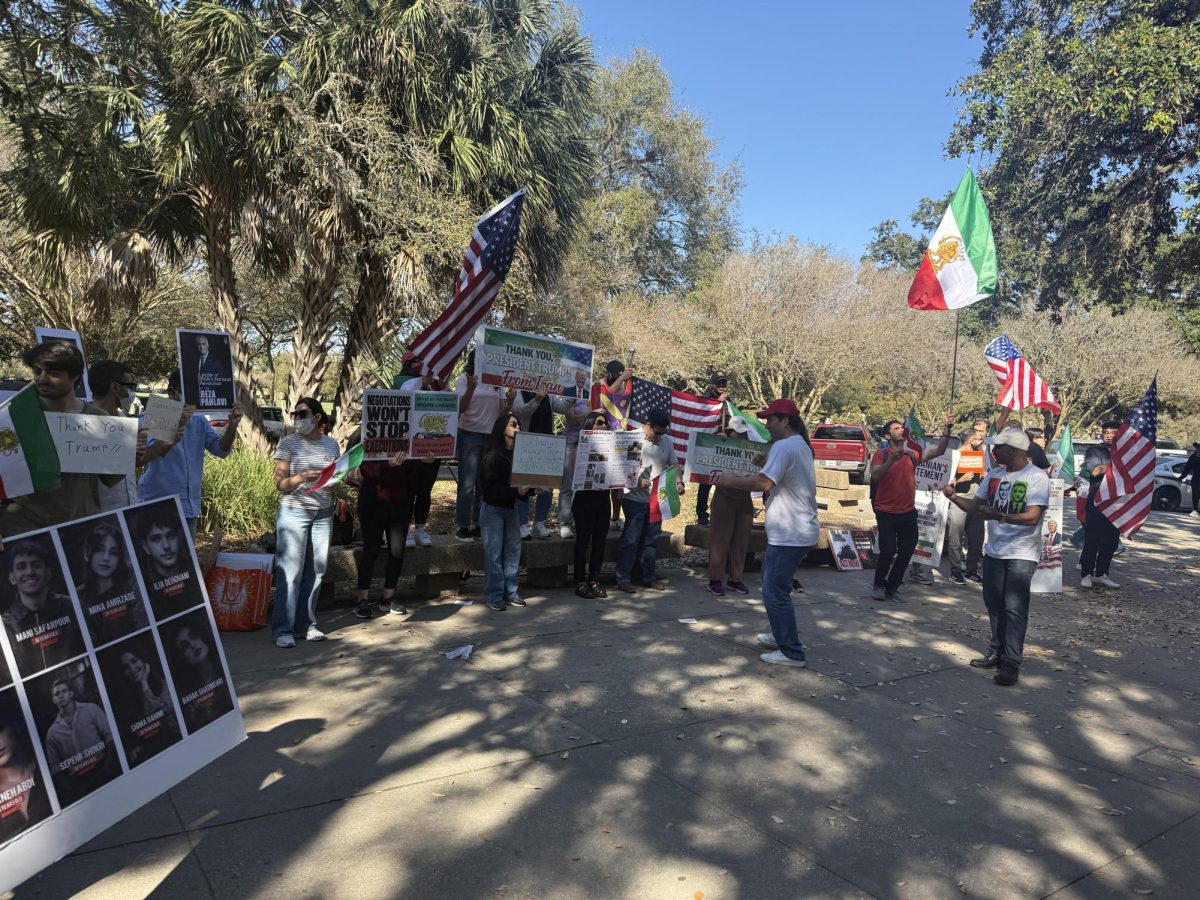
On Monday, dozens of demonstrators took to LSU’s Free Speech Alley to voice their opinions on President Donald Trump and Israeli Prime Minister Benjamin Netanyahu’s military intervention in Iran.
The demonstrators organized into two groups — one in support of the president’s strikes and one opposed.
Early Saturday morning, U.S. and Israeli forces “delivered synchronized and layered effects designed to disrupt, degrade, deny and destroy Iran’s ability to conduct and sustain combat operations on the U.S. side,” U.S. Joint Chiefs of Staff Chairman Dan Caine told reporters at a press briefing on Monday.
The campaign sank 10 Iranian warships, struck more than 1,000 targets and killed 175 Iranian civilians and Iranian Supreme Leader Ayatollah Ali Khamanei — an authoritarian leader who had recently come under scrutiny for violently suppressing anti-government protests.
While Trump initially framed the strikes as necessary to thwart Iran’s long-range missile program, in the days since, the president has at times insinuated that he may pursue full-scale regime change in the country. His official stance, however, remains unclear.
The group expressing support for American and Israeli intervention in Iran was composed primarily of Iranian faculty members and graduate students.
Their tone was celebratory: they shouted chants like “God bless Israel,” “God save American soldiers” and “Donald Trump, thank you.” One participant even played Village People’s “Y.M.C.A.” from a loudspeaker — a song Trump frequently danced to at his campaign rallies.
“We are here to celebrate our country, Iran,” said Sahar Javalvandi, a doctoral student in LSU’s Department of Environmental Science. “Now, we are here to support the military help that President Trump gave the people of Iran.”
After a few minutes of cheering and dancing, the pro-intervention group began to call for Reza Pahlavi, the self-proclaimed leader of the Iranian opposition movement, to take power in the country. They held signs lauding Pahlavi as “King of Iran” and chanted, “Who’s the next leader of Iran? Pahlavi.”
Pahlavi is also the son of the late Shah of Iran, an American-installed leader who came to power after American and British intelligence agencies launched a coup d’etat against Iranian Prime Minister Mohammad Mosaddegh in 1952 to protect Western oil interests. The Shah was later deposed in the 1979 Iranian Revolution.
“Iranians support Pahlavi,” said Ali Azandariani, a doctoral student in LSU’s kinesiology department. “He’s the only way to get rid of the radical Islamic regime in the Middle East by getting this relationship with the U.S. and Israel the way we used to 47 years ago [prior to the Iranian Revolution].”
Amin Kargarian, an associate professor of electrical and computer engineering at LSU and a co-organizer of a demonstration against the now-deceased Ayatollah’s regime in Free Speech Alley last month, praised the U.S. and Israel’s intervention as vital for the liberation of the Iranian people.
“We received many promises from many leaders, many of whom didn’t actually stay with the Iranian people … The only ones who stood with Iran were President Trump and Benjamin Netanyahu,” he said. “This is not a war. This is a rescue mission.”
The group of students who gathered in protest of the military campaign, however, were less optimistic about Trump and Netanyahu’s intentions in Iran.

Led by LSU’s chapter of Students for a Democratic Society, a progressive student group that has previously organized against Immigration and Customs Enforcement raids and Israel’s genocide in Gaza, the protesters charged that America’s intervention was an extension of Trump’s imperial agenda.
SDS President Margo Wilson instructed the group not to engage with the pro-intervention protesters. Instead, they stood on a bench and led the crowd in a series of chants, including “No justice, no peace. U.S. out of the Middle East” and “Not another nickel, not another dime. No more money for Israel’s crimes.”
For Ziad Eissa, SDS’ vice president and a film and television major, American intervention is both unnecessarily violent and patently illegal.
“We’ve seen Trump unleash a horrific bombing campaign in Iran, assassinating Iran’s leader, bombing schools,” he said, referring to an American strike on an Iranian girl’s school that killed 165 people, including children and teachers. “This will not stand. We cannot sit by while our government commits these crimes.”
Eissa also expressed doubt that Trump’s long-term ambitions in Iran are compatible with the interests of the Iranian people.
“When we’ve seen the U.S. get involved in other countries, it has primarily been to extract resources and set up dictatorial governments, and we saw that in Iran itself when Iran was under control of the Shah,” he said. “I don’t think that killing Iranians and killing Iranian children does anything to liberate the Iranian people. In fact, it does the exact opposite.”
Other anti-intervention protesters framed the U.S. and Israel’s military action in Iran as part and parcel of a broader Western imperial agenda.
“What we’re seeing is the final gasp of a dying empire,” said political science junior and SDS member Gabriela Juarez. “I think what we’re seeing is desperation by the U.S. ruling class to maintain the empire by exploiting large areas of the Global South.”
She was also skeptical that Reza Pahlavi will lead the Iranian people to prosperity.
“Look, I don’t have any love for any kind of strongman or regime abroad. But any attempt at regime change with the U.S empire breathing down its necks will not do anything for the Iranian people,” Juarez continued. “I think it’s disgusting the number of people cheering for a wannabe dictator to replace another dictator.”
Both groups of demonstrators remained in Free Speech Alley for hours, with SDS officers leading chants and miniature marching circles and the pro-intervention group blaring “Y.M.C.A.” and waving posters well into the afternoon.
At one point, a group of confused onlookers began lining up along the edges of Free Speech Alley in a desperate attempt to make sense of the fray.
But as the pro-intervention demonstrators began to dissipate, SDS promised to continue to oppose the Trump administration — on campus and beyond.
“We’re hoping to raise awareness of what the U.S. is doing in Iran,” Eissa explained. “We’re gonna get as many students as possible involved in resistance to Trump’s agenda.”