LSU professors are working to predict the future of the Lower Birdsfoot Delta, where the Mississippi River flows into the Gulf.
Oceanography and coastal sciences professors, Tracy Quirk and Matthew Hiatt, and geology and geophysics professor Carol Wilson are conducting this research for the Mississippi River Delta Transition Initiative, or MissDelta.
The Birdsfoot Delta is vulnerable to land loss due to factors like subsidence, sea level rise and levees.
Quirk explained that MissDelta aims to forecast the future of the landscape over the next 50 to 100 years and determine the best practices to manage and protect it.
“It’s an area of incredible socioeconomic importance,” Quirk said. “It’s a major trade route. It’s very important that the marshes there are protecting the channel.”
Quirk said the Army Corps of Engineers and the Louisiana Department of Wildlife and Fisheries are concerned with maintaining these wetlands because of the habitat they provide. This landscape also has many recreational and commercial fisheries.
The National Academies of Sciences, Engineering and Medicine fund MissDelta. It is a five-year project that began in 2023 and includes 14 institutions. LSU and Tulane are leading the initiative.
The LSU team is focused on researching marsh land building. However, each member of the team performs a different role.
Quirk studies marsh plants. She is investigating how environmental conditions influence the composition and well-being of marsh vegetation.
“If the marshes disappear, the channel’s going to disappear,” Quirk said.
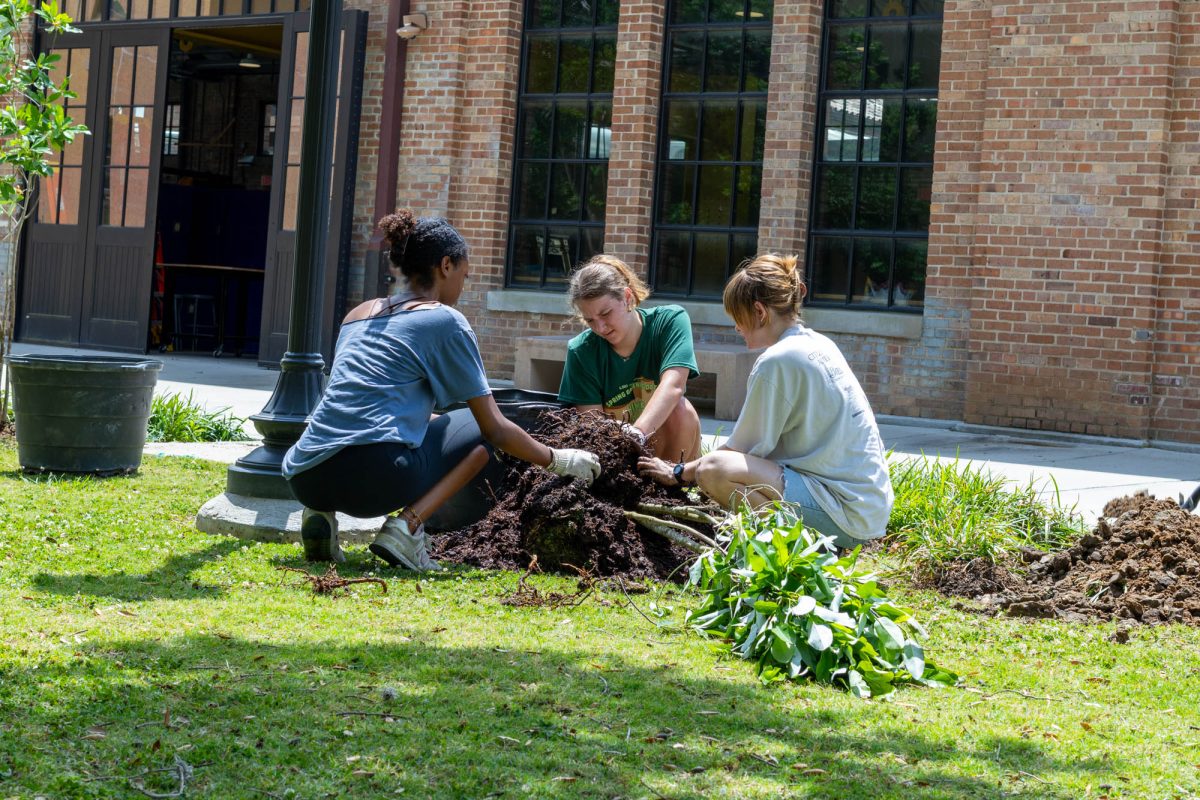
Quirk conducts field work in the wetlands of the Lower Birdsfoot Delta. Undergraduate and graduate students in her Wetland Plant Ecology Lab help her conduct surveys in the field.
Quirk said some of her work overlaps with Wilson’s. Wilson and her students also study landscape elevation.
“She’s looking at sediment deposition, and I’m looking at the role that plants play in that process,” Quirk said.
Hiatt said his role involves determining how much water and sediment flow through the channels to the deltaic wetlands and how much it flows into the Gulf.
His team goes in a boat and measures water velocities and amounts of sand and mud in the water column.
Hiatt also has a lab that undergraduate and graduate students participate in. It is called the Coastal Hydrology, Hydrodynamics and Oceanography Lab.
Quirk said the LSU team will finish its research soon.
“We probably have one more summer of doing field work and then we’re going to wrap it up,” she said. “We are starting to produce interesting results now. The modelers will continue to work on the models.”
Hiatt said they developed a new method for tracking velocity around vegetation patches using drones. He added that they are working with many other members of MissDelta to quantify the future of sediment through the Mississippi River Delta.
Once the LSU team finishes investigations, they will give the information to the MissDelta modeling team. Models will create simulations of future scenarios of the Birdsfoot Delta to determine how to manage the region.
“The delta is extremely important for the security of the coastal ecosystem and communities and is a major driver of U.S. economics,” Hiatt said. “Its resiliency in the face of sea level rise and climate change is vital.”