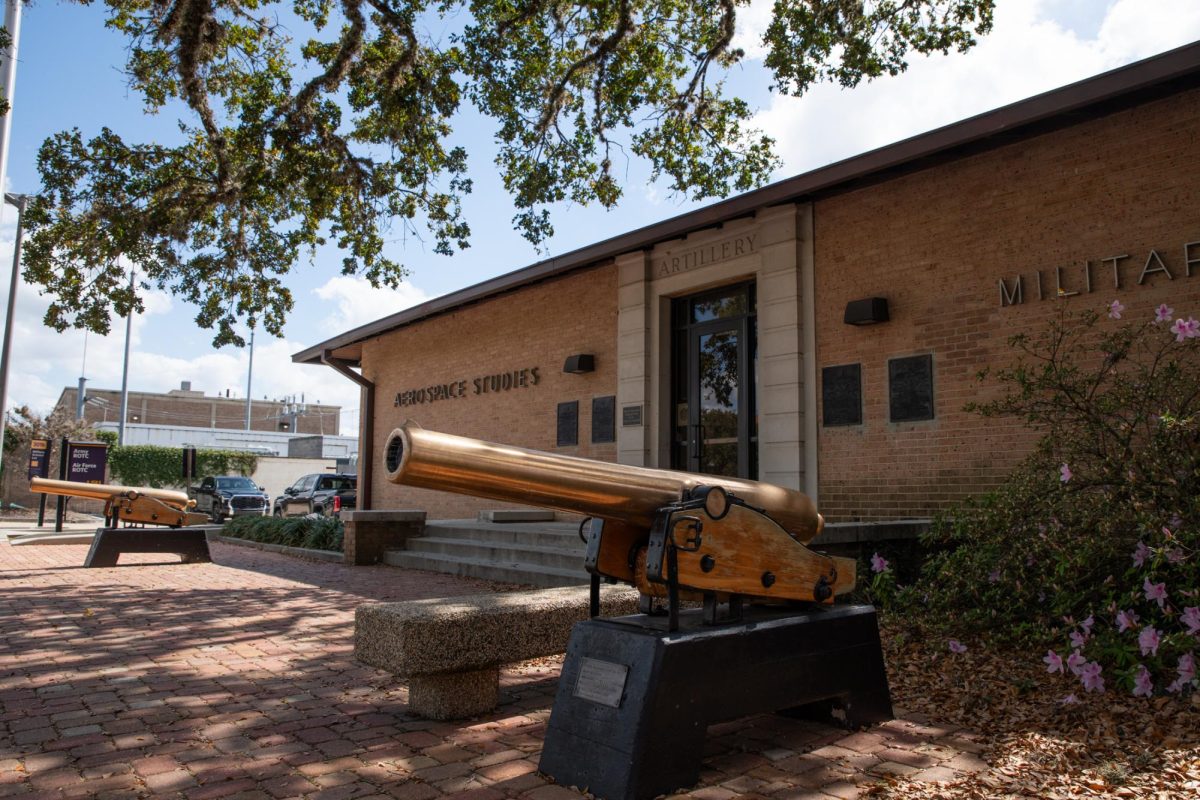
LSU’s William A. Brookshire Military Museum has received a national award from the Marine Corps Heritage Foundation for “Tigers in the Pacific,” an exhibit on LSU students who served in World War II.
Created by museum director James P. Gregory Jr., the display was recently recognized with the Colonel John H. Magruder III Award, the first time a university museum has earned the honor.
Sitting in his museum office one day, Gregory took a phone call. On the other end, someone said they had found a collection of World War II photographs.
“Is it a photo album? Is there anything else?” Gregory asked, jotting down a name and details as he listened.
Calls like that, Gregory said, are how much of the exhibit came together.
“When I started doing the research, I contacted the families to see what they had, and a lot of them either donated the material or let us borrow it for a few years,” Gregory said.
The exhibit’s main feature tells the story of two brothers who had survived WWII together to bring home several souvenirs.
“Happy Easter,” Stanwood Duval, one of the two soldiers, wrote on a postcard. “I don’t know whether you are still in Virginia or back home, but this letter, by the time you get it, may find you home.”
“TT is fine and the only souvenir he’s kept from Iwo Jima was a fragment the doctor dug out of his knee,” Duval wrote. “I did manage to get a Japanese rifle, bayonet, flag and samurai sword.”
Gregory explained that many of the letters were written just before battle, when soldiers knew they might not have another chance to come home.
“The letters, I think, are particularly poignant,” he said. “If you look at the dates, you can see the battle happened on Feb 19. The letter he wrote home to his mom on Feb 16. Obviously, he knows he’s going into battle, and so those letters, he’ll write one to his mom and to his wife and to his stepdad on the same day.”
Other artifacts fill out the exhibit above the handwritten note, including a Japanese rifle marked with a small flower.
“These flowers meant all the guns belonged to the emperor,” Gregory said. “When they surrendered, they chiseled them off so it wouldn’t disgrace the emperor. So this one was taken before their surrender.”
Against one wall sits an old box trunk, its contents left largely intact: clothing, shaving cream, toothpaste, a watch and stacks of letters and photographs.
“Everything is original to that trunk,” Gregory observed.
Nearby, uniforms stand upright in careful formation, preserved as they would have been worn. The research behind the exhibit, Gregory said, took months and extended far beyond what visitors see on display.
“People don’t realize how much work goes into the back side of doing these exhibits,” Gregory explained. “What you see here is just very little of the story.”
Much of that work involves confirming details that were never formally recorded. Without a central archive of LSU veterans, Gregory said he relied on scattered sources to piece together individual histories.
“There’s no document from LSU that says these veterans were on Iwo Jima,” he said. “So I had to go through newspapers and alumni records, hoping to find mentions. It took a long time to collect this information.”
Even after the research is complete, another challenge remains: presenting it.
“I’ll have students write six pages of research, then I tell them, ‘Great, now condense that into three paragraphs.’ That’s what goes on an exhibit.” Gregory said.
Gregory, whose background is in Marine Corps history, said the project also led to a longer manuscript expanding on the story behind the exhibit.
“I wrote a book about the two of them,” Gregory said. “Hopefully, LSU will publish it next year.”
The exhibit opened last year to coincide with the 80th anniversary of the Battle of Iwo Jima. This year, it was recognized by the Marine Corps Heritage Foundation as the top exhibit in Marine Corps history.
“It’s wonderful national recognition for the work we do here, but it’s also recognition for LSU as a whole,” Gregory said. “We’re trying to maintain a very high standard in our exhibits.”
He hopes the attention will encourage more families to come forward with artifacts and stories tied to LSU’s military history.
“We don’t have a list of veterans from LSU students, faculty or staff,” Gregory said. “So I’m hoping something like this gets the word out to people who might have material.”
Back inside the museum, that process is already underway, often beginning with a simple phone call.