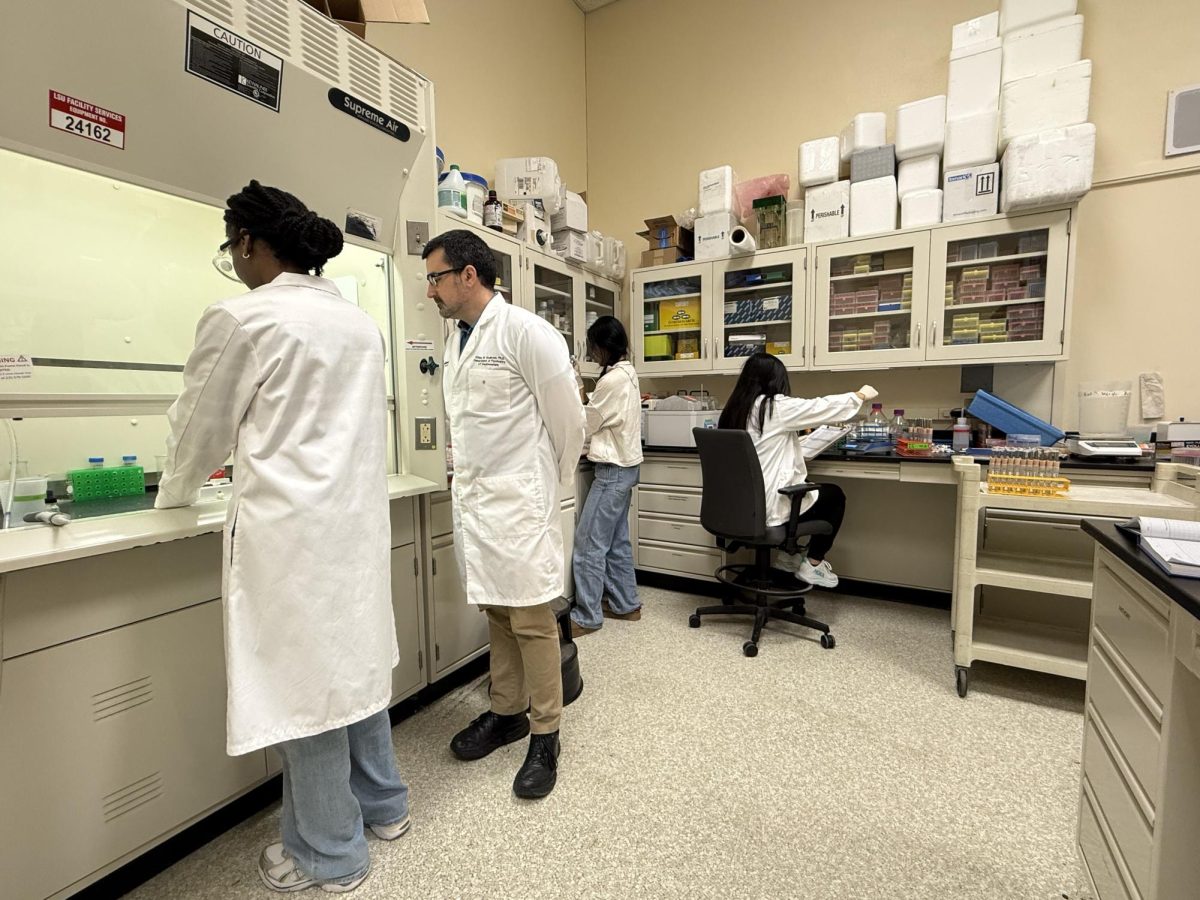
A researcher at the LSU School of Veterinary Medicine received a $2 million grant through the National Institute on Alcohol Abuse and Alcoholism to study new treatment methods for alcohol-use and substance-use disorders.
Ethan Anderson is a translational neuroscientist, which means that he develops research methods in the lab that can be used clinically for nervous system disorders. Anderson said that the grant is an R01 grant from the National Institute of Health, which funds the study over the course of five years.
Every year of the study, Anderson’s lab gets $400,000 from the NIAAA. Around a third of that goes to LSU and sustain operations to pay its researchers, but the rest is used on the preclinical addiction research.
Using live mice models of alcohol-use disorder, Anderson’s lab will try to better understand how lifestyle and environmental changes can impact a person’s genes to study addiction expression without altering DNA by studying the area of the brain known as the nucleus accumbens — the part of the brain that controls your limbic system and processes dopamine during times of stress.
“The idea is to try and find novel targets and novel mechanisms of action of how alcohol becomes addictive, or how the brain interprets alcohol and becomes addicted to it,” Anderson said. “More importantly, we’ll try and find ways to potentially treat those using cutting-edge methods.”
According to Anderson, the brain helps us understand the world around us using the limbic system, which is activated by both extremely positive and extremely negative experiences.
“Anything that’s good for you, something like good food, companionship, sex, things like that can activate your limbic system,” Anderson said. “It helps us learn to go do these behaviors that are helpful. At the same time, the limbic system also says if something’s bad for you, making you anxious or stressed. It helps you learn that those are bad things, so we shouldn’t do that.”
However, certain substances, like alcohol and cocaine, rewrite the limbic system and activate dopamine receptors despite also having negative effects on the body.
“By a little trick of nature, they activate these little things called receptors that are found in [the limbic system] and tell you, ‘I really like this. I should keep doing this,’” Anderson said. “In some people, those signals also probably appear to be stronger than others and make somebody more likely to become addicted.”
While Anderson believes that there is a genetic component to these disorders, he also said that there is a really strong environmental component to addiction. Because alcohol is so accessible in Louisiana, people here may be more likely than those in places with less alcohol to get addicted.
“For instance, let’s say you’re born on a small island, and there’s no opium poppies that grow on that island, and you’re never exposed to them. Guess what? There’s no way you’re going to develop an opioid-use disorder,” Anderson said. “That being said, we do live in a society where it’s around, everybody’s probably going to experiment with drinking, at a minimum, or smoking, and probably some type of illicit drug during high school or college.”
Anderson’s lab is currently studying a specific protein in the brain that looks like it can be regulated with a medicine to reduce alcohol consumption in mice.
“I have a couple of inhibitor compounds that have never been given to a human ever before,” Anderson said. “And in mice, it makes it look like they can reduce the drinking during times of stress and possibly during times of alcohol dependence as well. That’s very exciting, but I hope that over the next 10 years or so, we move into preclinical testing and clinical trials.”
Anderson said that this compound can help with any substance-use disorder, including cannabis-use disorder, as it manipulates the nucleus accumbens and the limbic system to alter behavior through viral vectors — a modified virus created to bring genetic material into cells. During the COVID-19 Pandemic, viral vector vaccines were given to billions of people.
“Anything we find that works there preclinically in the mice is something that theoretically could translate over to humans as well,” Anderson said. “Brain site-specific gene therapy is happening all the time for things like Parkinson’s disorder and Huntington’s disease and things like that. It’s not being used in psychiatric disorders or behavioral disorders or things like addiction yet.”
With the funding from this grant, Anderson is able to directly pay two of his researchers, and it indirectly funds many other research projects at the vet school. Anderson said Louisiana isn’t known for getting a huge amount of NIH funding, so every little bit helps.
While not the main reason for the research, the information released from Anderson’s study can mean billions of dollars down the line if a blockbuster addiction drug was brought to market in the next 15 years.
“Eventually, I’ll publish this research, and that will increase the visibility of LSU and help people see the great research we’re doing here,” Anderson said. “Additionally, there’s always a chance that you’ll find something really helpful, and then you’ll want to patent technology in order to try to make a new pharmaceutical drug. That would be huge levels of revenue for LSU.”