Elaine Nkwocha has had many influential women in her life, from her mother and her grandmother to her advisors; her work at LSU is a testament to those who shaped her.
Nkwocha is from the state of Imo in southeast Nigeria. She graduated from Madonna University in Elele, Nigeria in 2010 with a bachelor’s degree in microbiology.
She then graduated from the University of Lagos with her master’s degree in public health in 2015 and the Imperial College of London for a master’s degree in molecular biology in 2016.
She first came to LSU in 2020 to start her doctoral studies in biological sciences, and while she is here, she is also obtaining her master’s degree in science education.
Nkwocha’s grandmother was a midwife, and she used the shorter length of her L-shaped house as the clinic in her community. Nkwocha first became interested in microbiology when she was living with her grandma at her at-home clinic.
She noticed patients would come back even after being prescribed antibiotics, which prompted her desire to study antibiotic resistance.
“Initially, my dad wanted me to be a doctor,” Nkwocha said. “He wanted me to study medicine, but I was really drawn to learning about microbes, bacteria, and how they interact with the environment, but also looking into things like antibiotic resistance.”
The clinic is also where Nkwocha got her first taste of teaching. She would teach the younger children at the clinic English and math, which is how she found her love and passion for education.
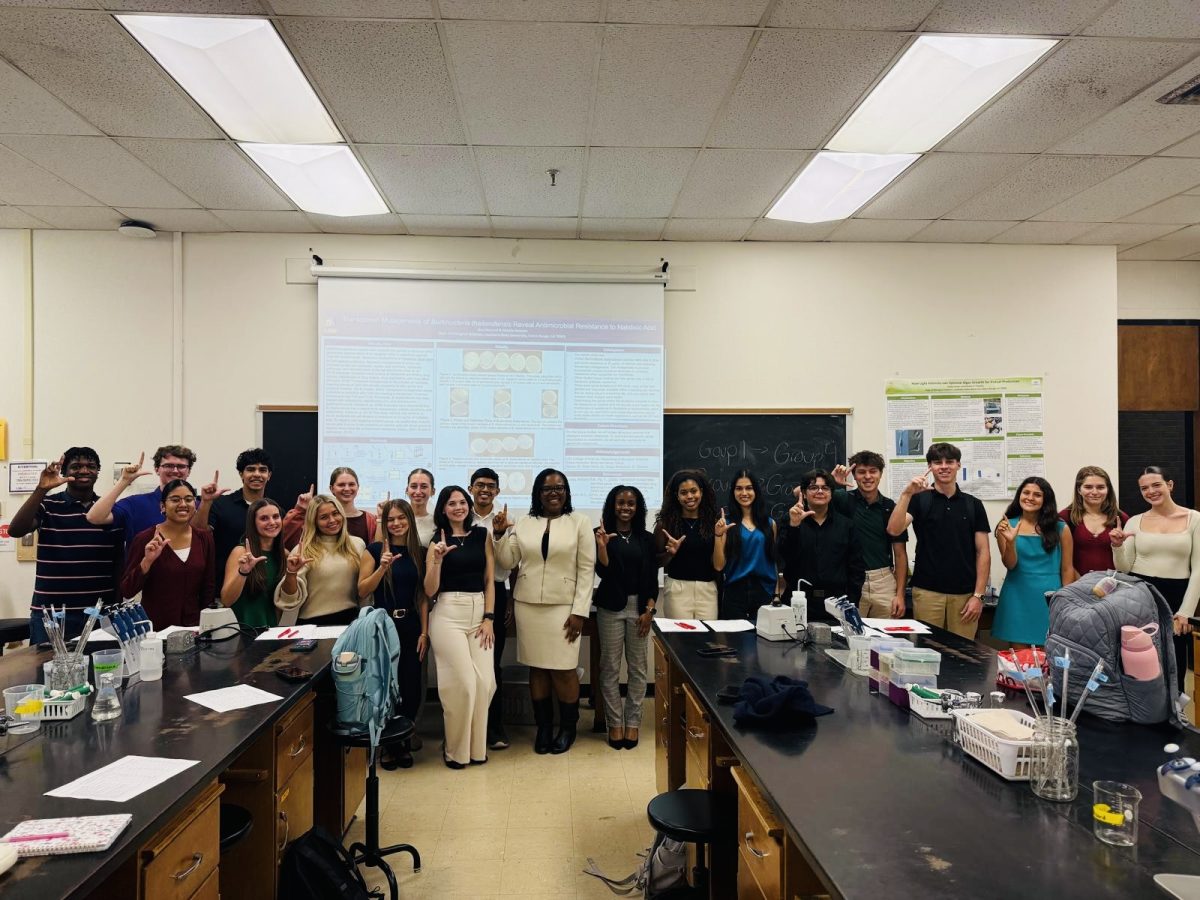
Nkwocha now teaches an introductory biology lab at LSU, and she said that it is not a traditional biology lab class, but rather a course-based undergraduate research experience lab, or a CURE lab.
“They are different from the traditional [labs] in that they bring in authentic research into the teaching labs for undergraduates,” Nkwocha said. “For instance, I came into the program with a part of my research, and so other instructors do the same. The unique thing about the class is that we bring in questions that we don’t have answers to yet.”
The class is once a week for three hours and is split up into different sections based on the semester. The first few weeks, students get to know their model organisms, then they start experimental set-up, before finally working in groups for data analysis of their organisms and putting their final projects on a poster for a presentation at the end of the semester.
According to the WHO, antimicrobial resistance is one of the top global public health and developmental threats. It is estimated that 1.27 million deaths can be correlated to AMR in 2019 alone.
Nkwocha says millions more are projected to die from AMR. Her research can help the Baton Rouge area build awareness of this phenomenon in the broader community.
Nkwocha hopes she can help students learn skills they can use outside the classroom, emphasizing the real world impact of their research.
“They’re building collaborative skills and engaging in analytical and critical thinking, all skills we need for the 21st century,” Nkwocha said. “So it’s really not just limited to the science [lab], but they take it to their everyday lives, and they also get to the higher level of thinking in the class, becoming co-creators of knowledge.”
Nkwocha said that she hopes that her class is able to provide an environment conducive to learning, using teaching methods to help best facilitate learning with her students, including how it is relevant to their local community.
“It’s kind of a full-circle moment for me,” Nkwocha said. “My love for education, love for science, and I’m bringing those together now [by] doing education, because I really want to continue to be able to support my students to learn. I think enrolling in that program has been so helpful and eye-opening on how I can best teach my students and how they learn.”
For her education master’s thesis, she is using her own class as a case-study.
“I’m looking at what elements of what components of the CURE labs actually help students understand biological concepts, but also what elements in the structure of the CURE labs help increase their interest and motivation to continue in STEM,” Nkwocha said.
Nkwocha referred to her situation as a double-edged sword, as much as she loves being the teacher of the class, she also wants to continue studying how students learn and how she can improve the classroom experience.
One of her students is Mary Leddy, a biochemistry freshman from Alexandria, La. She said she has learned more with Nkwocha’s teaching style compared to her other classes.
Leddy said Nkwocha was very reassuring and supportive of her students, even if they make mistakes, which allows Leddy to not be afraid to think outside the box.
“Her kindness, love, patience and never-ending support have helped me as a student thrive and feel comfortable in the class,” Leddy said in an email. “She has become a professor I can go to for anything and everything even if it is a simple conversation about our day or catching up on what is going on in our lives.”
Nkwocha has a lot of inspirations in her life, but she too can be seen as an inspiration to others, as she has held cross-disciplinary leadership both at LSU and the broader Baton Rouge community.
She is on the Board of Directors of the Women’s Council of Greater Baton Rouge and is an American Society of Microbiology ambassador to Louisiana, where she plans on starting an ASM chapter through LSU and other universities in the state.
She is also the founder of her own education research foundation, known as the Elaine Education Foundation, where she is trying to provide equal access to education to everyone regardless of their circumstances internationally.
Nkwocha said that LSU has been instrumental in their support for her and her research at-large. It has allowed her to study all of her most important disciplines, like research, science and education. She thanks the community she has fostered at LSU, which has helped her build her own team that wins.
“LSU has been a bridge helping me really become who I am today,” Nkwocha said. “As a professor in biology with different areas of expression, teaching, learning, mentoring, and advocacy as well. I do a lot of advocacy for STEM education, but I could go on and on. LSU has been a thriving ground and has molded me into who I am to become.”
Correction: Madonna University is in Elele, Nigeria, not Ogene. Nkwocha graduated from the University of Lagos in 2015, not 2014. A previous version of this article also incorrectly used the American Society of Microbiologists; it is the American Society of Microbiology.