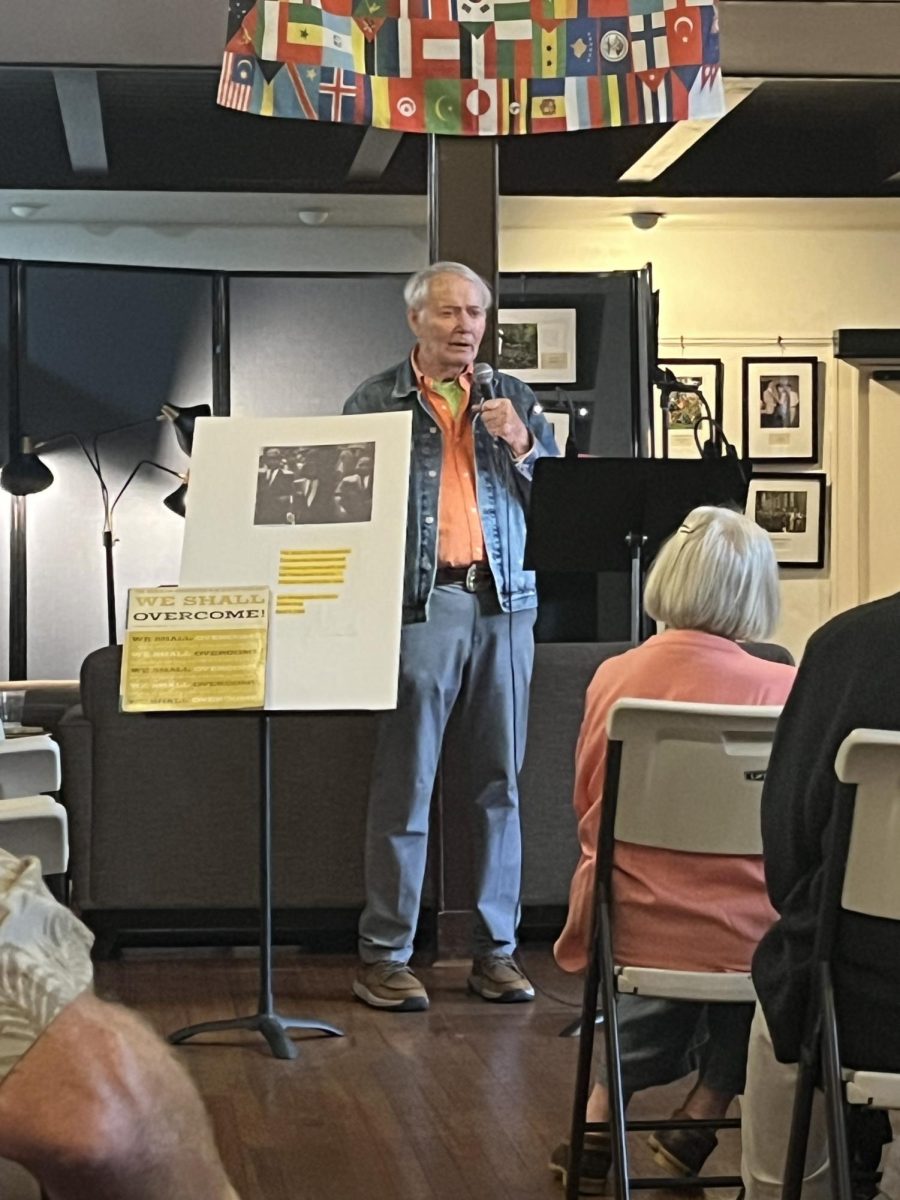
Dr. Andrew King, the last living academic to interview Dr. Martin Luther King Jr., recounted the experience on Wednesday evening at St. Alban’s Episcopal Church in Baton Rouge, La.
Originally from Illinois, King received his Ph.D. in Rhetoric and Public Address from the University of Minnesota in 1968. He taught at CUNY Buffalo and University of Arizona before transferring to LSU in 1985.
In 1991, he became Chair of the LSU Communication Studies program, where he served for 13 years before retiring in 2017.
While working on his Ph.D. in 1968, King was placed in charge of the speakers program at the University of Minnesota. He needed an impressive speaker — someone who would draw an audience. He reached out to Martin Luther King Jr., not expecting to hear back. To King’s surprise, MLK agreed.
On April 25th, 1968, MLK visited the University of Minnesota, planning to give a speech on civil rights. But when he stepped behind the podium and looked out into the crowd, he saw how many young people were there to listen to him – particularly young men, who were worried about the war in Vietnam at the time. He made a last minute decision to talk about the Vietnam War instead.
In his speech, MLK stressed his opposition to the war and reiterated his belief that nonviolence was the key to addressing injustice.
“If someone hits you, and you hit back, that’s the whole story of civilization. It never ends. War never ends,” King said, recalling MLK’s philosophy. “But if you don’t hit them back, they will feel guilt, and they will stop hitting you. They will begin to talk to you, and it breaks the endless cycle of violence.”
But later in a private interview with King, MLK opened up about some of the doubts he was having about his nonviolent approach to progress.
The Vietnam War changed MLK’s opinions on integration in the United States, according to King. Before the war, MLK had strongly opposed the Black Power movement, which aimed to create a separate Black economic, social, and political power, rather than integrating into white society.
MLK believed the movement was rooted in materialism.
“The Black Power movement was only about getting things, getting jobs, getting political power,” King said, recalling his interview with MLK. “He said, ‘I always wanted a moral change. I wanted to change people’s hearts.’”
But the the war in Vietnam altered MLK’s view. The military had integrated in 1948, so Black and white soldiers were fighting together in the Vietnam War. MLK began to fear that integration into a corrupt white society would corrupt Black Americans as well.
“‘Here are Black and white soldiers, who would never live next to each other at home. Here they are in brutal solidarity burning a poor Vietnamese village,’” said King, quoting MLK, “‘I began to think that maybe integration with a sick white society is like joining a burning house.’”
Another thing that shocked King was MLK’s socialist views. Publicly, MLK was a democratic socialist because anything more would have been extremely unpopular for the time, when Americans were fearful of the spread of communism.
But in his interview with King, MLK revealed his views aligned more closely with those of a hard socialist. King said his beliefs on capitalism were even more extreme than Bernie Sanders’ are today.
“He said, ‘Essentially, I’m a Social Democrat,’ but when he described what he wanted, redistributing the nation’s wealth, I mean, he was a hard socialist,” King said. “What he described was very much to the left of Bernie Sanders.”