LSU scientists have discovered a subduction zone decaying near Vancouver Island in British Columbia, Canada that sheds light on how tectonic plates on the Earth’s surface evolve.
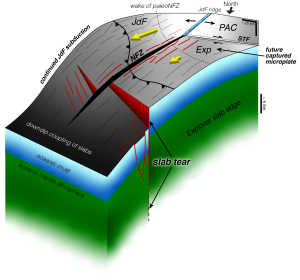
A Science Advances study authored by LSU geologist Brandon Shuck revealed a tear in the Juan de Fuca tectonic plate around 20-80 miles off the coast of Vancouver Island. The study revealed a subduction zone, where converging plates cause increased geological activity, tearing itself apart.
Shuck led the mission during his postdoctoral studies at Columbia University’s Lamont-Doherty Earth Observatory before coming to LSU last fall.
“These plate boundaries host the largest earthquakes, devastating tsunamis and explosive volcanism,” Shuck said in an email to the Reveille. “Our new study shows how subduction zones die off when a mid-ocean ridge — a divergent plate boundary where new oceanic crust is formed — approaches the subduction zone.”
The reason why the Pacific Rim, the land surrounding the Pacific Ocean, is highly volcanic is because the surrounding subduction zones create arc volcanoes. While volcanism is projected to increase in the region over the next million years, the zone is not expected to create new islands.
“In the northeast Pacific along western Canada, the plate boundary is a transform margin, where the Pacific and North American plates are sliding past each other instead of colliding,” Shuck said. “So there is no active volcanism in that region. Our study shows that the sliding plate boundary is expanding, while the subduction plate boundary along [the] northwestern U.S. is getting smaller over time.”
The tear was caused when the dense and cold part of the subducted Explorer plate detached from the weak but warm lithosphere, the first layer of the earth including the crust and the outer mantle. Shuck’s study found that the Explorer microplate first started breaking off the Juan de Fuca plate about 5 million years ago.
“Geology is a fascinating discipline because the processes span immense scales in both time and space,” Shuck said. “Meaning that some things are very slow, some are fast; some operate at the tiny atomic scale, some at the scale of our planet. It turns out that plate tectonic movements operate at rates of only a few inches per year – but earthquakes are a rapid release of built-up energy in just seconds to minutes.”
Although recent geological activity indicates active tearing of the plate, this process has likely been happening over the past million years, Shuck said. It may take another million years for the two plates to fully separate from each other.
“You’ll be shocked to learn that geoscientists consider this rapid for most geologic processes, which typically span tens of millions of years,” Shuck said.
While the discovery does show that Vancouver Island will experience an increase in volcanism and earthquakes associated with the tear, the natural disaster outlook for the region hasn’t changed too dramatically. The region will still be prone to earthquakes and flooding. This is because the Cascadia subduction zone still serves as a boundary that can create massive earthquakes or tsunamis.
“In the short term, the finding does not change the outlook for natural disasters in the region,” Shuck said. “That is because, as mentioned, these geologic processes take millions of years, whereas large earthquakes in this area take place about every 400 years.”