Two fraternities are returning to LSU’s campus this fall semester after being suspended due to hazing incidents. One of them is back four years earlier than its suspension initially stipulated.
In 2019, LSU found Pi Kappa Phi and Delta Kappa Epsilon responsible for violating the LSU Code of Student Conduct, which led to their suspension. Violations included hazing, coercive behavior and failure to comply with university rules.
 DKE was to be suspended until May 2029, but LSU permitted an early return this year. The fraternity was well-known, many in Greek circles said at the time of its suspension, for skirting the line with intense hazing and controversial gameday banners.
Over the past few months, DKE International said it has worked closely with LSU’s Greek Life staff and the dean of students to ensure its return is built on a strong foundation.
Pi Kappa Phi was suspended until May 2023. After completing its suspension, the chapter applied for return through the Interfraternity Council’s expansion process. Pi Kappa Phi’s Chief Marketing Officer Maureen Walker said the chapter is working to ensure students uphold its values in everything they do.
Through a series of interviews and public records requests, the Reveille has determined how the fraternities were reinstated and what restrictions will be placed on them going forward. However, some questions still remain.
One question is why at least two students appear to have acted as DKE representatives before the fraternity was approved to begin recruiting members. Other questions stem from whether LSU’s recordkeeping on the fraternities’ reintegration don’t entirely match what the university said it would require when the suspensions were put in place.
Reinstatement process
According to LSU Greek Life, both Pi Kappa Phi and DKE began the reinstatement process by submitting letters of interest in December 2023 and this May, respectively. They then submitted full re-establishment applications.
Greek Life Director Beth Newell said the department considered DKE’s request for an early return because “a significant suspension has been served.” She also noted that all of the members involved with the hazing that caused the chapter to be suspended are no longer at LSU.
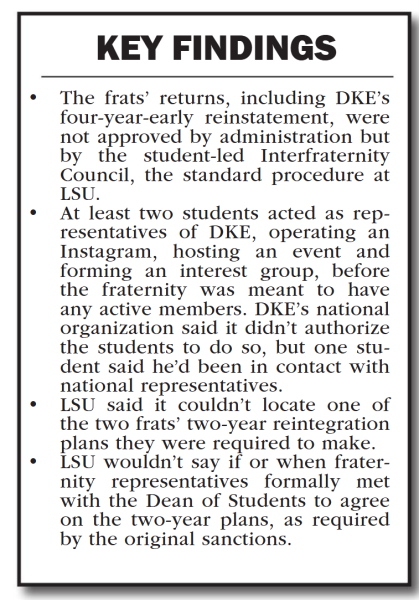
Greek Life and the Office of the Dean of Students told the Reveille they reviewed but did not approve both fraternities’ applications. The final decision to approve the chapters’ return was not administration’s, but instead was made by the Interfraternity Council, a governing body of students from the university’s fraternities. Newell and Dean of Students Fran’Cee Brown-McClure said this is the standard procedure for new or returning fraternities.
IFC President Brennan Belanger, a member of Sigma Nu, confirmed the IFC voted to let both fraternities return in special votes with all 14 chartered campus chapters represented. Standard IFC votes include only its nine executive board members.
The IFC vote on Pi Kappa Phi took place last fall, Belanger said, while the vote to reinstate DKE was this summer. For the reinstatement to pass, at least 10 of the 14 needed to vote to approve, Belanger said, though he wouldn’t disclose specific voting numbers.
Belanger said IFC’s process included hearing presentations from national representatives and alumni from both DKE and Pi Kappa Phi before making its decision.
Walker said Pi Kappa Phi regrets that its members at the time of the chapter’s closure did not abide by the standards of the fraternity or LSU. She said the new Pi Kappa Phi is made up of entirely new members who will be guided by Pi Kappa Phi staff to reflect the group and LSU’s values.
“We view the closure as an important reset,” Walker said in a message to the Reveille.
Walker said two leadership consultants for Pi Kappa Phi will recruit members and help establish a healthy chapter culture. The group is looking for men who want to contribute positively to LSU and the Baton Rouge community, Walker said.
Belanger estimated Pi Kappa Phi had so far recruited 70 to 80 students and elected its executive board and would soon move onto new member education.
As for DKE, Director of Member Services Trey Robb said the organization is excited to be part of the LSU community again as it begins informal recruitment. Robb said the chapter has had a great relationship with LSU and has been partnering with them upon return.
“We’re just excited to be a part of the LSU community again, contribute positively to campus and join a prestigious Greek Life community on LSU’s campus,” Robb said.
Restrictions on the fraternities
In the 2019 letters sent from Student Advocacy & Accountability to the two fraternities informing them of their suspension, each was given a list of conditions that they’d have to meet if they were to be reinstated.
One condition was that each frat would formally meet with the dean of students and agree on a two-year reintegration plan before reinstatement. When asked, Brown-McClure, who became dean of students last year, didn’t confirm if or when these meetings occurred but said she and Newell have been having “regular meetings with both organizations.”
Though it’s unclear if meetings to create and approve a two-year plan took place, the Reveille obtained DKE’s plan through a public records request. It lists stipulations that the fraternity agreed to meet, some of which were self-imposed.
According to the plan, DKE has agreed not to allow alcohol on its house premises for the next two school years or have animals in any ceremonies. It will also install cameras in its common areas, conduct a drug test program, remove hazing references from its chapter room and do away with its secret Friars society, among other things.
In the two-year plan, LSU initially said DKE would not be allowed to have any students living in its on-campus house this academic year. DKE requested that upperclassmen be allowed to reside in the house in the spring for “organizational financial reasons.” Brown-McClure said this request was granted.
Greek Life told the Reveille that Pi Kappa Phi’s two-year plan, which it agreed on with the dean of students, “cannot be located.” The fraternity did provide a year-and-a-half-long expansion timeline in its application for reinstatement, which included details about recruiting, philanthropy efforts and member education.
Greek Life will also receive weekly updates from a full-time staff member from Pi Kappa Phi’s national organization who’s required to live with and supervise the fraternity.
In the initial suspension letter sent to Pi Kappa Phi, the restrictions — which were less extensive than those placed on DKE — also included having an alumni chapter advisory team approved by LSU.
Like Pi Kappa Phi, DKE is also required to have a full-time staff member from its national organization reside in the fraternity’s house and deliver a weekly update to the dean of students. Both fraternities also submitted risk management policies, including hazing and alcohol policies, as part of their application for reinstatement.
Unauthorized representatives
Though they were not permitted to participate in this year’s rush process, both fraternities are now engaging in informal recruitment, which often consists of tabling and reaching out to students who didn’t receive bids during rush.
DKE’s appointed staff member arrived on campus on Oct. 10, Greek Life told the Reveille. According to university restrictions placed on the chapter, recruitment, initiation and new member education can only be conducted by DKE professional staff. Brown-McClure said that DKE had no members of its LSU chapter as of Oct. 1.
However, a public DKE LSU account has operated for over a month and posted while run by a student who identified himself to the Reveille. That Instagram account also issued a statement to the Reveille last month regarding the chapter’s return.
The student behind the account had previously indicated in messages with the Reveille that he’d been in contact with national DKE representatives and said he and another student had formed an interest group for the chapter.
All but one of the account’s posts have since been deleted, including one depicting the DKE fraternity house. Additionally, DKE held an event at Murphy’s Bar on Sept. 22.
Robb told the Reveille that the creation and operation of the Instagram was unauthorized and that DKE International will be attempting to gain control of the account. Robb didn’t confirm if the event at Murphy’s was authorized. He described the student running the Instagram account as “one of the students who is interested in joining the organization.”
It’s unclear on what authority the student created the account and issued a statement, though he said the statement came after “alumni discussion.” The student later told the Reveille that DKE nationals requested that he not “speak to anyone about anything.”
Background on the suspension
Founded on campus in 1923, DKE is one of the oldest fraternities at LSU.
The group’s 2019 suspension followed a thorough hazing investigation, during which pledges told LSUPD about several incidents they endured, including intense physical violence that left pledges with visible injuries.
Pledges were allegedly forced to lie on broken glass as members poured gasoline and urinated on them. Some were also allegedly forced to strip and get into an ice machine for 45 minutes, where they remained for fear of being physically assaulted.
One member arrested for hazing-related activities and second-degree battery was alleged to have kicked pledges while wearing steel-toed boots as they completed push-ups. Another allegedly struck pledges with a silver pipe, punched them and kicked them.
Pledges told LSUPD of other hazing incidents members allegedly subjected them to. One pledge said the worst were “new boy showers,” where pledges held milk crates filled with ice and cayenne pepper above their heads as cold water ran. They were forced to look up at the crates as the water and pepper melted in their eyes.
Police reports detailed many more horrific and painful alleged instances of hazing. Police also found the fraternity’s chapter room had references to initiation rituals written on the walls, as well as the threat “all narcs will die,” according to The Advocate.
In total, nine DKE members were arrested for hazing activities during the fall 2018 semester, all of them suspected of criminal hazing, and some for felony battery. There’s no record that any indictments or charges were ever issued, with East Baton Rouge Parish District Attorney Hillar Moore citing a lack of cooperation from potential witnesses, according to The Advocate in 2020.
DKE was also known for controversial and often offensive game day banners. The chapter’s banners ranged from poking fun at opponents to making references to the Casey Anthony murder trial, the Aurora, Colorado movie theater shooting and the Kent State shooting. They also sometimes included racist and homophobic references.
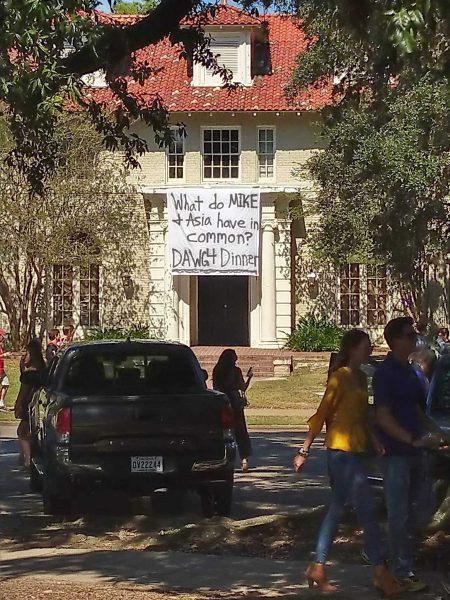
The national DKE organization issued a statement in 2014 saying it was “embarrassed” by the LSU chapter regarding one “tasteless” banner that referred to the openly gay NFL player Michael Sam.
The chapter had a history of violations prior to the 2019 suspension. It was suspended from November 2006 to June 2007 with an additional two-year “introspection period” after a misconduct investigation found a goat in the house.
K.C. White, the dean of students at the time, said some members reported it was the chapter mascot. Officials told The Advocate the incident raised questions about whether pledges were “forced to do anything with the goat,” though White at the time told the Reveille authorities concluded there was no mistreatment of the animal.
The chapter was also reprimanded in January 2015 for violating a rule in the university code of conduct and again in November 2017 for violating an alcohol policy.
Pi Kappa Phi was suspended by the university in May 2019 after initially receiving an interim suspension when the investigation began in October 2018. The chapter was charged with hazing, coercive behavior, failure to comply, endangerment and violating alcohol guidelines.
An incident report provided to the Reveille shows that the university’s investigation was prompted by allegations it received that a group of new members came out of the Pi Kappa Phi house around 1 a.m. one night looking “terrorized,” and some were also “forced to go strip.”
The DKE and Pi Kappa Phi suspensions came at a time when the university was placing increased focus on hazing after the 2017 death of Max Gruver, an LSU freshman who was forced to drink excessive amounts of high-proof alcohol during a Phi Delta Theta hazing ritual and died as a result. Gruver’s death prompted the state to pass a law making hazing a felony.
LSU currently has four fraternities suspended, according to its public community scorecard, as well as one sorority. Another sorority is currently on probation.
Ending hazing is an ongoing battle in Louisiana. Caleb Wilson’s death in March, after he was punched in the chest several times while pledging for Southern University’s Omega Psi Phi chapter, has sparked a renewed effort to crack down on hazing.
Lawmakers subsequently created the Caleb Wilson Hazing Prevention Task Force, which has so far met twice. McClure-Brown, Belanger and LSU General Counsel Trey Jones are members.
At its most recent meeting in September, the task force considered revisiting a 2024 law that requires universities to produce clear and convincing evidence to punish students for hazing in favor of a standard that would make it easier for colleges to penalize perpetrators.
CLARIFICATION: A previous version of the story’s graphic had a house bearing the letters Phi Kappa Theta. The house was the historic Pi Kappa Phi house, but it currently bears those letters as Phi Kappa Theta is renting the house. It has now been updated with a file photo of the Pi Kappa Phi house. The Reveille apologizes for any confusion.