Growing up in south Louisiana, it had always been Wade Rousse’s dream to play in Tiger Stadium. When LSU did not offer him a football scholarship, he was crushed.
The rejection led him to McNeese State University where, decades later, he would become the eighth president of the school.
Little did Rousse know, LSU would one day offer him something much more significant than an athletic scholarship: the chance to oversee the entire LSU system.
“I was the little boy that grew up leaning against the barricade as the band rolled down [Victory Hill],” Rousse said.
Rousse’s road to Baton Rouge
Rousse is a first-generation college graduate. He earned a bachelor’s degree from Nicholls State, a master’s degree in business administration from the University of New Orleans and master’s and doctorate degrees in economics from the University of Illinois at Chicago.
After spending time as a policy research specialist at the Federal Reserve Bank in Chicago and a professor and administrator at Northern Arizona University, Rousse found himself back in the boot in 2019 as the dean of McNeese’s business college.
Rousse said he’s glad to have landed back home, where he doesn’t have to hide his accent.
During the presidential search, many had concerns with Rousse’s fit as LSU’s president. A common worry was that he would not know how to manage a larger university system. McNeese has an enrollment of around 6,000, while LSU’s flagship campus alone has around 40,000 students.
However, Rousse said the problems at the two universities are the same; it’s just that the scale is different. For example, McNeese’s total budget is roughly $137 million compared to $3.6 billion for the LSU system.
“So you’re talking about 30 McNeeses when you talk about the entire portfolio of [the LSU] system,” Rousse said.
Despite concerns, Rousse said strong leadership and organizational structure is scalable.
There were also concerns about Gov. Jeff Landry’s connection to Rousse. Many reports have indicated Rousse was Landry’s preferred candidate beginning early in the search process, and the Board of Supervisors made of mostly Landry appointees approved Rousse as president.
Rousse said he is not afraid to admit he is a fan of the governor. He commended Landry for not ignoring the problems Louisiana faces in education, such as being in the bottom 10% of higher education attainment.
But Rousse said he and Landry are not in contact as much as people think. He said Landry has never told him what to do besides make LSU great.
In November, Rousse said he thought the governor’s current level of involvement in LSU was “not healthy.” Landry had at the time gone on a tirade against former football coach Brian Kelly and former athletic director Scott Woodward. He also called for LSU to build a statue of deceased conservative activist Charlie Kirk on campus. Landry also played host to meetings with university leaders and major donors as the decision to fire Kelly was made.
However, now that LSU has appointed new leadership, Rousse anticipated Landry taking a step back.
“I think he was very happy to move back and worry about other things and allow us to run the university,” Rousse said.
Last week, Landry said in a radio interview on WRKF that he has been working on stabilizing university finances with Rousse and that people should “stay tuned.” Landry said he hopes the pending initiative will be a model for other Louisiana universities.
When asked for details, Rousse said he could not give much information on the initiative yet but to expect more information within the next 60 days.
His strategies
When he was at McNeese, Rousse reversed a 14-year decline in enrollment and brought in over $40 million in philanthropic support.
He said he is bringing this same strategy to LSU by “driving aggressively” to seek more corporate partnerships at LSU.
Rousse said partnerships with major contractors have funded $60 million towards the new School of Construction, the next step in LSU’s Master Plan to transform the campus.
He said these partners are important because they help push LSU towards the “frontier of knowledge.”
This strategy aligns with his goal for LSU to become one of the top 50 research institutions in the nation.
Another strategy Rousse pursued was the restructuring of the university’s leadership.
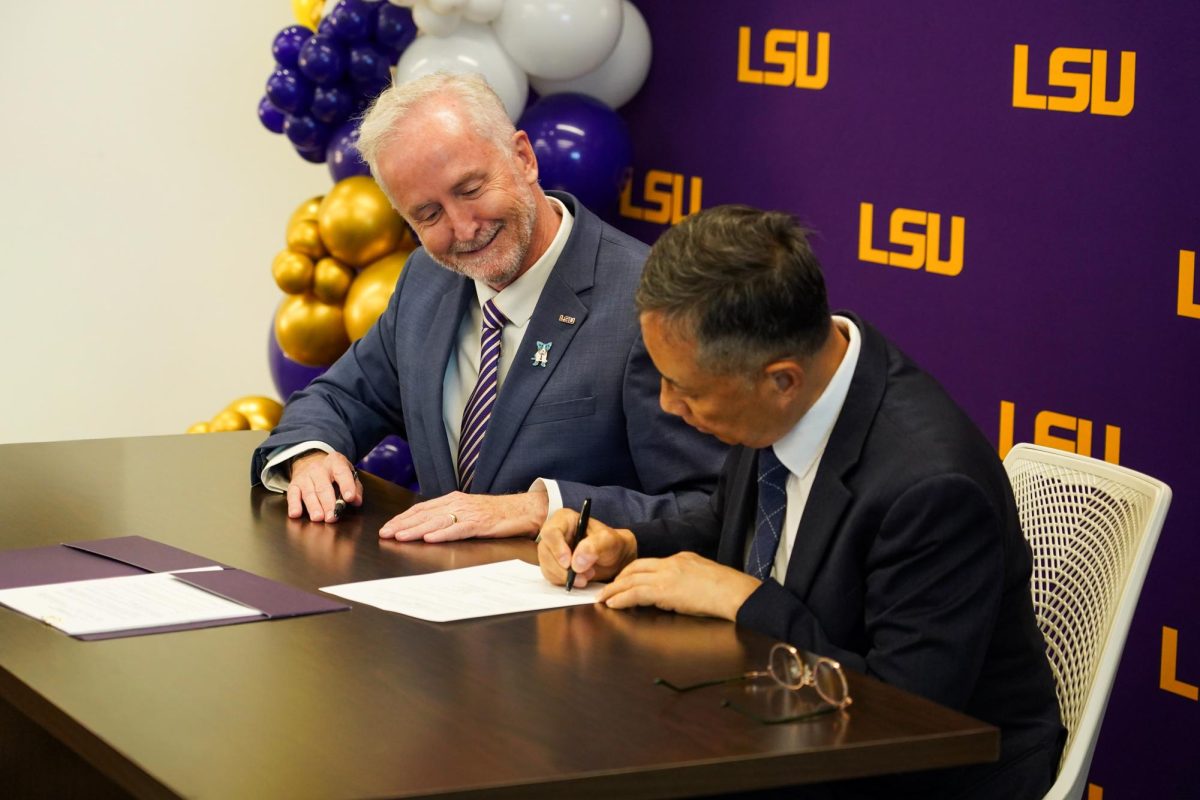
During the search for LSU’s next president, the Board of Supervisors decided to divide the president role to two positions: a president, Rousse, and an executive vice president and chancellor over the Baton Rouge campus, James Dalton. The president role had overseen both job’s responsibilities since 2012.
Rousse advocated for this change during the presidential search. Dalton was one of the search’s three finalists alongside Rousse, and the two worked together to draft the blueprint for LSU’s new leadership structure.
Rousse said he thinks the new leadership is working well and that the job would be too much for one person.
Dalton’s more traditional academic research background has been a boon to LSU’s research goals, while Rousse said his background in economics and business helps him oversee the entire LSU system.
LSU has already taken a step towards that goal. Administration united the Baton Rouge campus with the system’s other research institutions under Dalton’s supervision, which now allows LSU to report the campuses’ total research spending as one. In 2023, the most recent year with data, LSU’s combined research campuses would’ve ranked No. 69 in the country in research spending with $488 million.
Rousse said this spending can benefit the university beyond improving national rankings; it can open the door for larger grants and more money to pay highly qualified faculty.
Along with pursuing partnerships and restructuring, he plans to increase the research portfolio system-wide by 5 to 6% a year.
As LSU strives to reach these goals, standards for acceptance to the flagship will be higher. The university already announced it will require standardized test scores for undergraduate admission starting next summer. Despite heightened criteria for admission, Rousse said he does not want to leave anyone behind.
“It’s very important that as we’re building an elite top-50 research enterprise, that we don’t cut off the ability for kids to get into a Louisiana education,” Rousse said.
His plan to ensure accessibility is to create a bigger connection between the LSU satellite schools — Alexandria, Eunice, Shreveport and soon New Orleans — and the flagship campus.
Rousse said it is important to him that a student is able to transition throughout the LSU system seamlessly.
“If you take your first math class at Eunice, it should be equivalent to the first math class here,” Rousse said.
He said if a student at a regional campus is excelling, there should be a clear pathway for them to transfer to the flagship campus if desired.
System-wide connections
To better connect the satellite schools, Rousse is focusing on LSU’s leadership personnel. He said a cabinet of the chancellors of each school now regularly meet, both for administrative reasons and to bond.
Rousse said the cabinet went bowling together Wednesday after it met to promote the idea of “one LSU.”
“There’s one state, two colors and three letters — LSU,” Rousse said.
When he was chosen as a finalist, Rousse said his biggest challenge would be gaining the trust of the faculty, many of whom had concerns about his lack of a research background.
But Rousse said he feels that getting too involved with faculty would disrupt the chain of command, which is why Dalton and the other chancellors drive connections with faculty.
Meanwhile, Rousse said he is focused on connecting with students across the LSU system. He went to LSU-Eunice’s baseball game Saturday to throw the first pitch.
“If I lose contact with the student body, I’d lose the inspiration of doing what I do because we’re truly here for students to change [their] lives,” Rousse said.
Rousse said he regularly met with LSU Student Body President Lavar Henderson throughout the semester. He added that he’s also met with next year’s Student Body President Ben Barousse.
His favorite way to connect with students is through teaching. He will be teaching a macroeconomics course at LSU in the fall.
Rousse also acknowledged the magnitude of his position as the head of a system that is deeply tied to the culture, economics and future of Louisiana.
“As LSU goes, so goes the state,” he said.
Rousse said the pressure of his new position is a privilege because the university means so much to him. He’s had his time resting, sailing in California and drinking wine in Napa, but now, he said, is the time to focus on LSU.
“It’s the most important institution in the state by far, which is why it’s the honor of my life,” Rousse said. “I love Louisiana.”