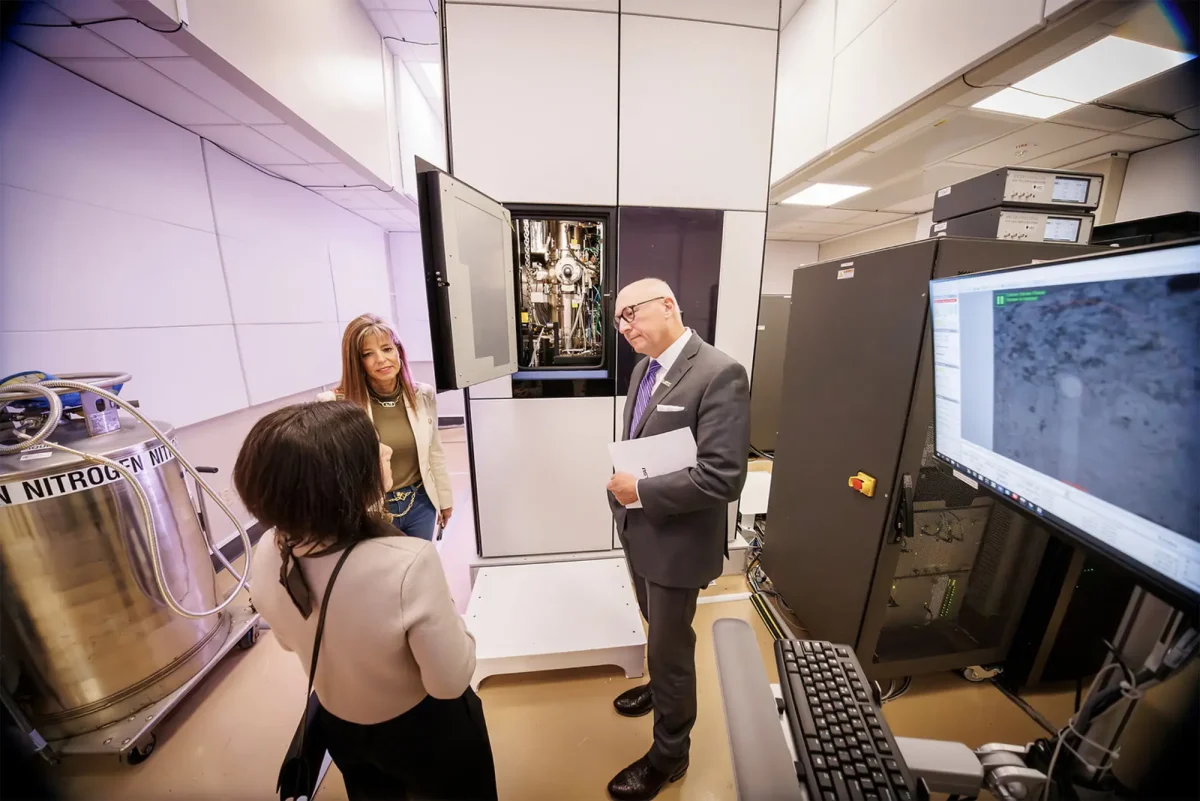
On Thursday LSU unveiled the most advanced microscope in the state-of-the-art Advanced Microscopy and Analytical Core facility.
Interim President Matt Lee, Vice President of Research and Economic Development Robert Twilley and Board of Supervisors Chair Scott Ballard attended the ceremony. There were demonstrations and detailed presentations on the technology, emphasizing how LSU is becoming a leader in scientific discovery and innovation nationally.
The new microscope, the Spectra 300 Scanning Transmission Electron Microscope (S/TEM), enables LSU students and faculty to address issues related to national defense, energy security and technological innovation with advanced atomic imaging and analysis technology.
“This is the kind of investment that builds the future of Louisiana,” Lee said. “It strengthens our platform on which we can innovate. It provides a clear example for us on how Louisiana delivers on its promises. On how we lead in research and innovation and education and service.”
The STEM has the magnification power of 10 million times, which is powerful enough to enlarge a single piece of river silt to the size of Tiger Stadium. This magnification power reveals material structure and chemistry, allowing for advancements in energy sources and supporting biomedical research. Lee described the microscope as more than a piece of equipment.
“We need to think of it as a catalyst for discovery, a catalyst for innovation, a catalyst for inspiration as we continue to explore the boundaries of human knowledge,” Lee said.

The preparation for LSU’s newest technological addition came long before this year. Three years ago, professors addressed their need for a higher power microscope to the former Vice President of Research and Economic Development Sam Bentley. He took the opportunity to work with Louisiana Congressional members to write a budget proposal that would allow the U.S. Army 10 million dollars to fund the project.
The proposal was successful, but it was the first of many steps in the process.
“There’s identifying the need, identifying the possible funding source, getting the funding, deciding what it is exactly you are going to buy, building the facility and installing the technology,” Bentley said.
Specifically, the Advanced Microscopy and Analytical Core facility needed approximately $300,000 in renovations before the microscope could even be installed due to its 13-foot size and vibration weakness. But the time and funds spent became worth it when the microscope was available for use on campus.
Both the Interim President and Board chair expressed their deepest gratitude to the U.S. Army for their role in the advancement and the belief in LSU’s ability to take on such an important project.
“This moment reflects what happens when collaboration and purpose align,” Ballard said. “When higher education, federal partners and innovation come together to strengthen Louisiana’s role on the national stage.”
This new microscope sets the tone of LSU’s role in innovation for the future. LSU Vice President of Research and Economic Development, Robert Twilley, said that talent and facilities attract the best of the best to LSU.
By offering unprecedented research capabilities, LSU is positioned to attract top-tier scholars, inspire students and drive discoveries that will benefit industries and communities throughout the state. He compared the idea to athletics, stating that research is no different.
In order to produce the winning team, it requires the best facilities to attract the best talent. The microscope is included in LSU’s first core research facility, and Twilley expresses that it will definitely not be the last.
Twilley said that the Advanced Microscopy and Analytical Core facility is “the first of more to come to attract, train and support the best research talent for Louisiana and build research teams that win.”